
When reality intrudes, it’s not pretty, sorta like the first look in the mirror in the morning.

In my defense, my horns are only visible on Oct. 31.
This is just one of the reasons I caution against using political talking points in letters (besides everything sounding the same): The looseness of the truth puts us on a slippery slope with WD-40 on our feet.
To wit: Until there is proof we don’t know about, Barack Obama is neither the Anti- Christ nor the Second Coming, and Ronald Reagan was not Satan or God.
And chocolate, unfortunately, won’t cure cancer or the common cold. Dammitdammitdammit … I need to cry …

Sob … but at least scientists say it may still, in moderation, lower LDL cholesterol, improve mood, and prevent or delay memory decline. Now if I can just remember where I put it …
Notice that, before my little fit, I used the word “proof” up there? That’s because if you state something as a fact, there must be real evidence to back that up; opinion isn’t evidence.
At the very least, why not offer truthful examples that you believe make the point?
And if you want to accuse someone of being a criminal, well, he’d better have, at minimum, a clear-cut indictment and case hanging over his head. Being repugnant isn’t against the law. If it were, there’d be a lot more people in prison.
And ya know, it’d be a lot quieter just about everywhere (except the prisons, of course). Oh so pleasant …
Recently, Ron Burns of Hot Springs Village opined on the Voices page that perhaps the press should be fact-checking politicians’ statements. While I completely agree with that, I had to laugh thinking about the people who are so firmly against the entire concept of fact-checking that even the phrase apparently causes an allergic reaction (oh, if only the reaction was to break out in “truthiness” instead of self-righteous indignation; at least it’d be entertaining).

Image from colbertrally.com.
As I’ve said many times before, fact-checking is nothing to fear if what you’ve written is documented and/or attributed to its source. Want to cite a study? Go ahead, but if it’s been discredited or cherry-picked, don’t be surprised when others note that.
Repeat a talking point from a campaign ad? Sigh … but sure, citing the source—and yes, if it’s been discredited, there will be people pointing that out.
There might be some snickering too.
Oh, screw that “might” … there will definitely be snickering, and quite possibly snorting, chortling and guffawing as well.
***

What he hath said.
Image from creativenetwork.com.
All this is to say we really should be more aware of where we get our information. Getting your news from one source is just asking to be led astray, whether it’s on the right or left side of the spectrum. And honestly, the right seems to pretty much send the exact same story to every site in the conservasphere (surely that’s a thing), and that’s just lazy. They even recycle tired tropes (welfare queens, gun-grabbers and related bans, etc.) repeatedly … are they soap opera writers??? (Yes, there are far-left sites that can be as bad, but it seems they’re not as pervasive … or lazy.)
That’s why I don’t much trust clearly partisan fact-checkers, which besides the obvious tilt, usually don’t link to original, unbiased sources. You get what you came for with sites like Conservative Fact Check (which some still debate as parody) and Political Correction, but most of the time, it ain’t facts. Sometimes they luck onto something, but not often. Political Correction is part of Media Matters, which is one of the more reliable of the partisan fact-checkers, but definitely still has its drawbacks.
For all the detractors who pile on sites like FactCheck and PolitiFact, the fact remains that, in addition to checking statements from across the spectrum and correcting themselves when necessary, they link to original source material so readers can judge the information’s merit themselves. I wish they’d also provide transcripts of the interviews they do as well, but we can’t have everything, especially in today’s world.
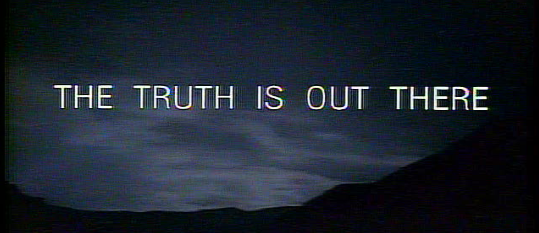
The truth is out there, said The X-Files. You just have to look harder now.
Image from sciencefiction.com.
Reputable media sources do their own fact-checking on local reporting, but on some things, we have to rely on other trusted outlets when necessary. This includes not only nonpartisan (or more accurately bipartisan) fact-checkers, but also sites like OpenSecrets.org (especially for information on money in politics), the U.S. House and Senate clerks’ sites (for congressional votes), and the National Archives.
No fact-checker is going to be completely absent of bias if just for the fact that we’re human and inherently biased in some form. When we seek only those things that confirm our bias, that’s when we have a problem.
Not being able to admit that? That’s an even bigger problem that you’ll have to solve for yourself.

One of the side effects of confirmation bias tends to show up in letters, especially on topics such as the Burwell v. Hobby Lobby ruling, effectively turning what could have been a heartfelt letter into rote recitation of talking points.
Try googling “Hobby Lobby 16 forms of birth control” and I think you’ll see the point in the overwhelming sameness of the results. I’m fairly sure I found chunks of a few letters in those results, even up to the misinterpretations of others’ letters. (Here’s a tip: If someone didn’t say something, don’t say that they did because it makes your point better; that’s called a lie, pure and simple. And yes, I will expand on this trend next week in the column.)
While I’m a lover of facts, in instances like this—where so many letters look almost identical because they use the same points, often in the same words—it’s the letters that hinge on emotion that tend to get picked.

Pleeeeeease buy me a fish! It would remind me so much of those fishing trips with Grandpa!
Image from imgur.com/gallery/yn8w4an.
A personal story is typically far more compelling than political boilerplate and usually makes the point better than any talking point ever could. Make your case with facts and statistics if needed, but something people can relate to is infinitely more readable.
Am I saying no more politics on the Voices page? Far from it. Hell, if opinion editors did that, there’d be a lot of columnists out of a job, and possibly sitting in a coffee-shop corner twitching from having to hold in all that smug pomposity.
All I ask is that you think before firing off that cranky letter that reads like every other letter on every letters page in the country and maybe consider it from the approach of how it will affect you. Aiming for anger usually works, but accomplishes little.
Aiming for the heart—that can encourage change, even if it’s just to make someone a little less cranky.
 Serenity is a fuzzy belly