
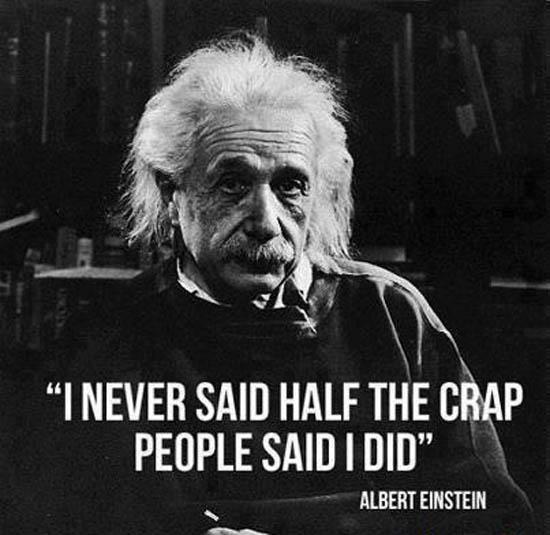
He probably didn’t say exactly this, either, but it’s fun to imagine Einstein saying “crap.”
Image found on Simplicate.
Every day I get letters containing myriad quotes, some of which are easily confirmed or debunked because they’re used—and misused—so much. It’s gotten to the point that I can pinpoint where the writer got his information because of a much-repeated misquote (or completely made-up one).
I also get the occasional letter accusing someone of having misquoted another when, in fact, a paraphrase (and an accurate one at that) was what was used. So can you be misquoted when it’s not a direct quote? Answer: If you change the meaning, yes, but otherwise, a paraphrase is generally not a misquote.

You can’t go anywhere anymore without seeing people doing this.
Image found on LateRooms.
We live in an age when just about everything is recorded, but even when there’s an audio or visual record, people misquote or re-edit that record to suit their purposes. When those purposes are to entertain, such as editing together isolated words from a politician to make it sound like he’s “singing” popular songs, that’s one thing (and sometimes hilarious). When it’s to remove all context to use an isolated phrase for political purposes, that’s another thing entirely, and intellectually dishonest.
I cringe, for example, every time I see a writer use the “fundamental transformation” line supposedly uttered by Barack Obama; this bad (in more ways than one) paraphrase has been put in quotes so often by people with a fear-based agenda that entirely too many people actually believe those specific words came out of his mouth, probably as horns sprouted from his head and his eyes glowed red.
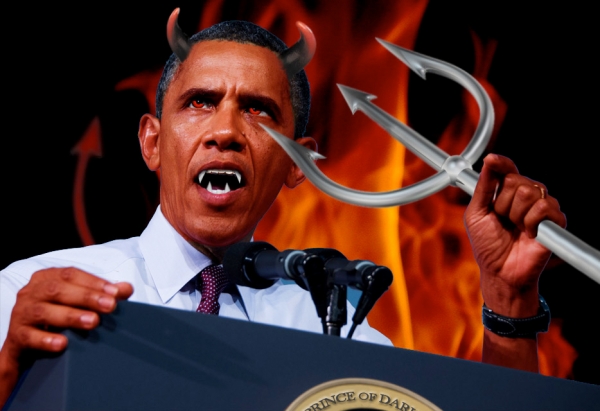
Well, of COURSE he’s the anti-Christ.
Image found on Apologetics Ministries, and I really hope what I read was satire. No matter what, someone believes it.
But that wasn’t what he said, and as David Weigel of Slate noted of the Oct. 30, 2008, speech in Columbia, Mo., it was really nothing more than standard political boilerplate:
“After decades of broken politics in Washington, and eight years of failed policies from George W. Bush, and 21 months of a campaign that’s taken us from the rocky coast of Maine to the sunshine of California, we are five days away from fundamentally transforming the United States of America. In five days, you can turn the page on policies that put greed and irresponsibility on Wall Street before the hard work and sacrifice of folks on Main Street. In five days, you can choose policies that invest in our middle class, and create new jobs, and grow this economy, so that everyone has a chance to succeed, not just the CEO, but the secretary and janitor, not just the factory owner, but the men and women on the factory floor. In five days, you can put an end to the politics that would divide a nation just to win an election, that tries to pit region against region, and city against town, and Republican against Democrat, that asks—asks us to fear at a time when we need to hope.”
There’s no end to the slight (and sometimes huge) discrepancies in reporting of quotes by politicians; not all reporters record what’s said and instead rely on memory and their notes.
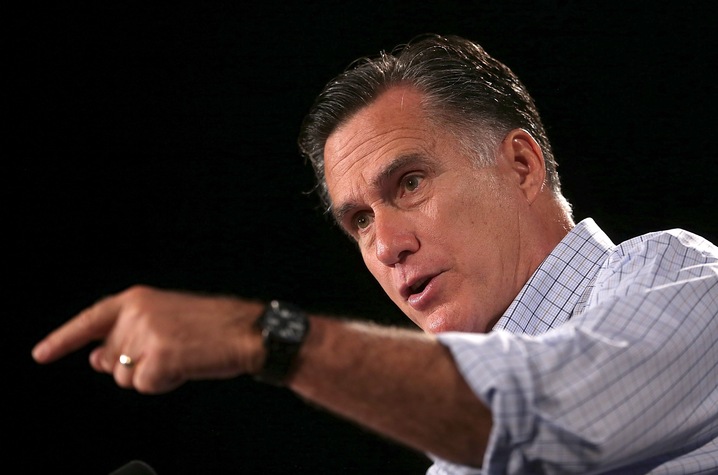
Hey, you! Try recording it next time, and don’t doze off while transcribing it!
Image found on PBS Newshour.
Most of the time, these approximations are fairly accurate, as Slate’s Mark Liberman found in an exploration of how a Mitt Romney quote was reported in 2012, but “cleaning up” the quotes gives a false impression. Liberman called journalists out on the practice, and that of outright fabrication (or “capturing the spirit” of an interview, as did Gay Talese in an 1966 Esquire piece on Frank Sinatra), and said it contributes to a culture of carelessness.
When I was in school, I was so concerned about the notes I was taking in class that I not only took notes, but recorded lectures (and even my voice lessons) to make sure I heard what I thought I heard.

They don’t look quite as nerdy as I did …
Image found on RRK Advisory.
Yes, I really was, and remain, that much of a nerd.
Not everybody worries as much, and in everyday life, it’s a bit of overkill. But when an accurate record is the aim, it’s a wise strategy.
With the size of the daily news hole in a newspaper, news stories tend to use direct quotes sparingly (usually only the best) and paraphrase where necessary. We just can’t print everything, but we try to be as complete as possible in the space available.
I’m of the school of thought that direct quotes should be just that—exactly what was said. You don’t clean up grammar (other than something slight, like punctuation in something spoken) in a direct quote, or offer your interpretation—within the quote—of what was said. If the quote isn’t usable without cleanup, use a partial quote or paraphrase it, but stay true to its meaning.
I really miss Bloom County …
Image found on robpegoraro.com.
How a quote is framed can sometimes make all the difference in how it’s interpreted; what seems straightforward to the writer may be completely misinterpreted by a reader. Writers who insert their own thoughts in quotes, put quotation marks around paraphrases, skew paraphrases to suit their purposes (like that “fundamental transformation”), or treat paraphrases as direct quotes (they’re indirect quotes) endanger their credibility, spread misinformation and risk landing in my grammatical purgatory.
Whether a direct or indirect quote, the information should always be attributed to the source, and if quoting from another writer, it should be exactly what was written (that means no “enhancement”). That’s one of the reasons that we may ask readers for copies of their sources, especially when they’re obscure volumes not widely available on the Internet. We trust you, but we don’t want to give the original authors short shrift by possibly misquoting them.
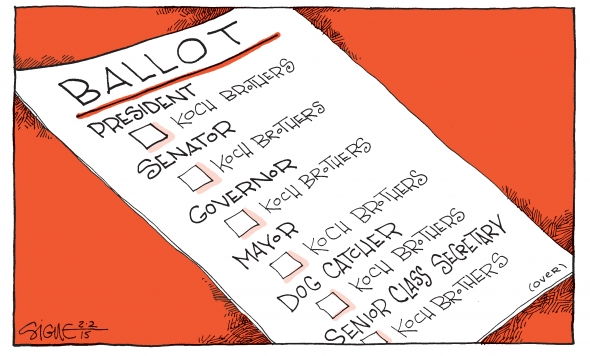
This one upset at least one guy in Cabot. Awwww …
Cartoon by Signe Wilkinson.
A complaint I sometimes hear is that we haven’t run cartoons recently on George Soros from the editorial cartoonists we use on the Voices page—Michael Ramirez, Lisa Benson, Signe Wilkinson, Nick Anderson, Clay Bennett and Bruce Plante.
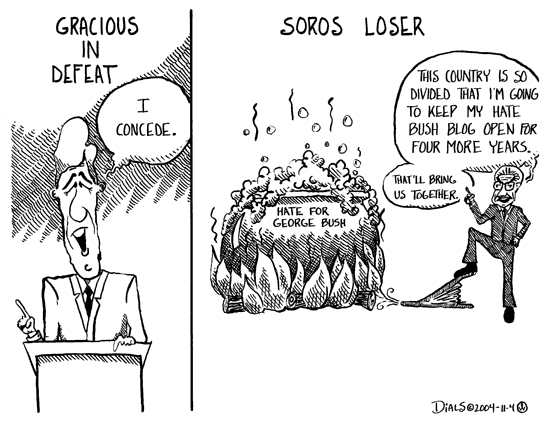
This is probably along the lines of what those obsessed with Soros want, but we don’t have contracts with every single cartoonist.
Image found on TobyToons.
We don’t tell syndicated cartoonists what to draw, and what they draw is usually based on big news stories. The Koch brothers announcing (already!) that they plan to spend $900 million on the 2016 elections was big news. George Soros making a much-smaller contribution to a California proposition race or commenting on the euro zone was not (except in California and the euro zone).
If Soros does something major, I’m sure he’ll be fair game, as were the Kochs.
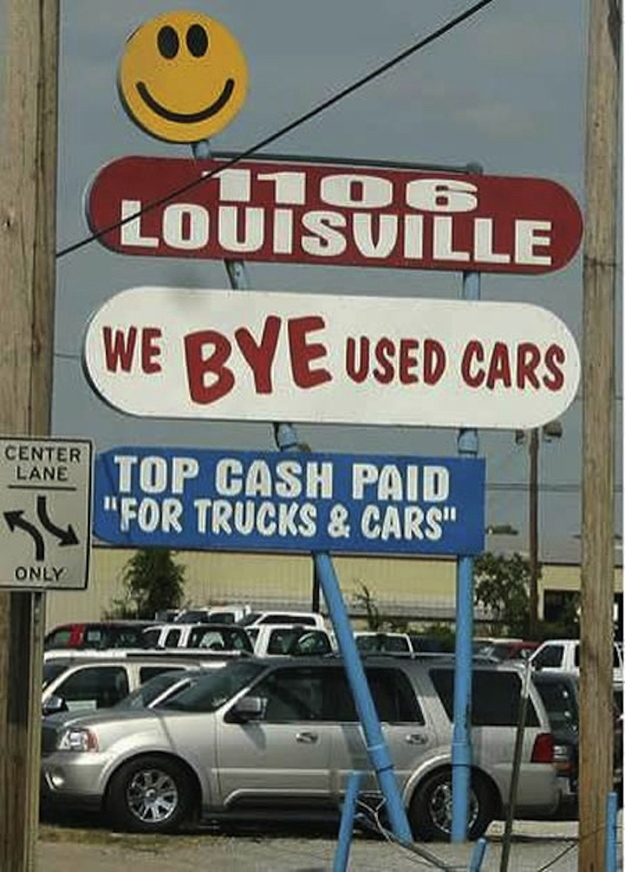
I have a feeling the sign-painter’s English teacher is on suicide watch.
Image found on Bit Rebels.
Speaking of fair game, a few people seemed a bit upset that I cut state Education Commissioner Tony Wood some slack last week by acknowledging that we all misspeak and excusing the “he and I” incident as long as he doesn’t make a habit of abusing grammar rules. Most—if not all—of us have given our English teachers reason to cringe at least once in our lives.
To those who were offended by my stance, I’ll borrow a phrase from a certain itinerant preacher and say that those without grammatical sin may cast the first stone.
 Serenity is a fuzzy belly