
Because of a feline medical emergency (more about that later), I put the column I was writing for this week on hold; I’d rather not give you something that’s not quite soup yet. I offer instead an updated version of this column, originally published March 26, 2014.
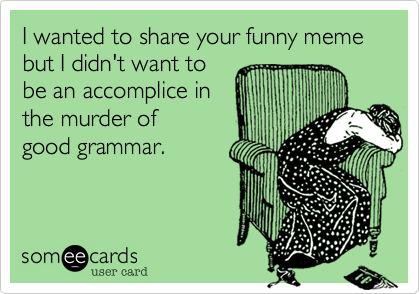 Copy editors are some of the most underappreciated employees at most publications, partially because their job is basically to be unnoticeable. They correct grammar and mistakes in copy so (hopefully) readers can glide easily through stories without crashing into a wall. They are the reader’s last defense.
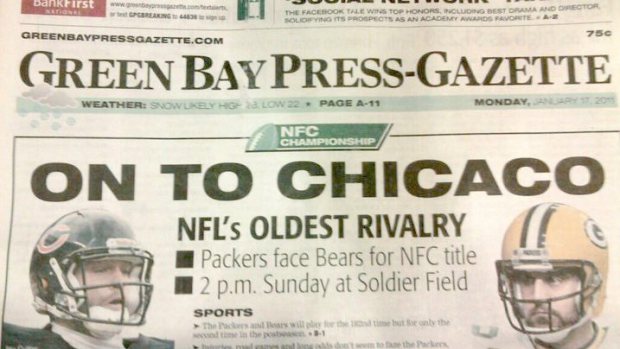
I love Chicag … oh … Green Bay Press-Gazette (Photo Credit: waplross.blogspot.com).
They get noticed, though, when there’s a mistake, such as a misspelling in a headline … especially if it happens to be on the front page of a section.
Even though we strive for perfection, we’re human and make mistakes—but have you ever wondered why that happens? At the risk of sounding like I’m defending myself or my colleagues, one explanation is that of the brain filling in gaps (even if you don’t have stroke brain).
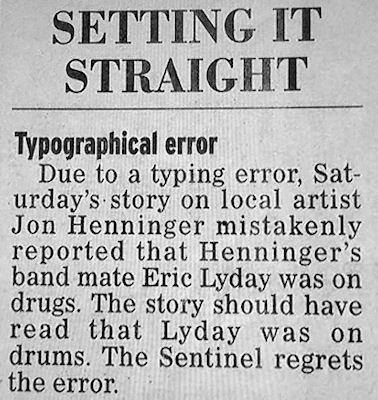
Drugs, drums … same difference, right?
Image found on Serial Bus.
And when people like me see the boneheaded errors we’ve made—and some days there are a plethora—there’s the concussion that follows banging our heads repeatedly on our desks.
It’s one of the reasons someone other than the writer should review what’s been written, as fresh eyes might catch what our own didn’t. At the paper, at least two people other than the designer see the proofs before the pages go to press in hopes that we can catch any errors; on the news side, there are even more people reading the page proofs.
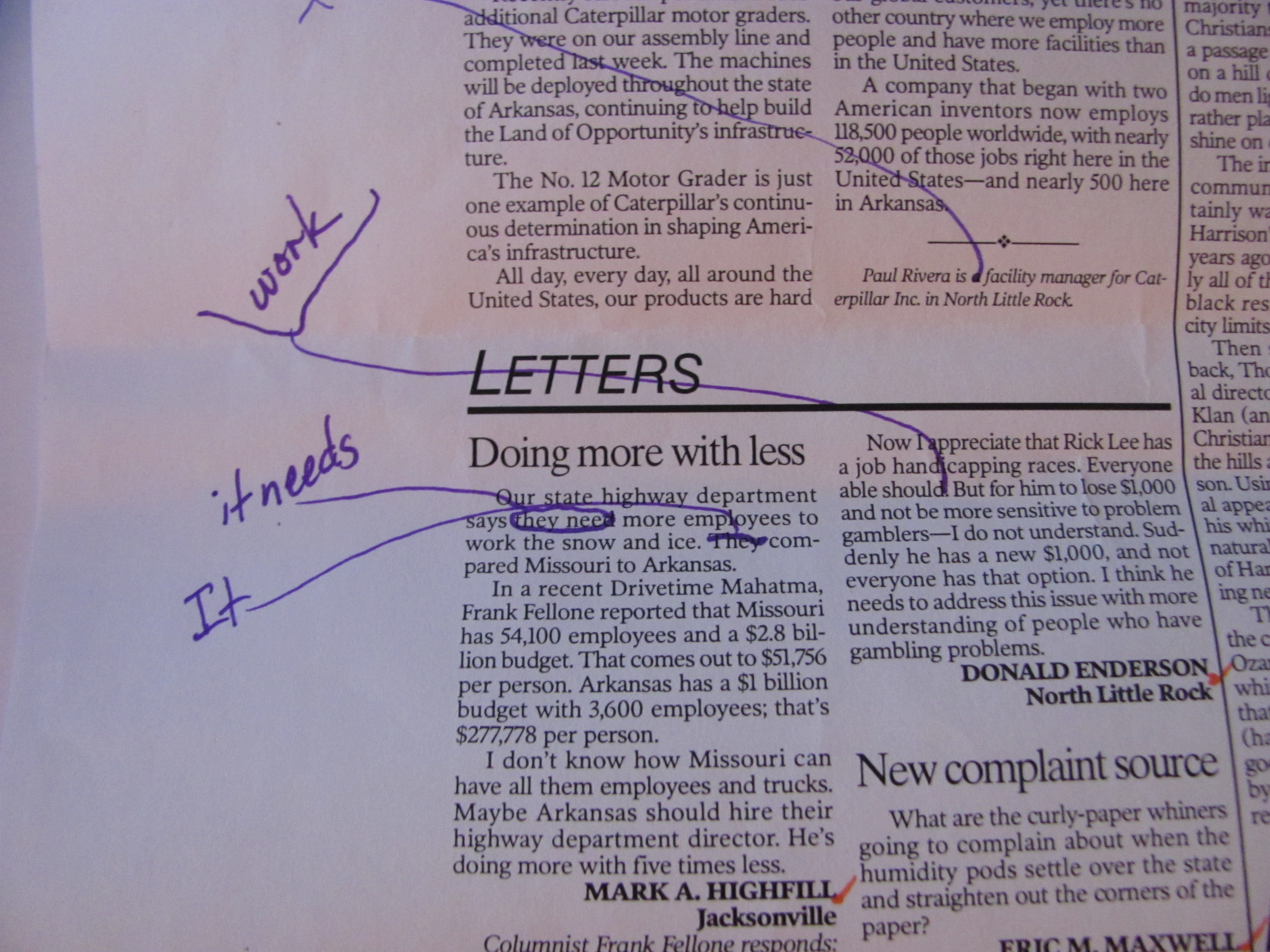
A proof after my first read. You’ll notice I don’t adhere to the stereotype of the red pen. It’s easier to make jokes about purple prose if your pen is actually purple.
Often the problem will be an extra word dropped into a sentence that no one notices till it’s actually in print (if you’re lucky, it’s not a curse word). Other times, it may be a missing small but significant word, such as “not,” which is why we use “innocent” rather than “not guilty” in court stories. You definitely don’t want to convict in print someone who’s been acquitted of a crime … unless you like being sued.
It’s best to keep a sense of humor and be able to laugh about those mistakes that don’t really hurt anybody. Somewhere I believe I still have a copy of the edition of my college newspaper that, in a cutline for a picture of Department of Public Safety officers, just happened to have dropped the “l” in the department’s name. Since the office was across the street from the largest men’s dorm on campus, most of us chose to see the humor in that error. After all, we didn’t mess it up.
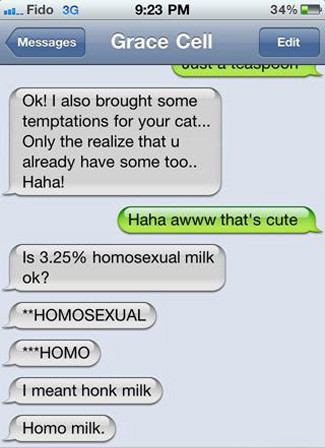
What the hell is honk milk???
Image found on BrainBerries.
Some researchers blame technology and innovations like auto-correct for our having become a bit lazy. Of course, it’s things like auto-correct that have spawned so many Internet memes and more than a few websites (and split up God only knows how many couples). And without auto-correct, many office workers would be at least a little more bored while Web-surfing on the job.
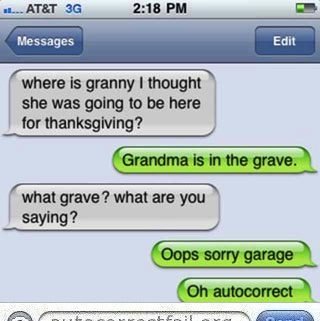
Poor Grandma …
Image from autocorrectfail.org.
If you’re like me, though, seeing those squiggles underneath a word you know is spelled correctly, or even worse, the word changed to what the program thinks you meant, drives you crazy, and makes you a bit more careful about what you write (though cursing still ensues if I happen to hit send just as I notice a bad auto-correct).
But all the caution in the world won’t help when your brain decides to have a little fun with you.
Kathryn Schulz explores the wide world of mistakes in her book, Being Wrong, noting that the brain unconsciously fills in gaps for us, and sometimes gets it wrong. That would be one of the reasons we sometimes don’t notice that we’ve repeated a word or used the wrong word, such as “since” rather than “sense.”
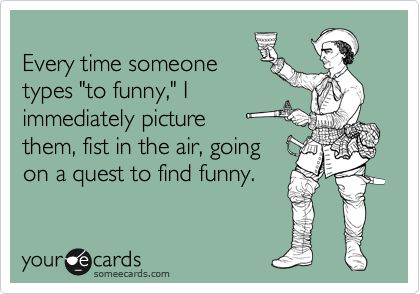 One of the lingering effects of my stroke is that I sometimes use the homophone rather than the correct word, so I’m very aware of the possibility of a mistake. If we’re lucky, someone else will notice before it gets too far, like, say, all over the state.
But we’re not always lucky, like the Chronicle Herald in Nova Scotia, which spelled its own name wrong in a headline in 2013, or the New Hampshire Valley News, whose misspelled name was on its front page, in the masthead, in 2008.
You might have seen the viral email about “typoglycemia,” which says Cambridge researchers have found that most people can still read jumbled-up words as long as the first and last letters are in their proper places. Despite the fact that it’s an urban legend/Internet meme, it does show how our brains can help or betray us.
Plus, you have to admit that “typoglycemia” is a pretty good name to give to that garble that we type when we’re tired.
Yuka Igarashi, Granta magazine’s managing editor, calls the brain the original auto-corrector, and notes that urban legend in an August 2013 piece on The Guardian’s Mind Your Language blog. She employs that story and Schulz’s work in an effort to show that copy editors have to be abnormal humans in order to do their jobs.
See? All those people who thought I was abnormal …
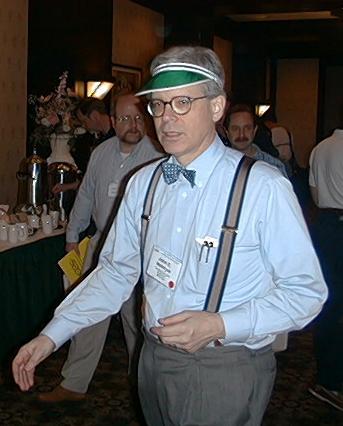
Stalwart copy editor John McIntyre of The Baltimore Sun models a green eyeshade at the 2000 ACES conference. Not many of us wear them anymore, or bow ties and suspenders either.
Image from poynter.org.
Anyone who knows a copy editor can confirm that we can be a weird lot at times, and that if one of us starts talking about misplaced modifiers, it’s best to smile and back away before breakable objects start flying. And some couldn’t care less when AP changes a style rule (like the “more than” versus “over” kerfuffle) because they’re just going to keep using the old style rule.
They’re rebels like that.
Editors have to constantly battle the brain’s tendency to make us see things that aren’t there or ignore things that are. Sometimes we may use strategies such as reading stories from the end to fool gray matter into reading every word that’s actually there. I tend to use the trick I learned in my radio/TV days, reading out loud (my “sounds right” rule). And if I happen to be having a discussion with myself when someone walks by, I can always say I’m editing.
But still, mistakes happen, not just to us, but to everyone. Even the Vatican.
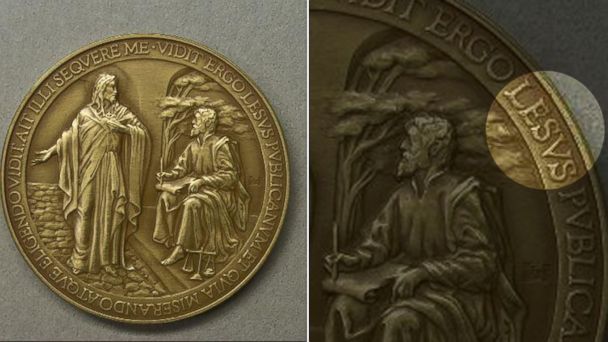
Who gets to say mea culpa for this one?
Image from ABC News.
In the fall of 2013, 6,200 commemorative medallions created to celebrate the papacy of Francis were recalled after it was discovered that the Latin inscription on the medals produced by the Italian State Mint talked of “Lesus” rather than “Jesus.”
Which reminds me of something Jesus said about casting the first stone. Or was that Lesus?
For those wondering about the boy, Luke was not feeling well at all when I got up Monday morning, having thrown up and missed the litter box. He also was yowling and seemed to be in a lot of pain. Since he had the renal insufficiency problem last year, I decided it was better to be safe than sorry, and called the vet’s office near me.
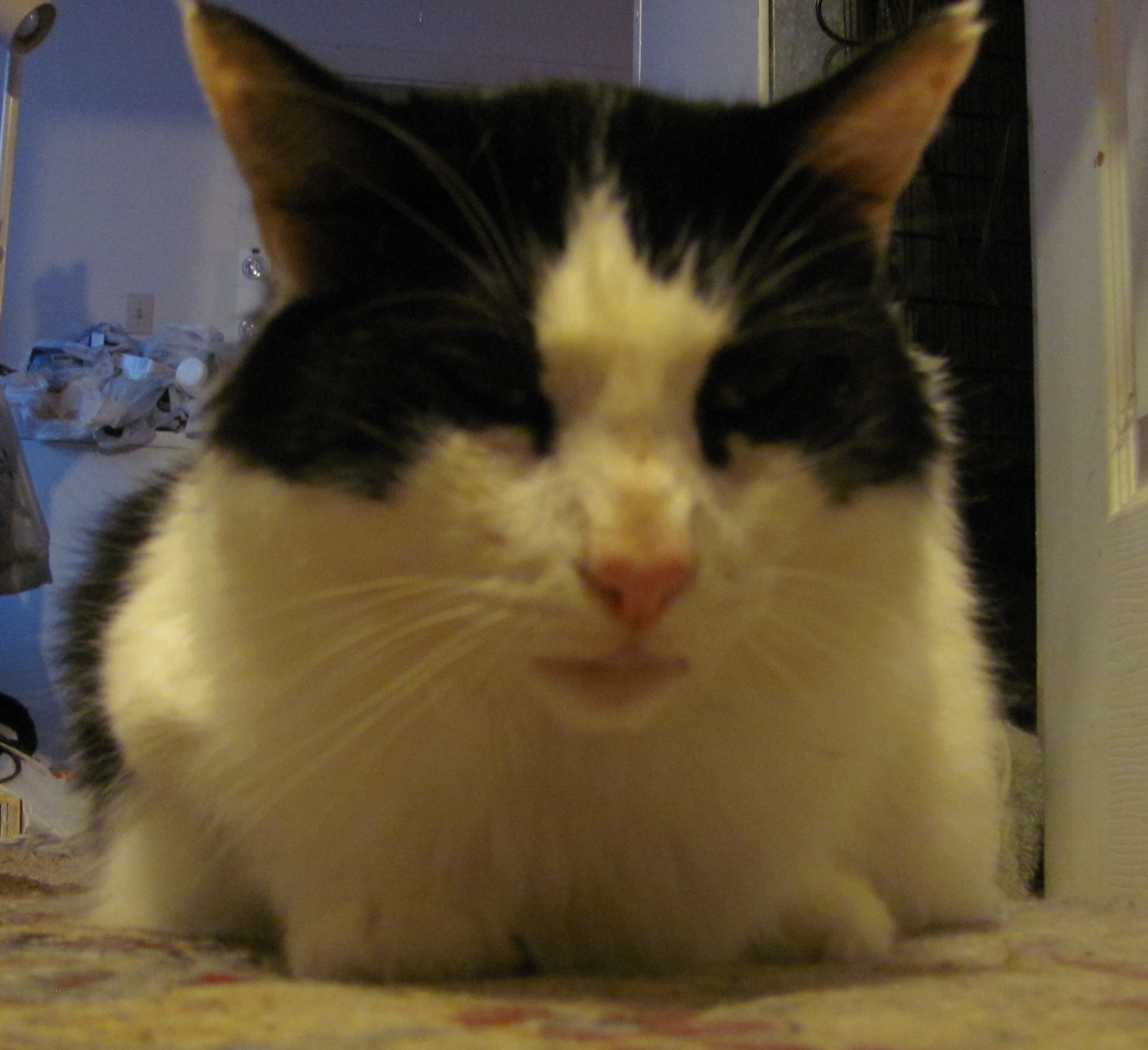
Nope, sorry, not being cute today.
After an exhausting day (for both of us) of tests and treatments, not much was found that pointed to a clear cause … a few levels slightly elevated or depressed, some matter and gas in his digestive track, but no crystals or stones. The vet thought it might be a stress reaction, especially since he’s nearly 13 and indoor-only.
He was cleaned out of what little debris was causing the problem, got fluids, steroids and pain medication, and is on wet food exclusively for a while. So far it seems to have done the trick.
He was still a little groggy Tuesday morning and when I checked on him at noon, but was very lovey (he tends to be that way after the shock of a vet visit wears off … I wasn’t the one poking and prodding him). By the time I got home Tuesday evening, he was feeling well enough to jump on the bed. With any luck I’ll have my crazy boy back shortly.
Lord knows I can use a laugh. Him walking around with his tail down all night (to prevent anything else being stuck where the sun don’t shine) was funny, but I need goofy.
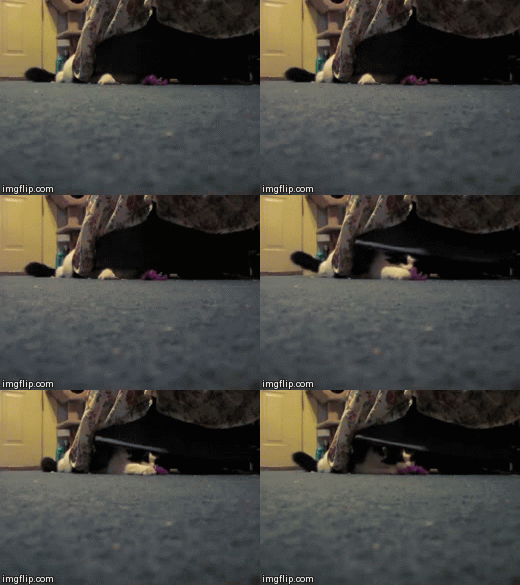
No, Mom! My toy! MINE!
 Serenity is a fuzzy belly