
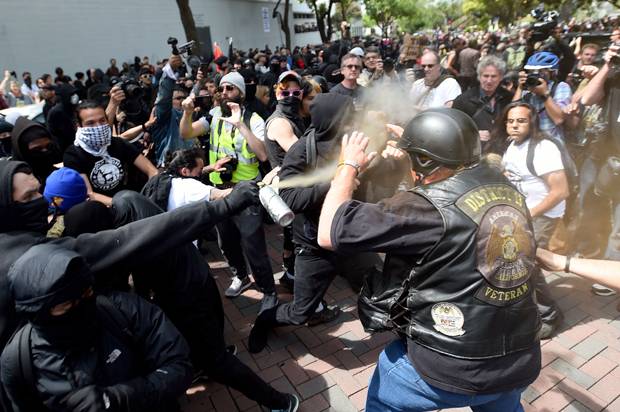
These are not the bogeymen each side seeks … these hosers are still on the fringe.
Image from Berkeley protest in April by Josh Edelson, Getty Images, found on Salon.
Like many, I find myself a bit at sea when seeing violent protests from the alt-right (white supremacists and neo-Nazis) and Antifa (anarchists using “black bloc” tactics who tend to hijack peaceful counter-protests). Part of that is the painting of each as indicative of the broader right and left wings when they are only tiny parts of the whole.
We’ve seen multiple peaceful protests overshadowed by small groups of militants tagging along with the intention of creating disruption, and sometimes greeting violence with violence and property damage, thus tarring the far greater number of nonviolent attendees.
It’s a long way from Mohandas Gandhi and Martin Luther King Jr.
When protesters of any stripe show up armed, that increases the chances that violence will be met with violence. And when that happens, any “higher cause” is undermined.
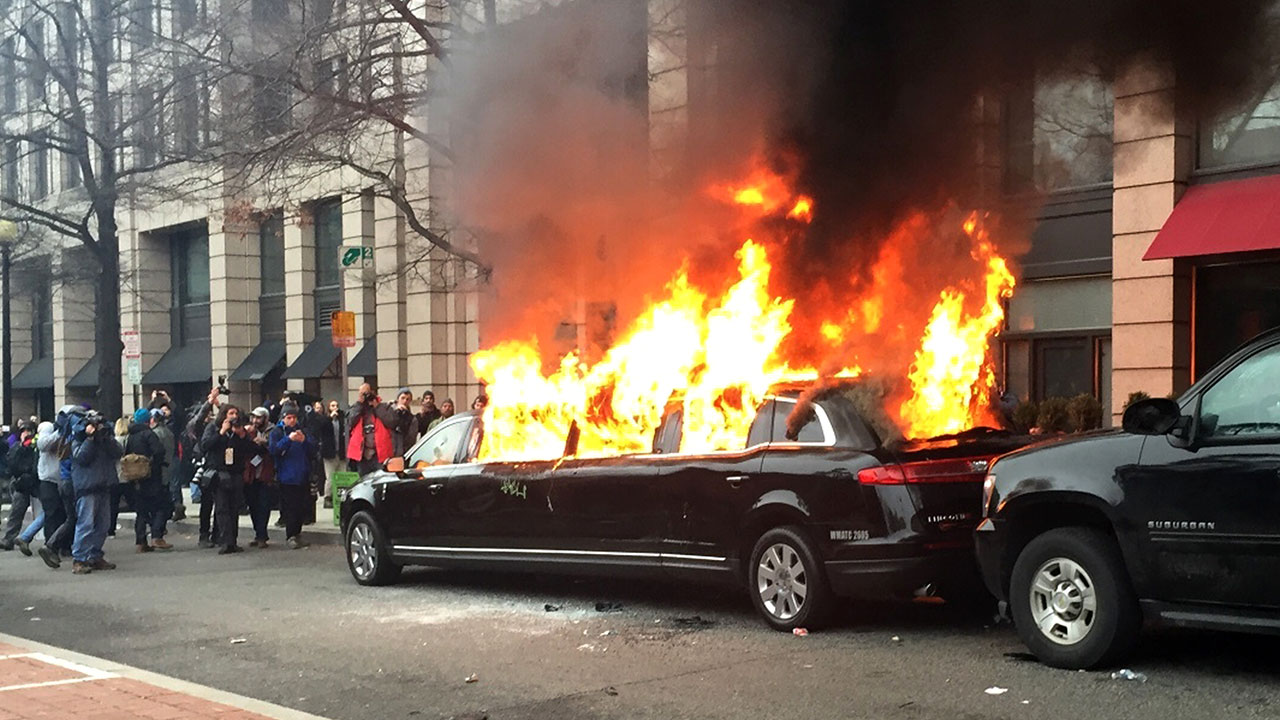
But I don’t wanna set cars on fire! I wanna prank people!
Image found on ABC13Houston.
Erica Chenoweth and Maria J. Stephan wrote in the Washington Post last year about the comparative effectiveness of violent and nonviolent protests. In that piece, they cited research by Chenoweth and Kurt Schock that found “violent flanks may achieve some short-term process goals such as media attention, the perception of self-defense, the diffusion of an oppositional culture that builds the commitment of more radical members, or catharsis around the ability to ‘blow off steam.’ But violent flanks typically undermine longer-term strategic goals such as maintaining an increasingly large and diverse participation base, expanding support among third parties and eliciting loyalty shifts among security forces. … violent flanks are typically associated with smaller participation rates and more homogeneous participation, undermining the main advantage of using nonviolent resistance in the first place.”
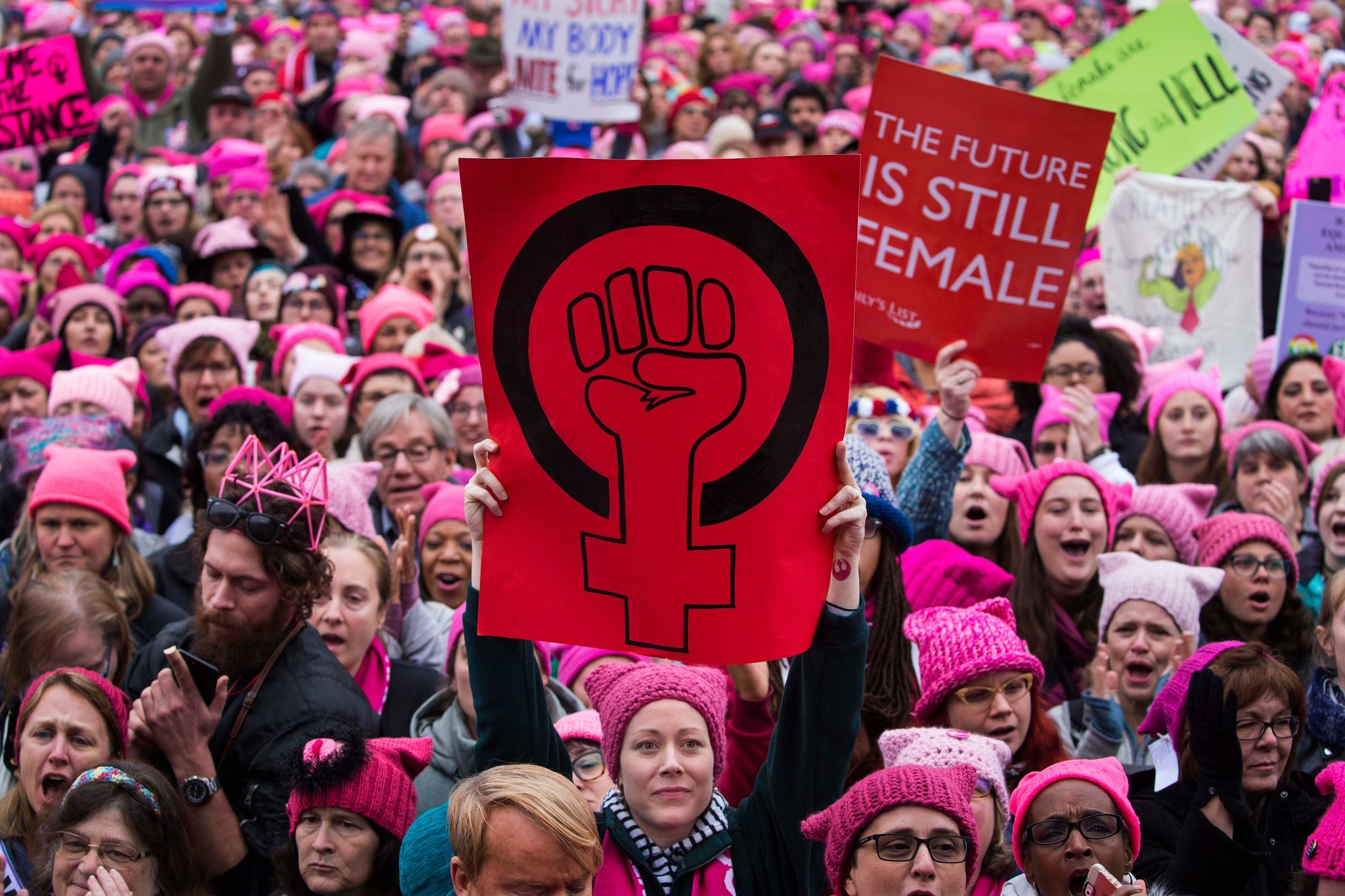
When people are armed with pussy hats and signs, violence rarely ensues.
Image by Ruth Fremson, New York Times.
They further found that “nonviolent resistance campaigns don’t succeed by melting the hearts of their opponents. Instead, they tend to succeed because nonviolent methods have a greater potential for eliciting mass participation—on average, they elicit about 11 times more participants than the average armed uprising.”
Recent studies show that extreme protests such as have happened at Berkeley dissuade those who don’t identify with the extremists. So if rioting doesn’t win people to the cause, why do it, especially when nonviolence is more effective? Do some people just see nonviolence as too passive?
Sit-ins, picketing and other such methods are not the only way to protest nonviolently, and one form in particular seems to be gaining in popularity: “laughtivism.” It’s much easier to gain recognition for your cause if you can make people laugh and think. It shouldn’t be hard to figure out why I prefer this method.
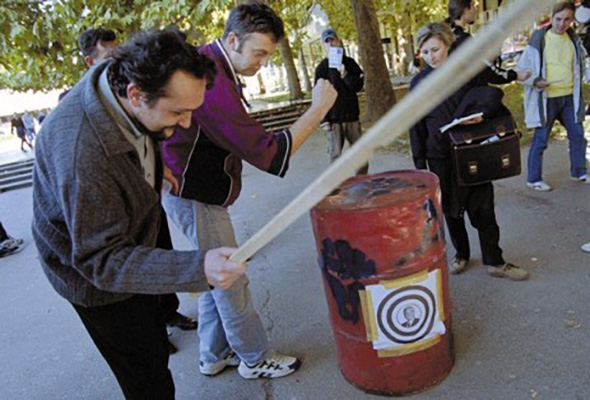
I’m not a Serb, but I’d whoop up on that barrel.
Image found on Slate.
Serbian protest group Otpor showed the way for many when, in 1998, the group placed a barrel with dictator Slobodan Milosevic’s face painted on it, along with a baseball bat, in a Belgrade shopping district, then sat at a cafe across the way to watch secretly. People who hated Milosevic but were afraid to criticize him soon lined up to take a turn whacking away at the barrel. Police showed up after about 30 minutes and arrested … the barrel. The image went viral in the nation and, Otpor co-founder Srdja Popovic later recounted in a 2013 essay in Foreign Policy, “Milosevic and his cronies became the laughingstock of the nation, and Otpor became a household name.”
Sure, it was only for a few years (Otpor lasted from 1998 to 2004), but the group and its founders helped lay a foundation, and have spent the ensuing years teaching others about laughtivism.
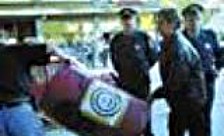
For a viral image, it was awfully hard to find, but yeah, it’s pretty ridiculous to arrest a barrel.
Image found on Color Revolutions and Geopolitics.
In his 2015 book, Blueprint for Revolution, Popovic wrote:
“The best humorous actions—or laughtivism—force autocrats and their security pillars into lose-lose scenarios, undermining the credibility of their regimes or institutions no matter how they manage to respond. Politicians, whether they are democratically elected or harsh dictators, usually share an inflated sense of self-importance. After too long in power, and after seeing their own Photoshopped face too many times in newspapers and on the covers of magazines, they start taking themselves too seriously. It’s as if they start believing their own propaganda. This is why they make stupid mistakes when challenged with laughtivism.
The high and mighty can’t take a joke.”
Hence all the crazy/funny replies on Donald Trump’s Twitter timeline. The more he tweets, the more angry he is over those slights. (He’s not a baby! Waaaaaaaah!)

No, I don’t wanna eat that stuff. I want KFC and a Trump Taco Bowl!
Image found on Wonkette.
In Wunsiedel, Germany, where Rudolf Hess was originally buried, neo-Nazis descend on the town each year to march to honor Hess. After years of quietly watching from afar, in 2014 the group Right Against the Right turned the march into an involuntary walkathon: For every meter the neo-Nazis marched, local businesses and residents donated 10 euros (about $12.50) to an organization that helps neo-Nazis leave the movement.
The Post reported then: “The 200 neo-Nazis had only two choices when they got to know about the plan: Either they proceeded, indirectly donating money to the EXIT Germany initiative, or they acknowledged their defeat and suspended the march.” They decided to march, and each year they return to colorful banners poking fun at them, confetti, and a route marked as if for a marathon. And each time, they raise 10,000 euros to help people leave them.
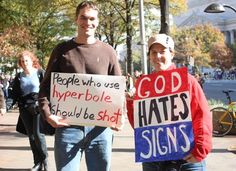
I think God probably doesn’t hate all signs … just ones that make no sense. Me too.
Image found on Pinterest.
Laughtivism has shown up here as well, as seen in many of the participants in the Women’s Marches in January (what … you thought the pussy hats were a fashion statement?), Jon Stewart and Stephen Colbert’s 2010 Rally to Restore Sanity and/or Fear, and the numerous clowns (yes, really) mocking neo-Nazis from North Carolina to Washington state.
David Neiwert, in his book Alt-America, wrote: “Fascists, you need to understand, are the ultimate psychic vampires. They feed off hate. They want to stoke it as much as possible. They want things to become as violent as possible. They love it when you become violent, and give them martyrs.”
Mockery, by defanging them, seems to be proving a far more potent and effective weapon. And, bonus, they don’t get to say the mean counter-protesters hurt them.
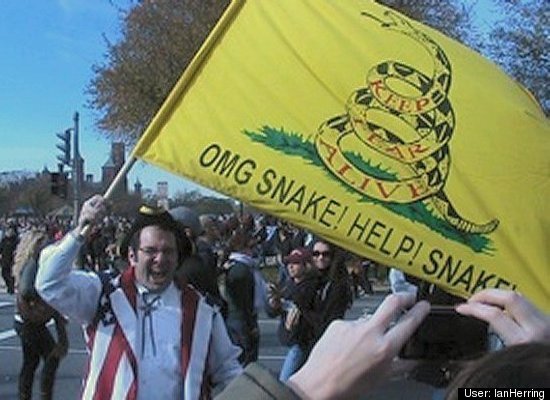
Best thing to happen to that snake.
Image found on Pinterest.
King and other civil-rights protesters would train beforehand on how not to react with violence even when being beaten. Today, some groups are training to include laughtivism methods because, just as militant methods undermine the effectiveness of peaceful protests, humor can undermine violence and authoritarianism.
Hopefully, though, they’ll steer clear of the clown costumes. For some of us, clowns are just creepy.
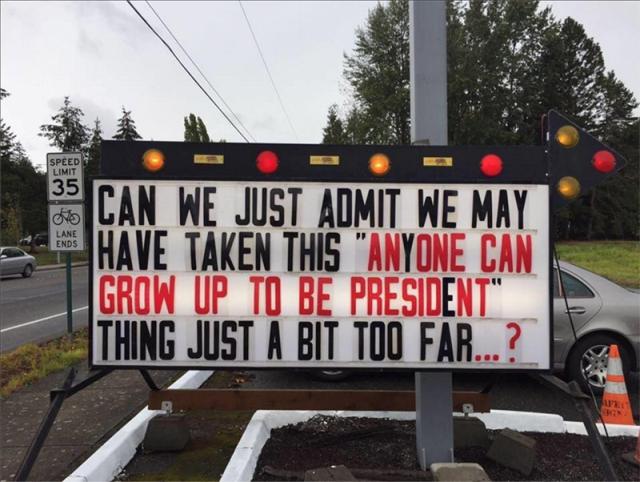
Speaking of clowns …
Image found on brokeasssttuart.com.
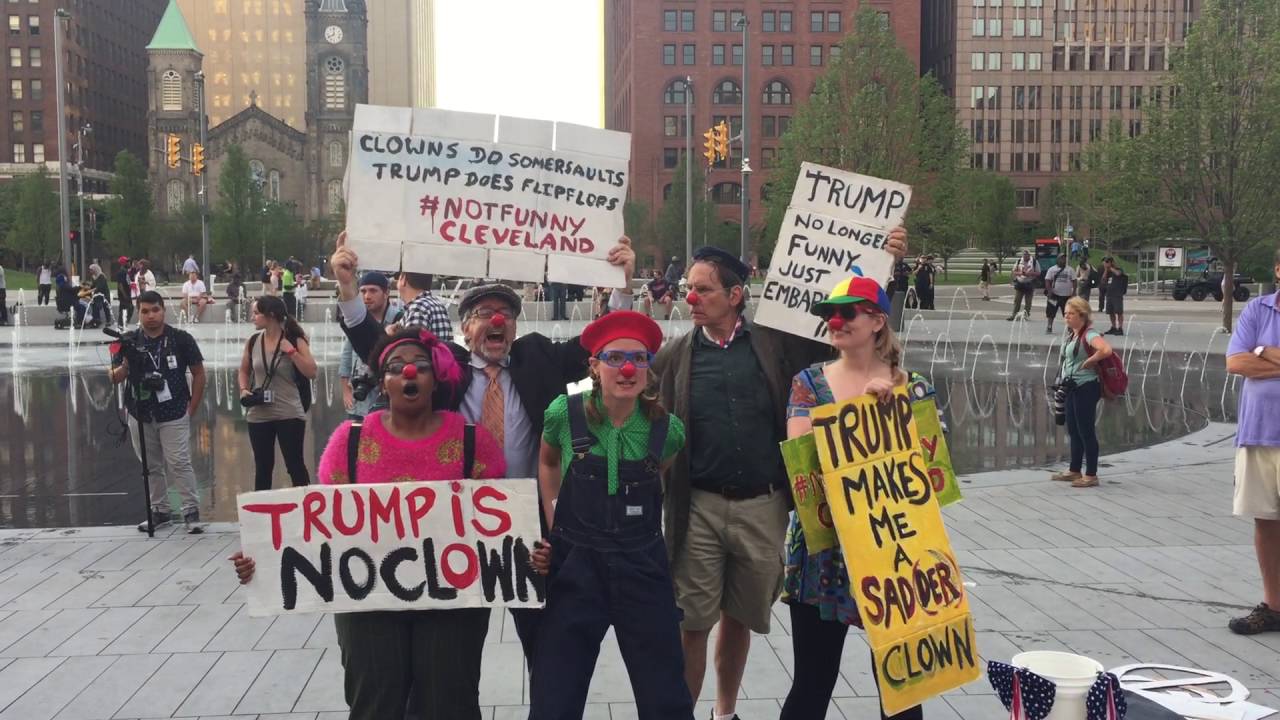
Well, at least they didn’t go full clown …
Image found on YouTube.
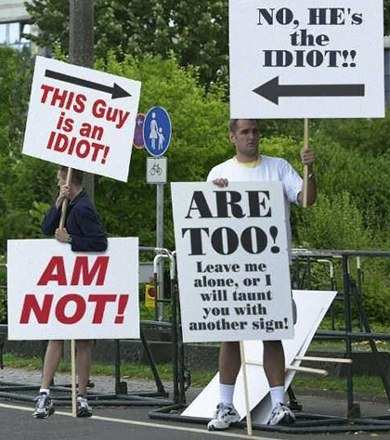
These two must be brothers.
Image found on nuffy.net.
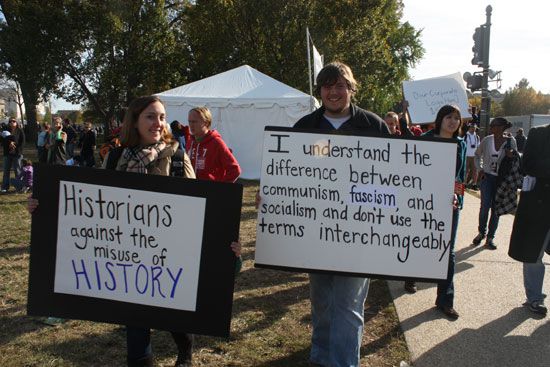
Ya damn fascist communist socialists!
Image found on ThoughtCo.
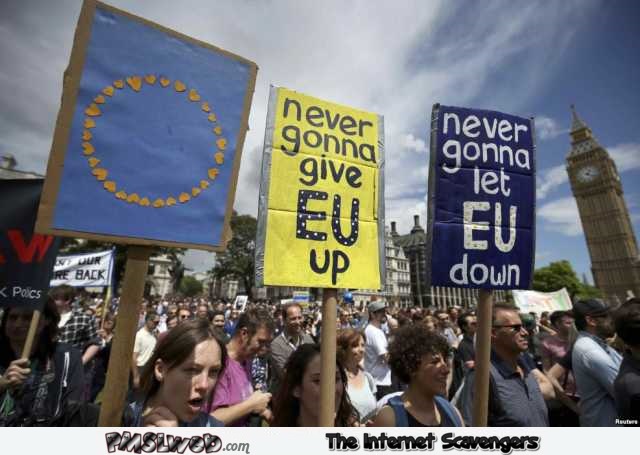
Ah, those crazy pro-European Union protesters … just had to get in a rick-roll.
Image found on PMSLWeb.
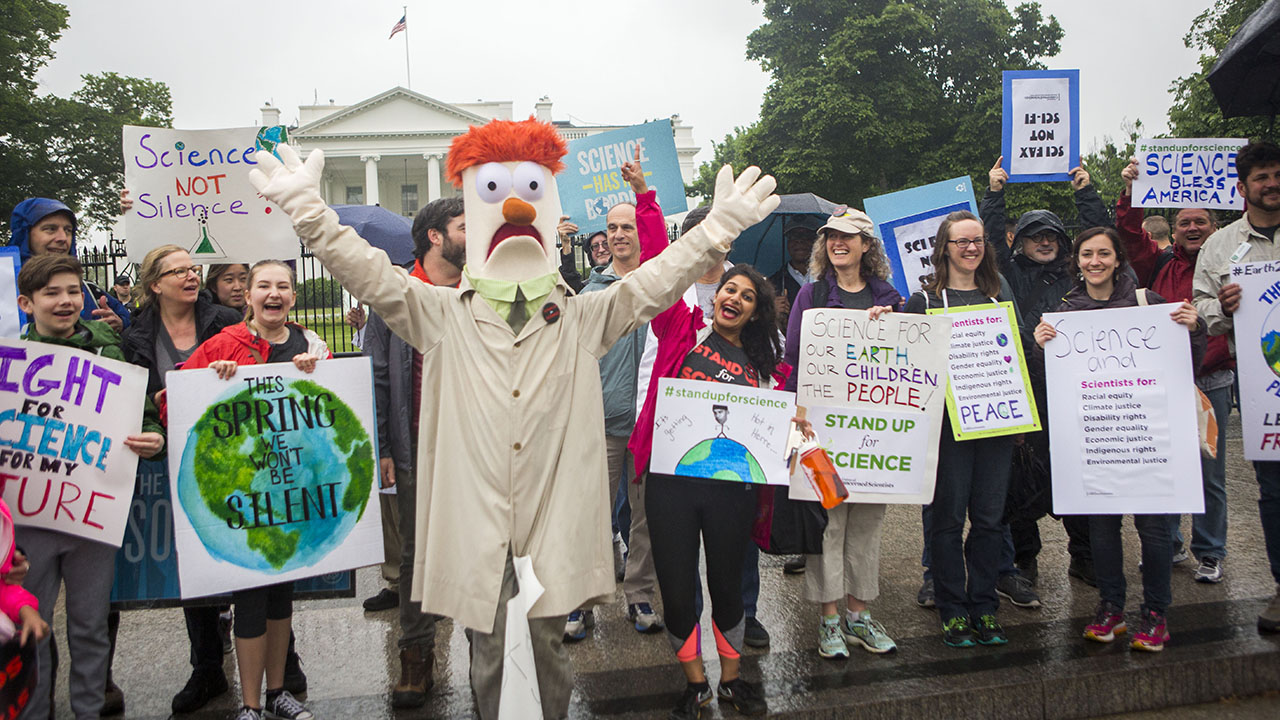
When Beaker shows up to protest, this is serious.
Image by Jessica Kourkounis, Getty Images, found on FirstPost.
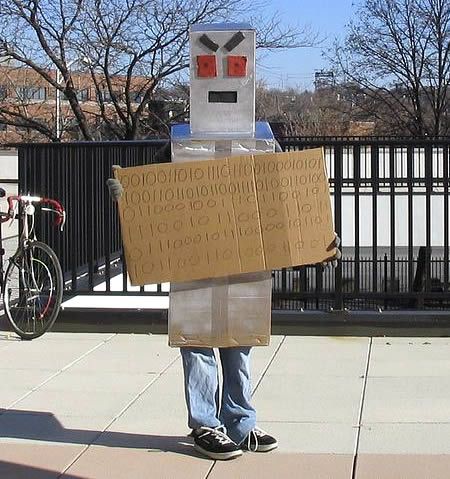
Ooh, that is one pissed-off robot. Count yourself lucky if you can’t read binary code.
Image found on Pinterest.
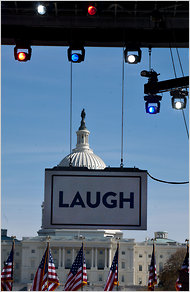
If you can do this, there’s still hope for you.
Image found on the New York Times.
 Serenity is a fuzzy belly
Reports of Berkeley and free speech takes me back. I was in graduate school at Berkeley in the 60s, when a student organizing committee called for a picket line around the whole campus to protest the administration limiting the freedom to set up tables protesting the Vietnam War. The next day saw hundreds, maybe a couple thousand students on the line, but there were not nearly enough to encircle the very large campus.
Frustrated, the organizing committee called for more drastic measures the next day, and fewer students showed up. This process repeated for a few days, until the protest was reduced to thirteen people holding signs and saying nothing in an “informational picket” in front of the administration building, not blocking anybody from anything.Theirs was a symbolic protest at best.
At that point, the police arrived, grabbed everyone at the picket line, dragged them to the basement of the administration building where they proceeded to beat up the one black guy–who turned out to be a reporter, not a protestor.
The next day, thousands of us sat in front of the administration building. An encircled police car was used as a platform for speeches. We stayed for days until the administration gave in to demands for free speech protections. (Fifty years later, I may have some of the details jumbled, but it was something like that. A colleague, Rod Stark, wrote it up in a book entitled, Protest + Police = Riot)
It is true that protestors often behave in counterproductive ways, as you’ve described. However, police can sometimes be counterproductive in those situations, as well. Laughter can serve all the various interests involved. Jon Stewart, Stephen Colbert, Trevor Noah, and others have taught us that.
LikeLike
When the police act like the military, it serves to exacerbate the situation, so when protesters forget the lessons of King and Gandhi, it just gets more volatile. Humor can’t fix everything, bit it can certainly ease tensions.
For the humorless, though, I got nothin’. 😉
LikeLike