

Are there classes in victimhood? I’m feeling persecuted because no one’s given me chocolate lately.
Image found on someecards.
What kind of life do you have to lead to see everyone who disagrees with you as evil? Why would you want to be angry all the time, or to see yourself as a perpetual victim?
There could be very good physiological or psychological reasons for this—having weak boundaries (just can’t say no), being sleep-deprived, or experiencing depression or anxiety, for example. But for a lot of people, it seems … it’s all about politics. And it’s always the other side’s fault. Always.
(Wrong. It’s everybody’s fault. Often one side is more to blame, but everyone bears some responsibility.)
Ask said cranky people why they’re cranky, though, and they’ll say, no, we’re happy … everything’s going our way. So stop asking why we’re mad, dammit!
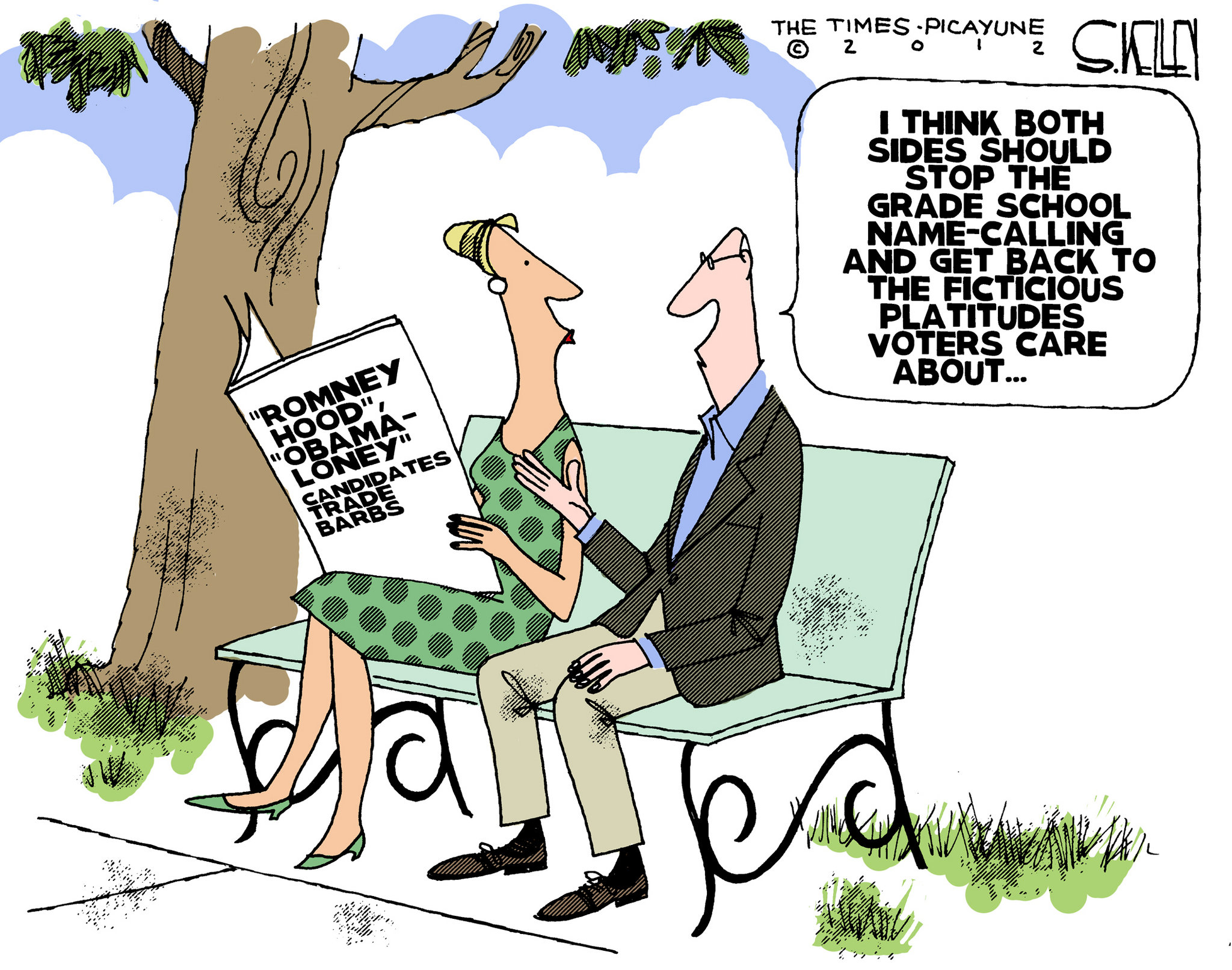
The name-calling isn’t even inventive anymore, so let’s just move on.
Editorial cartoon by Steve Kelley, New Orleans Times-Picayune.
So again I ask: Why so grumpy, buttercup? Why the need to denigrate others? (Really, picking on LeBron James, whose foundation is actually doing something useful?) And no, again, in the U.S., you’re most likely not being persecuted for being Christian, so stop saying you are every time someone doesn’t let you do whatever you want. Seriously, don’t you have better things to do than antagonize people with whom you disagree?
Right … look who I’m asking … some people can’t help themselves, apparently. I nearly lost my eyes rolling them while reading comments on the newspaper’s site. Hate is not a hobby, and yet so many seem to use it as one.
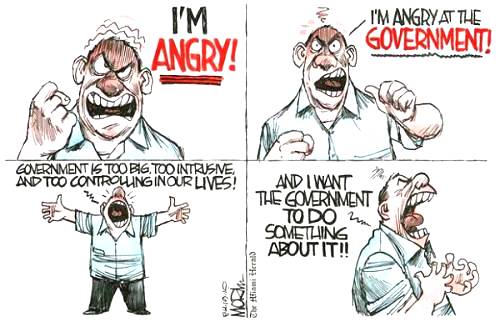
I’d prefer a hands-off approach for things like medical decisions, but for public works, government is necessary.
Editorial cartoon by Jim Morin, Miami Herald.
Anger isn’t exactly a new thing in American political life—Boston Tea Party, anyone?—but it’s gotten worse in recent decades, and for less reason; a football player kneeling for the national anthem isn’t quite on par with taxation without representation. (Seriously, it’s not. Really.) Those out of power have reason to be angry, though not as much as those facing real adversity—poverty, violence (real, not imagined) and the like. But those in power? Why, when you’ve gotten what you wanted? Wait … did you realize that power and more stuff aren’t everything?
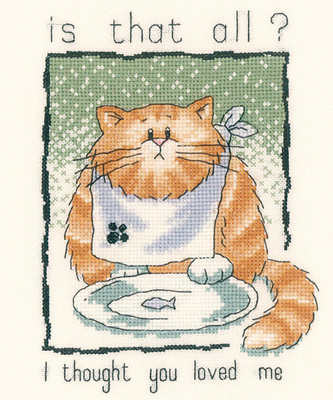
Why are you being so mean to me?
Image found on Quality Needlepoint.
What we see now is more of what Richard Hofstadter wrote about in his 1964 essay, “The Paranoid Style in American Politics,” published in Harper’s Magazine:
“American politics has often been an arena for angry minds. In recent years we have seen angry minds at work mainly among extreme right-wingers, who have now demonstrated in the Goldwater movement how much political leverage can be got out of the animosities and passions of a small minority. But behind this I believe there is a style of mind that is far from new and that is not necessarily right-wing. I call it the paranoid style simply because no other word adequately evokes the sense of heated exaggeration, suspiciousness, and conspiratorial fantasy that I have in mind. …
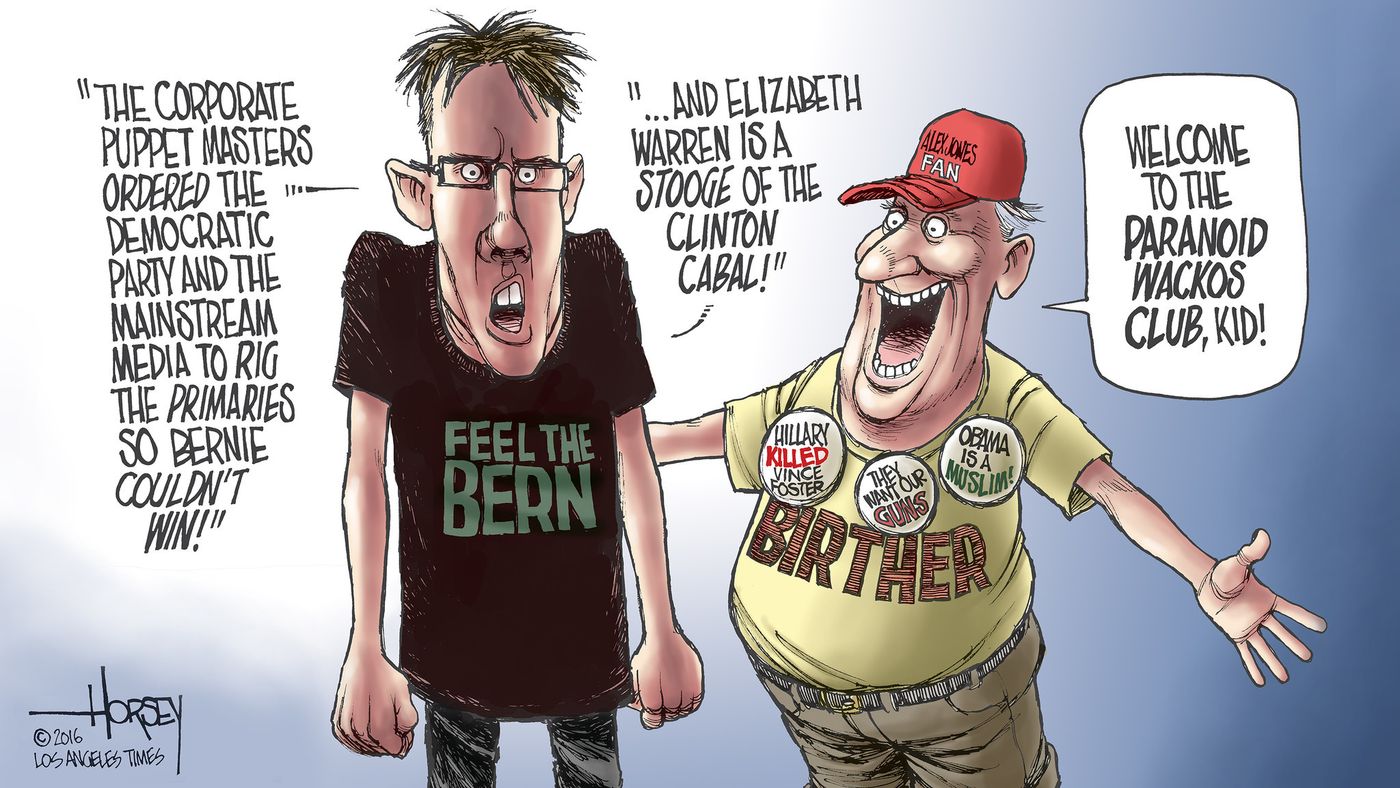
Paranoid politics happen all over the spectrum.
Editorial cartoon by David Horsey, Los Angeles Times.“[T]he idea of the paranoid style as a force in politics would have little contemporary relevance or historical value if it were applied only to men with profoundly disturbed minds. It is the use of paranoid modes of expression by more or less normal people that makes the phenomenon significant. Of course this term is pejorative, and it is meant to be; the paranoid style has a greater affinity for bad causes than good.”
As Jeet Heer wrote in New Republic shortly after the shooting of Rep. Steve Scalise, political discourse has been violent for a while, pointing to rhetoric in the late 19th and early 20th centuries from writers Ambrose Bierce, Westbrook Pegler (who Heer described as the Rush Limbaugh of his day … oh, joy) and others advocating assassination of political enemies such as William McKinley and Robert F. Kennedy.

Elmer always did seem tightly wound.
GIF found on Tenor.
Because that would just solve everything. And if you believe that …
At least at some points during all this, those in Congress and the White House managed to work together well enough to get work done that helped Americans (the Civil Rights Acts and protecting natural resources like the Buffalo River come to mind, even though people have been rolling back protections on all of that). That changed, maybe for good, with Newt Gingrich’s early 1990s directives to congressmen to use extreme rhetoric and to return home on weekends rather than stay in D.C. and work with the opposition.
Civility? Who needs that? Oh, right … we do. That’s why August is “Win With Civility Month.” (Really. It is.)
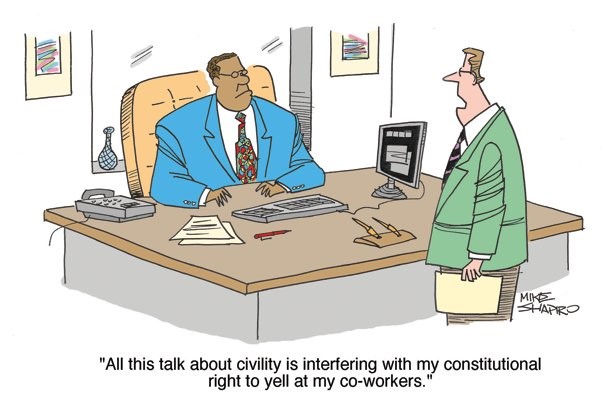
It’s not fair!
Cartoon by Mike Shapiro.
Without civility, we end up fighting each other all the time, calling each other names, and getting nothing productive done. Well, except producing more anger, much of it pointless.
Incivility does have its purposes—other than to annoy the crap out of me—as political science professor Emily Sydnor pointed out in the Washington Post: “Exposure to incivility can reduce trust in government, belief in institutional legitimacy and media credibility while further polarizing citizens politically. But it can also be a way to assert political rights when traditional methods are ineffective and can rally supporters to your cause. Incivility can open up political debate, even as it makes us uncomfortable.”
Dissent is an important part of our political system, and it’s often not civil. Incivility tends to be met with the same, but take it too far, and we end up where we are now. Angry, unable to take a joke, and feeling persecuted when someone simply disagrees with us.
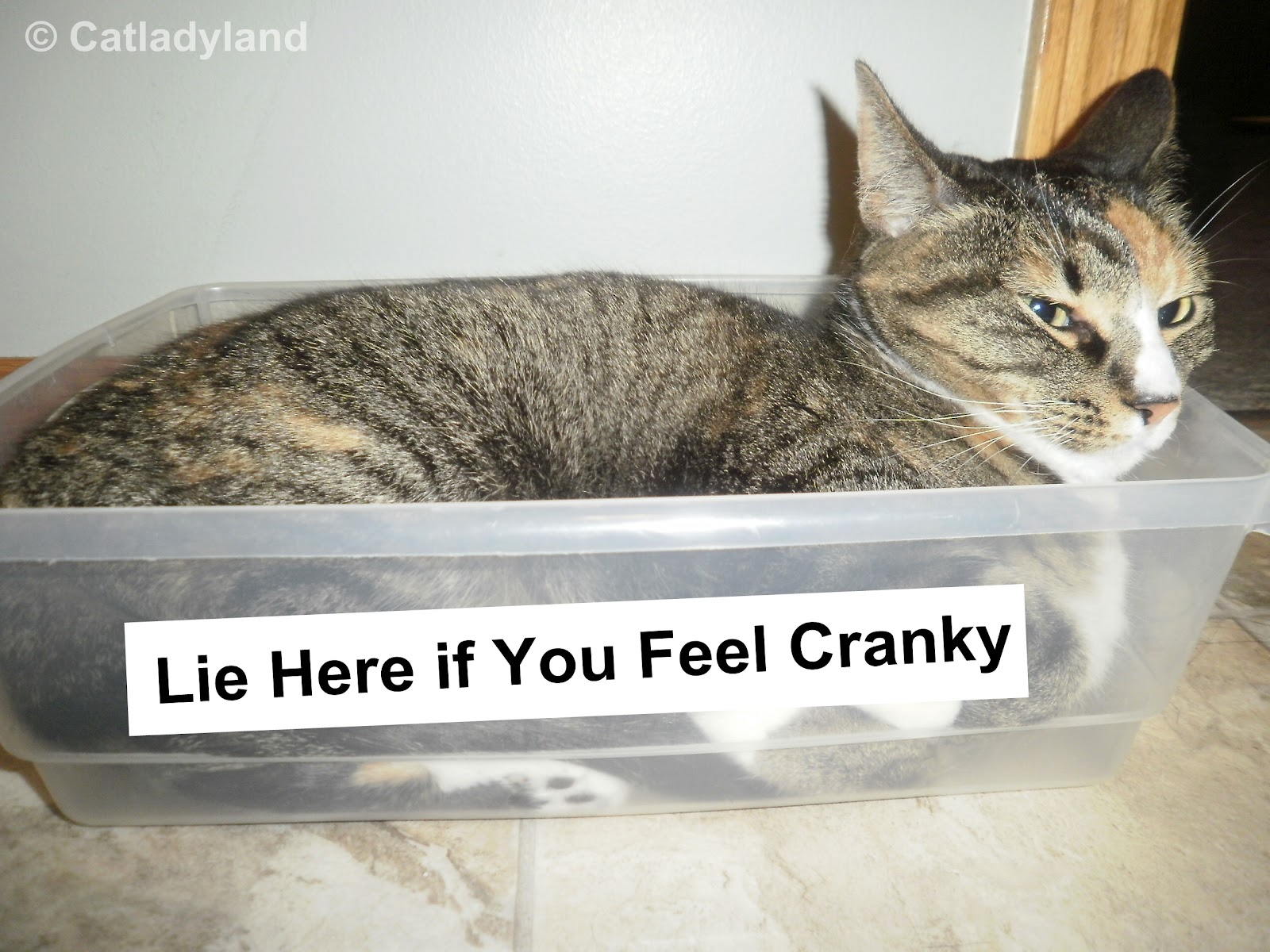
Truth in advertising. This is not a happy kitty.
Image found on CatLadyLand.
But if anyone asks, we’re blissfully happy.
However, people who are actually happy don’t spend their time running down others for no reason other than they don’t believe the same things. They don’t see a reason to worry about things they can’t change, but are energized by the prospect of what they can change. They’re also pretty sure those conspiracy theories are mostly (if not all) bunk.

C’mon, the goat just wants a friend!
Image found on Pinterest.
Maybe most importantly, they see other people as people, not evil hell-beasts out to get them.
It’s a lot more fun to be around civil people who have a sense of humor. And a lot less exasperating. As for you other people … have you thought about stamp-collecting?
Oh, and leave journalists (the real ones) alone. We’re doing our jobs. It’s not our fault you don’t like reality.
 Serenity is a fuzzy belly