
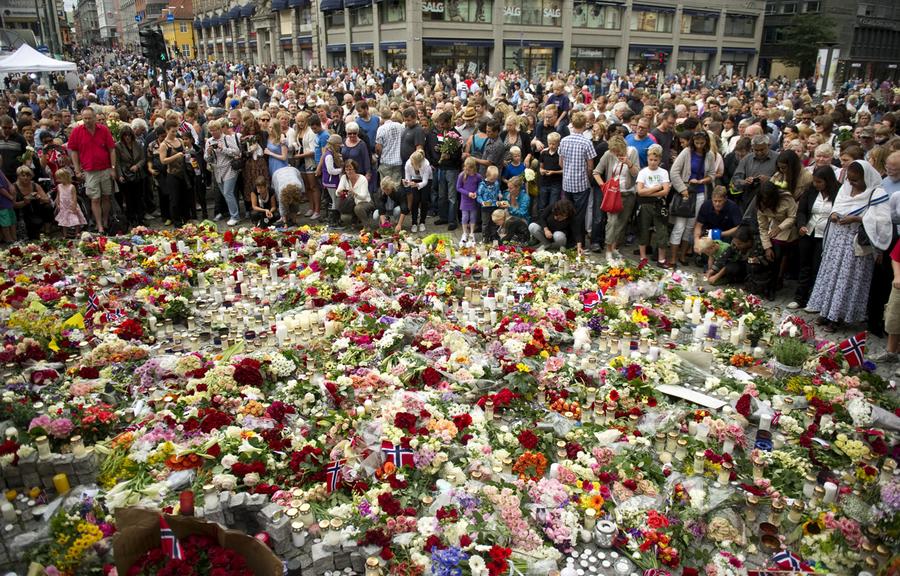
A sea of flowers and mourners fill the streets of Oslo, Norway, two days after the deadly attacks of July 22, 2011.
Image by Odd Andersen, AFP/Getty Images, found on The Atlantic.
Over the weekend, I finally watched a movie I had added to my Netflix queue months ago but hadn’t been able to work up the courage to watch: 22 July.
The attacks by Anders Behring Breivik in Norway on July 22, 2011, were horrifying for many reasons, not just the 77 people who died in the Oslo bombing and in the protracted assault on a Workers’ Youth League summer camp on the island of Utoya. Breivik caught attention not only for the slaughter of so many, but for his radical far-right motivations. Who can forget his Nazi salute in court?
We’ve had few foreign attacks on U.S. soil (Pearl Harbor and 9/11 are the most notable). What we should worry more about, like Norway in this instance, is homegrown attacks from people (groups and individuals) with extremist views, be they white supremacy, jihad, or any number of other violent and radical ideologies.
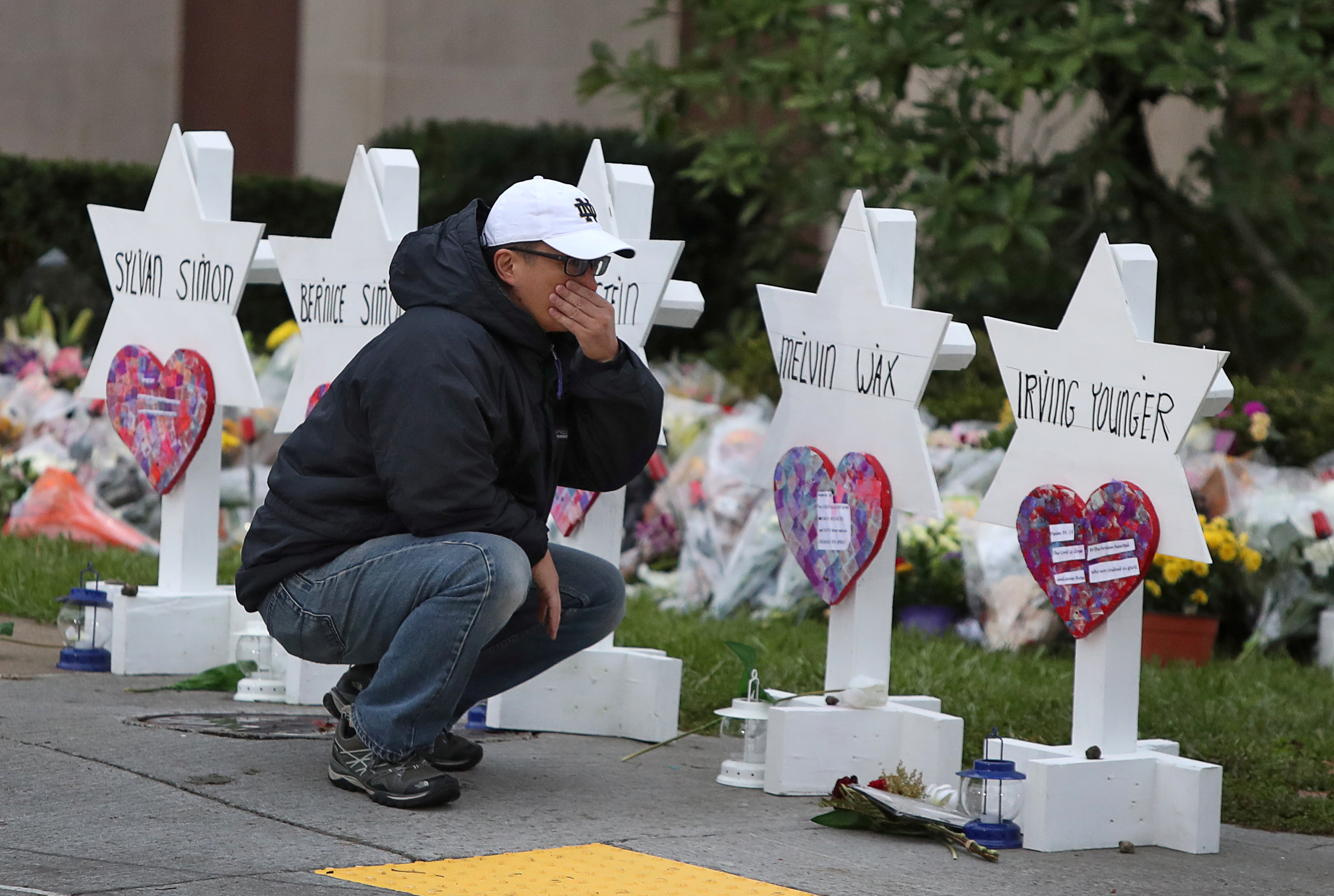
A man reacts at a makeshift memorial outside the Tree of Life synagogue after the shooting at the synagogue in Pittsburgh, Pa., on Oct. 27, 2018.
Image by Cathal McNaughton, Reuters, found on Brookings Institution.
Peter Bergen and David Sterman wrote in October in Foreign Affairs (sorry, no link since it’s subscriber-access with a very stingy free-read policy), just after a racially motivated killing of two people at a Kentucky grocery store, the sending of package bombs to prominent Trump critics, and an attack on a Pittsburgh synagogue that killed 11:
“Since 9/11, no foreign terrorist group has successfully conducted a deadly attack in the United States. The main terrorist problem in the United States today is one of individuals—usually with ready access to guns—radicalized by a diverse array of ideologies absorbed from the Internet. …
“The recent attacks show that the most glaring terrorist threat facing the United States today is primarily domestic in nature. Ubiquitous firearms, political polarization, images of the extensive apocalyptic violence tearing apart societies across the Middle East and North Africa, racism, and the rise of populism have combined with the power of online communications to drive up violence across the political spectrum.
“Whether expressed in right-wing, left-wing, jihadist, or black nationalist ideological terms, today’s acts of political violence share a common lineage in the above mixture and together have resulted in almost 200 deaths since the 9/11 attacks. The death toll is even higher if one includes other deadly attacks with less traditionally political or clear motivations ranging from the new ideological misogyny of “incel” violence (incel being a term for a community of people who view themselves as involuntarily celibate and generally frame their perspective in ideological misogyny) to a spate of deadly school shootings. Addressing this threat will require a broad process of renewing U.S. society, a task far more difficult than disrupting a foreign terrorist organization’s operational capacity.”
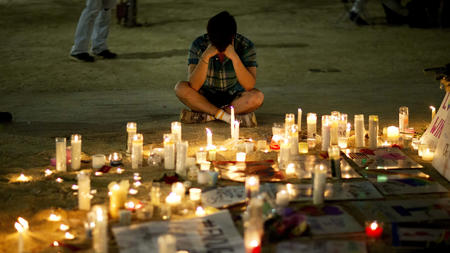
More mourning that shouldn’t have had to happen, after the Pulse Nightclub shooting on June 12, 2016.
Image found on Orlando Sentinel.
We should still be aware of the possibility of jihadist attacks like that at the Pulse nightclub in Orlando, but we have to remember that the majority of those perpetrators were citizens or legal residents, and every lethal jihadist terrorist in the U.S. since 9/11 was born here, was naturalized, or was a legal resident. Meanwhile, deadly attacks on U.S. soil such as the Oklahoma City bombing, the Las Vegas Route 91 shooting and the Charleston, S.C., church shooting continue, all undertaken by Americans.
The U.S. is not a stranger to violent domestic attacks, having dealt with the Mountain Meadows Massacre, Unabomber attacks, Weather Underground bombings, and others before the 1995 bombing of the Alfred P. Murrah Federal Building in Oklahoma City, killing at least 168 people, several of them children. That attack is still the most deadly domestic terror act in U.S. history, and one I remember with horror. I was working in TV then, and spent much of the following few months editing footage from the aftermath and talking to the network correspondents during our satellite feeds.
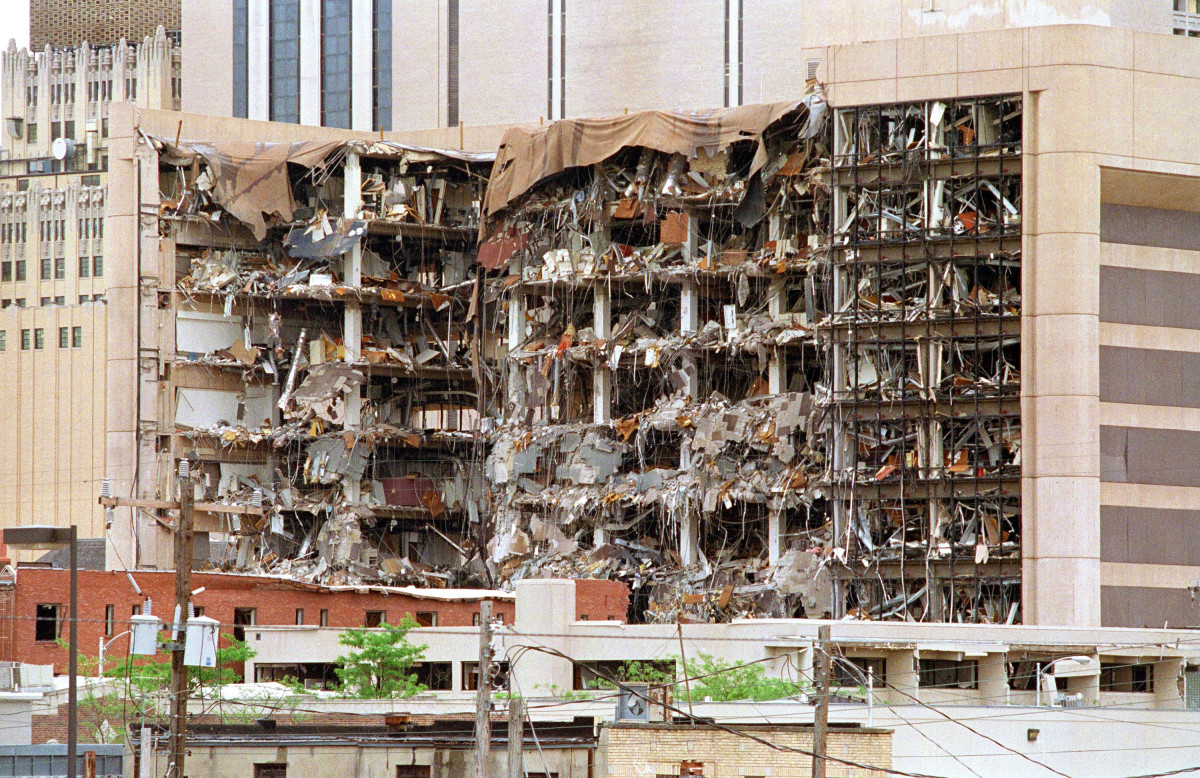
This is one sight I’ll never be able to forget, nor can I forget the people who died in the Oklahoma City blast on April 19, 1995.
Image found on History.com.
The Government Accountability Office defined violent extremism in an April 2017 report: “Violent extremism—generally defined as supporting or committing violent acts to achieve political, ideological, religious, or social goals—has been perpetrated and promoted by a broad range of groups in the United States for decades. Such groups include white supremacists, anti-government groups, and groups with extreme views on abortion, animal rights, the environment, and federal ownership of public lands; and radical Islamist entities, such as the Islamic State of Iraq and Syria (ISIS), among others.”
Violent extremism of any type is a danger we should not ignore. In that 2017 report based on data from the Extremist Crime Database at the University of Maryland, the GAO reported that of 85 fatal acts by domestic violent extremists from Sept. 12, 2001, to Dec. 31, 2016, 62 of them were by far-right extremists. However, the 23 attacks by radical Islamist extremists were more deadly, with 119 deaths to 106 from attacks by far-right extremists; 41 percent of the Islamist-attack deaths were from the Pulse shooting.
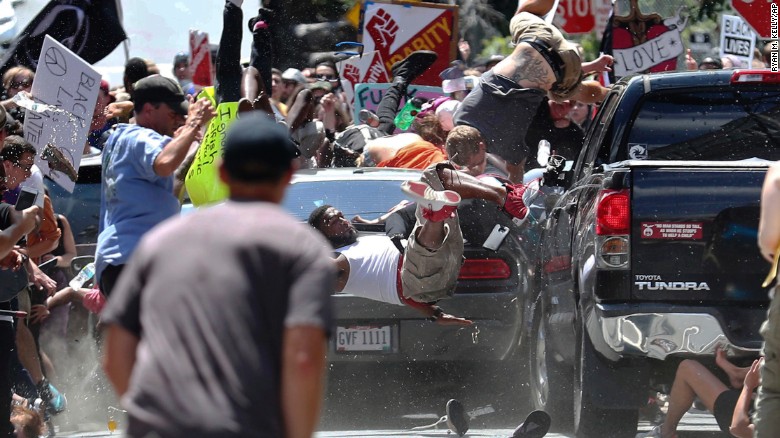
Counter-protesters fly into the air after being struck by a car in Charlottesville, Va., on Aug. 12, 2017.
Image by Ryan M. Kelly, Daily Progress.
The GAO report found no fatalities caused by far-left extremist attacks in that time period (property damage and simple assault, primarily from the relatively small militant Antifa movement, seem to be the biggest issues), but did not include the 2016 killings of eight police officers in Dallas and Baton Rouge; the gunmen in that case were reportedly sympathetic to Black Lives Matter. In February 2018, nearly a year after that report, an ex-Marine sympathetic to the far-left Black Nationalist movement shot and killed a Georgia police officer who was trying to arrest him at his home. Also last year, a Bernie Sanders supporter attacked GOP congressional members at baseball practice, critically wounding Rep. Steve Scalise; thankfully, no one died.
In a November Washington Post report on domestic terror attacks, Wesley Lowery, Kimberly Kindy and Andrew Ba Tran wrote:
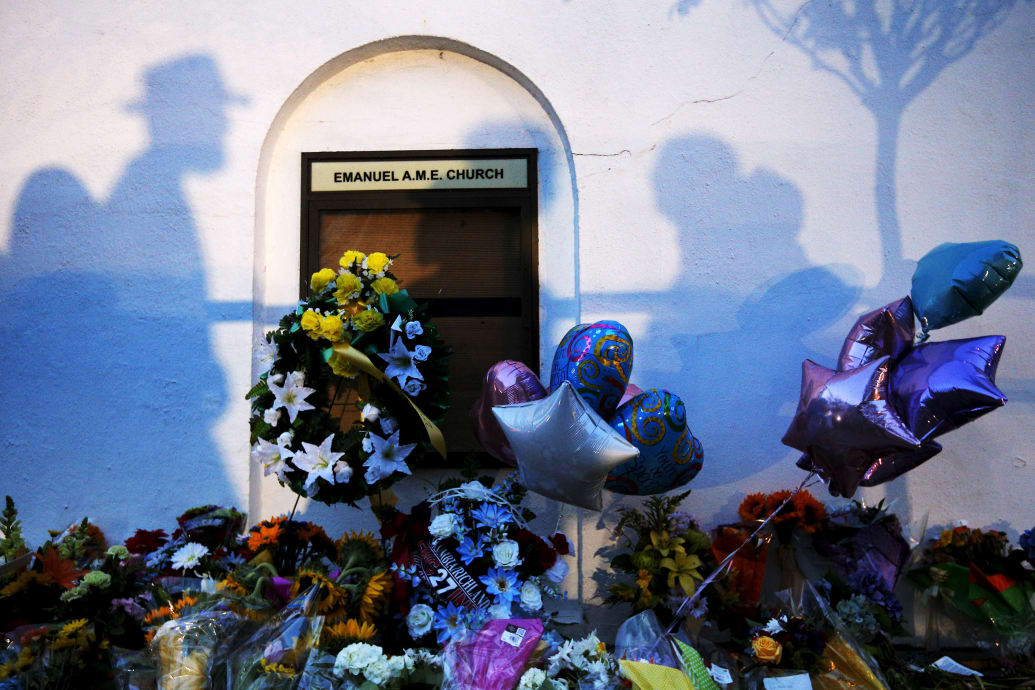
Mourners cast shadows at a makeshift memorial at Emanuel AME Church in Charleston, S.C., where nine members of the congregation were killed during Bible study June 17, 2015, by a white supremacist.
Image by Brian Snyder, Reuters, found on Daily Beast.
“Over the past decade, attackers motivated by right-wing political ideologies have committed dozens of shootings, bombings and other acts of violence, far more than any other category of domestic extremist, according to a Washington Post analysis of data on global terrorism. While the data show a decades-long drop-off in violence by left-wing groups, violence by white supremacists and other far-right attackers has been on the rise since Barack Obama’s presidency — and has surged since President Trump took office. …
“The uptick in right-wing terrorism comes amid a renewed national focus on hate-driven violence. The Anti-Defamation League documented a 57 percent surge in anti-Semitic incidents in 2017, especially at schools and on college campuses. Meanwhile, FBI statistics released this month show reported hate crimes jumped 17 percent last year.”
Shocking, right? And yet you’ll find many defending this.
So what kind of people tend to commit these crimes? The Post reported: “Stacey Hervey, a criminologist at the Metropolitan State University of Denver who has studied radicalization, said [U.S. domestic] attackers generally fit one of three archetypes: thrill-seekers, such as teenagers who paint swastikas on the sides of buildings; reactive attackers, who lash out suddenly at perceived enemies; and mission-oriented attackers, who aim to send a specific message or achieve a certain political goal.”

Investigators look for clues after the Weather Underground bombing of the Pentagon on May 19, 1972. The group is one of the most famous far-left extremist terror groups, but was only active in the 1960s and 1970s. The only deaths attributed to their bombs were three members in an accidental explosion while assembling a bomb in a Greenwich townhouse in 1970.
Image found on Wikimedia Commons.
We see the first two quite often, but it’s those mission-oriented attackers, like Breivik, that should really concern us. Extremists on both sides are becoming very open with their intentions, posting them on Internet forums and in videos. Some create their own compounds, such as Covenant, Sword and Arm of the Lord, Elohim City (which has been linked to Timothy McVeigh and the Kehoe brothers) and others.
What can we do? How about not giving them an audience, or not trying to excuse violence on either side with, “Well, they do it too”?
While we should not forget or gloss over the actions of radicals, we should remember that they are still a very small segment of the population; far more of us are moderate in our beliefs.
Not everybody on the right is a white supremacist/neo-Nazi, just as not everybody on the left is Antifa. Most of us are no more interested in starting a race war than we are in fulfilling Marx’s vision … but everybody would know that if they’d just start actually listening to one another. It’s not that hard, really, unless we make it that way.
I think I’ll go for some comedies this weekend. At least they won’t depress me. Maybe.
I would be remiss if I didn’t mention that it was four years ago last Friday that I had my stroke … an anniversary I actually forgot about till the next day. Maybe that’s a good thing.
But then we got the news that Luke Perry, who had a massive stroke last week, died Sunday. While I wasn’t a fan of 90210 or Riverdale, Perry always struck me as a good character actor if you could get past his lead-role looks. He was extremely creepy and convincing as the leader of a violent separatist cult (sounds familiar) on Criminal Minds.
I was lucky that my stroke was a fairly small embolic stroke (a type of ischemic stroke; I also had a couple of transient ischemic attacks [TIAs]) and that I recognized quickly enough that I needed medical attention, so got to the hospital within the time window for tPA to be effective. I have no idea if Perry’s stroke was ischemic (if you’re going to have one, this is the better one) or hemorrhagic (the bad one) or how long it was before he got medical attention. This is, though, a good time to remind you of BE FAST (thanks to UAMS) because anyone, of any age, can have a stroke:
BALANCE Is there a loss of balance?
EYES Is there a vision change in one or both eyes?
FACE Facial weakness, drooping or uneven smile
ARM Arm numbness or arm weakness
SPEECH Slurred speech, difficulty speaking or understanding
TIME Call 911 and get to the hospital immediately
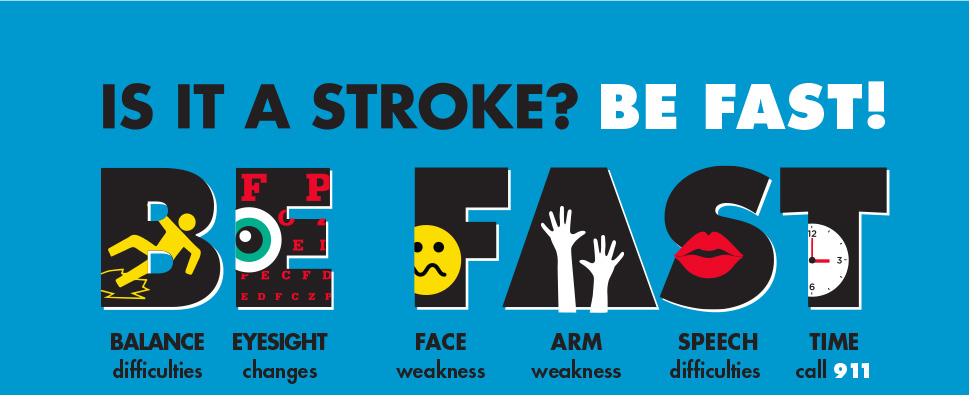
Remember to be aware of the warning signs of stroke … I need you guys to stay healthy!
Image found on Arkansas Saves.
 Serenity is a fuzzy belly