
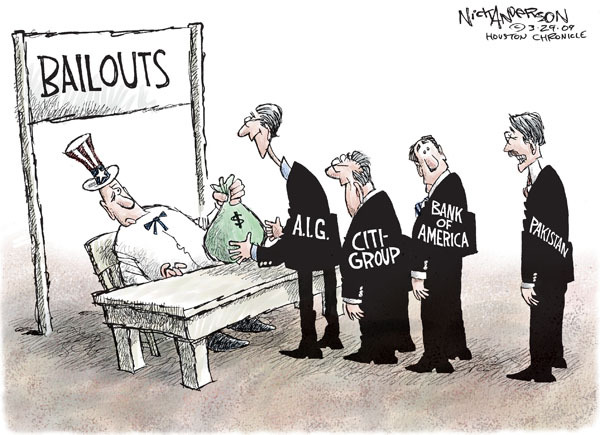
A previous Word of the Year, bailout … the last time we bailed out banks because of credit default swaps.
Editorial cartoon by Nick Anderson, Houston Chronicle.
Well, that was different.
Words of the Year, especially from Merriam-Webster, have the tendency to reflect what’s going on in the U.S., especially as regards politics, it seems (that stuff infects everything). The Word of the Year for 2008 in the height of the Great Recession, for example, was “bailout” (a reminder that that infamous bailout started under the Bush II administration); in 2006, when we were receiving mixed messages on the Iraq War and trust in government reached its lowest level (at that point), it was “truthiness.” Other past Words of the Year include “democracy,” “integrity,” “socialism” and “justice.” Try not reading something into those. (And check out the list of also-rans from this year then try to not see politics: quid pro quo, impeach and exculpate, among others.)
This year, while there is a political element to Merriam-Webster’s Word of the Year—“they”—it’s also recognition that language evolves, which won’t sit well with grammar grouches.
The dictionary said lookups for they increased 313 percent over the previous year. It notes on its blog that “although our lookups are often driven by events in the news, the dictionary is also a primary resource for information about language itself, and the shifting use of they has been the subject of increasing study and commentary in recent years.”
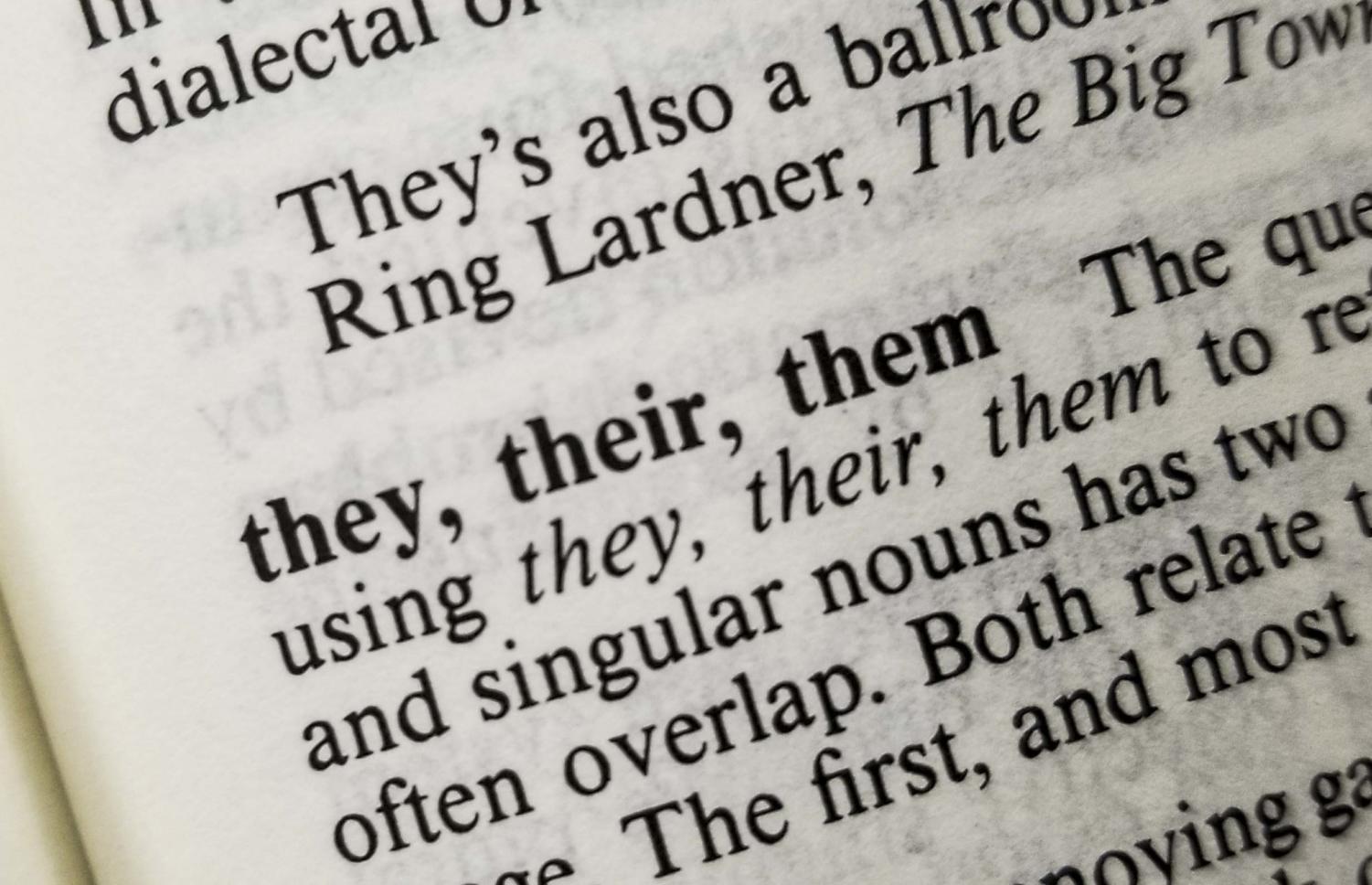
No matter the context, someone’s gonna get ticked.
Image found on The Pitt News.
Part of the renewed interest in they comes from its use as a pronoun for people who identify as nonbinary—“relating to or being a person who identifies with or expresses a gender identity that is neither entirely male nor entirely female,” according to Merriam-Webster—but it’s also because “English famously lacks a gender-neutral singular pronoun to correspond neatly with singular pronouns like everyone or someone, and as a consequence they has been used for this purpose for over 600 years.”
I have at least one friend (Hey, Cousin Earl!) who is a huge fan of the singular they, and commented on one of my columns a few years back, “Maybe there’s even hope for the ‘singular they.’ ‘Whenever a student told me they wanted a really good grade, I’d tell them they’d have to do the extra-credit assignments.’ ’Twould let our writin’ catch up with our speakin’.”
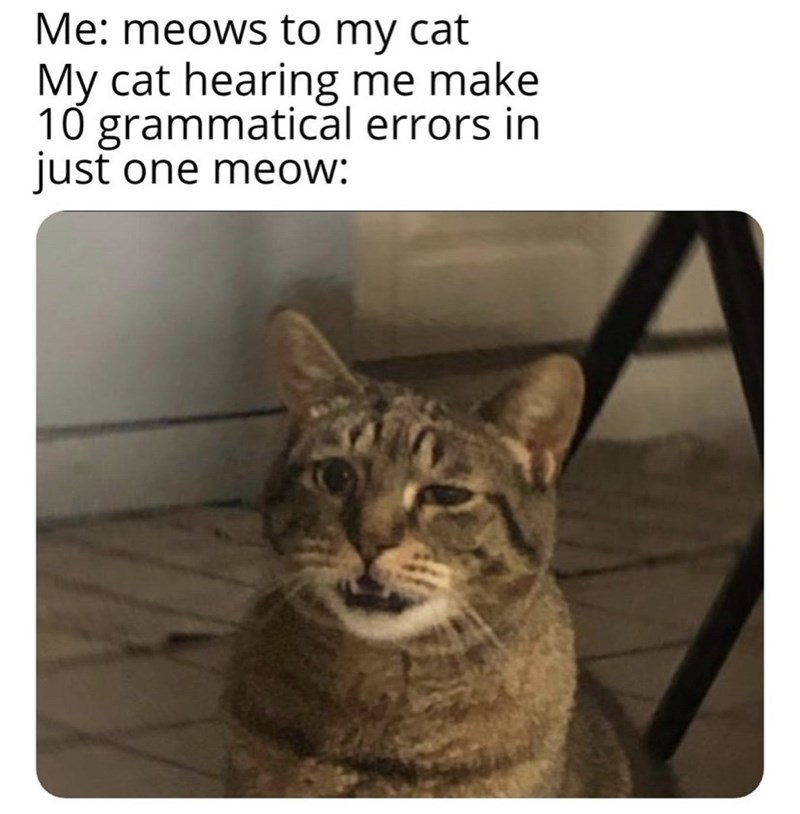
This looks like so many grammar grouches I’ve known. Reform, y’all!
Image found on Twitter.
The Associated Press Stylebook did just that in 2017 when it added they as a singular gender-neutral pronoun. Lead editor for the stylebook Paula Froke told The Washington Post, “[W]e offer new advice for two reasons: recognition that the spoken language uses they as singular, and we also recognize the need for a pronoun for people who don’t identify as a he or a she.” She also emphasized that writers may “write around” it to avoid awkward construction. (I similarly advise writing around words like who/whom when you might not be sure of the correct grammatical use.)
The Post, by the way, has used the singular they since 2015.
The Arkansas Democrat-Gazette follows the AP guidance on they, copy desk chief Sandra Tyler told me last week, but said, “It will take some getting used to.” As a former copy desk resident and recovering sometime grammar grouch, I concur. But I know it’s been used as a singular pronoun since at least 1375, according to the Oxford English Dictionary, not falling out of favor till the 18th century. It’s only recently that there’s really been any controversy over the singular they … except among grammar grouches.
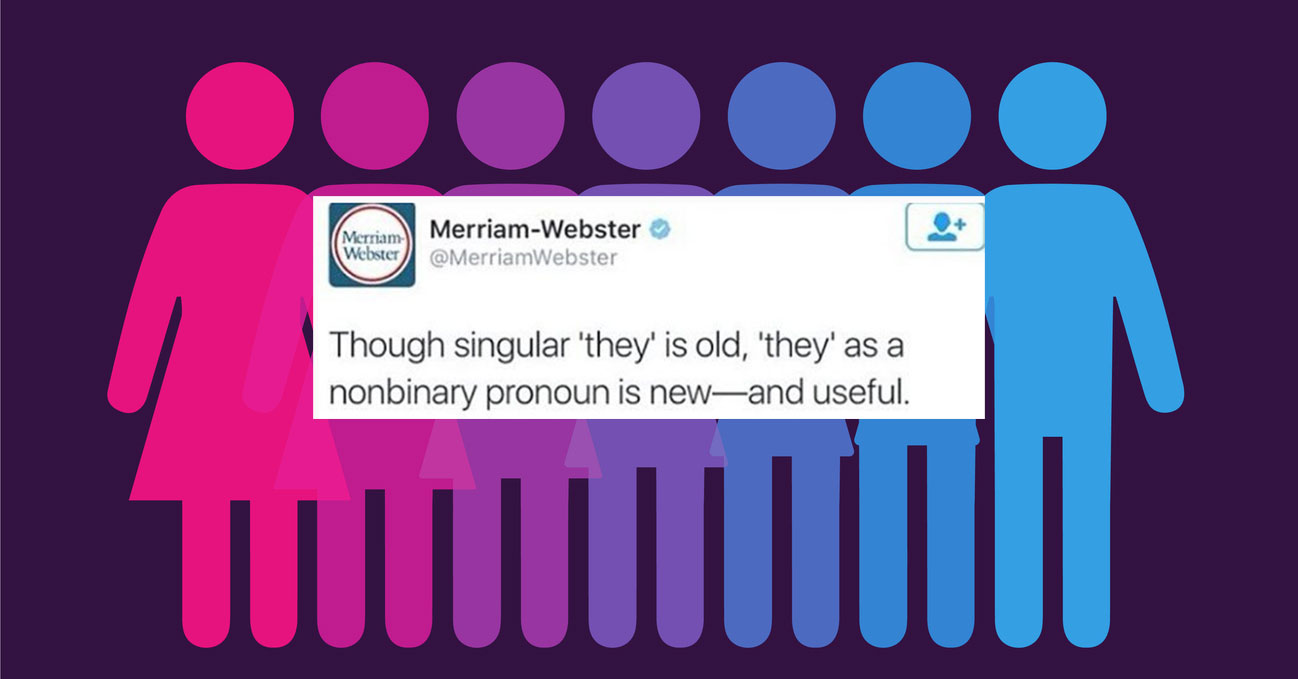
But … but … but … it hurts my feelings!
Image found on Did You Know?
Merriam-Webster wrote, “Congresswoman Pramila Jayapal … revealed in April during a House Judiciary Committee hearing on the Equality Act that her child is gender-nonconforming and uses they. Singer Sam Smith announced in September that they now use they and them as pronouns. And the American Psychological Association’s blog officially recommended that singular they be preferred in professional writing over ‘he or she’ when the reference is to a person whose gender is unknown or to a person who prefers they.”
The AP Stylebook does note that clarity is the top priority in usage of they, since many people are still unfamiliar or uncomfortable with it being used to denote a nonbinary person, and advises explaining in the text of stories that the person prefers that pronoun. And as in most things, moderation is best with they, and it’s better used in more relaxed writing (no resumes or academic papers, people!).
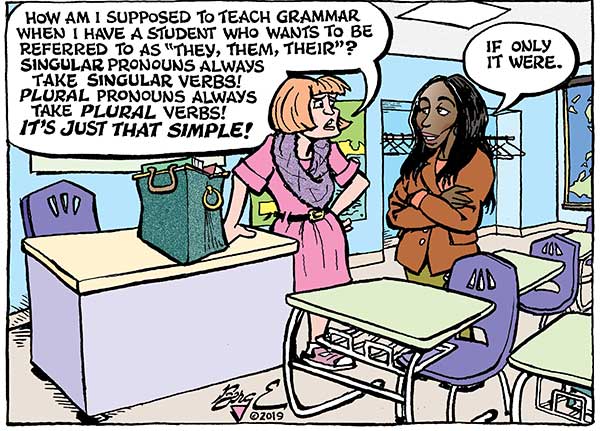
It’ll still take a plural verb, sooo …
Editorial cartoon by Paul Berge, Q Syndicate.
But what about the people who say it’s too hard to use the singular they? In most cases, they probably already have been doing so in everyday conversation without realizing it (since most of us don’t worry so much about our grammar when speaking to friends).
Predictably, there were those who got riled up over Merriam-Webster’s choice, but as activist Miranda Boyd wrote on Twitter: “Imagine being mad at a dictionary because you never bothered to look up how people have been using a word for literally centuries. That’s like half the people in here.”
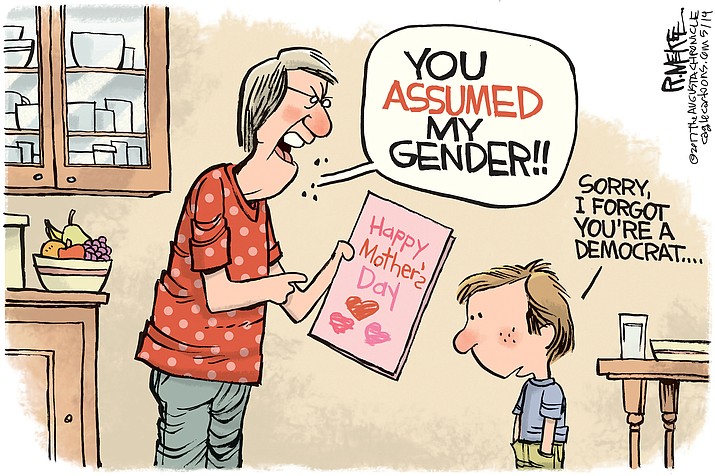
Yeah, because there are no reactionaries in the GOP. Try whispering “they” in their ears.
Editorial cartoon by Rick McKee, Augusta Chronicle.
Some people may feel like author Jen Doll, who, while not degrading its usage for nonbinary people, wrote in The Atlantic in 2013:
“I see absolutely no reason other than laziness to start subbing our hes and shes with a clunky they, or our hises and hers with theirs. There is a reason we have distinct pronouns, and that is so we can be specific. If we don’t know the specifics, we should try to find them out, or use one of those handy words — he or she or one, for instance — that get around the they problem. …
“Every time I see a singular they, my inner grammatical spirit aches. I have no issue with their used in its proper place, as a plural pronoun. That’s completely fine, even necessary, and the usage is quite valuable. But why must we accept their as a singular? I say no. … The easy fix is not necessarily the best one, and they is not the solution to our pronoun ills. The singular they is ear-hurting, eye-burning, soul-ravaging, mind-numbing syntactic folly. Stop the singular they. Stop it now.”
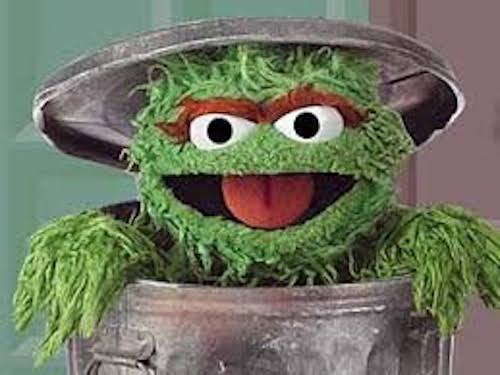
Oscar is less grouchy than a lot of grammar grouches.
Image found on Muddling Through Middle Age.
Sorry, Jen. I think with this Word of the Year designation, that ship has sailed. But I’m sure there’s a support group out there somewhere for you … maybe Grammar Grouches Anonymous.
As for the people offended by the idea of preferred pronouns, Benjamin Dreyer, vice president, executive managing editor and copy chief at Random House, offered his thoughts in The Washington Post, leading him to the conclusion: “Language is here to serve those of us, all of us, who use it, and when one’s perhaps unconsidered thoughts as to what is correct run smack into the honor we owe another person, one can only hope that it’s honor that wins out.”
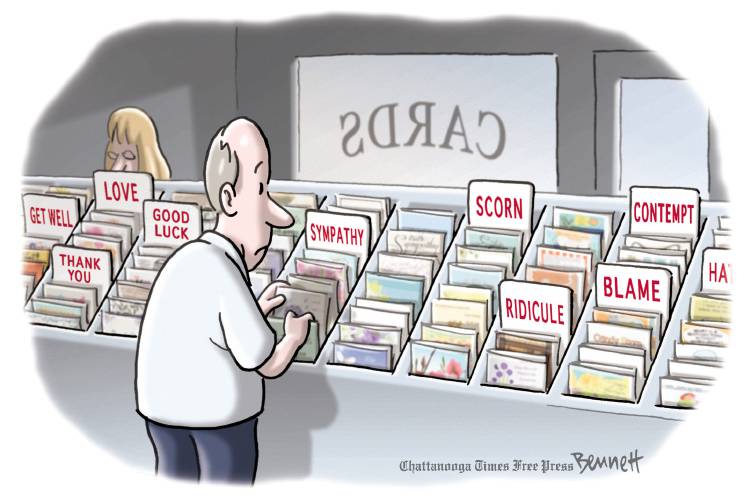
But if not honor, at least get them a card. Just not these.
Editorial cartoon by Clay Bennett, Chattanooga Times Free Press.
 Serenity is a fuzzy belly
Thank you, thank you very much. You say the ship (U.S.S. They) has sailed, but I feel it’s my ship coming in.
When I wrote my first textbook in 1973, I used the third-person masculine convention without giving it a thought. A researcher was a “he.” But when I began the chapter that discussed coders and key-punchers, I hit a wall. All the ones I knew were women. This resulted in a long footnote explaining the dilemma and making clear that some fine researchers were, in fact, of the female persuasion.
Over the years, I sought and found ways around the dilemma. Writing in first and second person not only skirted the problem, but students wrote that they felt as though I was speaking directly to them. If a third person was needed in a discussion, Pat, Jan, and their androgynous mates served nicely.
One edition, I had to rid the book of “s/he” which an editor thought was a cool solution. I refused to publish anything I couldn’t pronounce.
Finally, I offer that if a President violates the Constitution, they should be impeached.
LikeLike
Your ship has indeed come in. And I think whoever came up on with the s/he thing deserves to be flogged with a wet noodle. It’s horrid. 🤢
And yes, that president does, especially if he’s being a big baby about it. 😏
LikeLike
How many times should they be flogged with that wet noodle? Thirty-nine-and-a-half times?
LikeLike
You know the answer is 42. 😉
LikeLike
“42”? Like in The Hitchhiker’s Guide To The Galaxy?
LikeLike
Yaysh. You found the question, huzzah! 😏
LikeLike
The Hitchhiker’s Guide To The Galaxy has been one of my favorite books ever since I first heard the original BBC radio version of it in November 1981 at a science fiction convention.
LikeLike
I didn’t read it, but I’m a fan of the adaptations I’ve seen. I have a soft spot for the last one because of Alan Rickman. 🤖
LikeLike
I recommend that you read all five books of the trilogy of The Hitchhiker’s Guide To The Galaxy. Yes the late Douglas Adams, who wrote the original radio version and all of the books, referred to it as a “trilogy of five books”.
LikeLike