

A lie doesn’t become true if you tell it repeatedly, you know. Doesn’t stop him from trying, though.
Editorial cartoon by Rob Rogers, Andrews McNeel Syndication.
My first thought when I saw the phrase that was the most nominated for banishment by Lake Superior State University in Michigan was: “Gee, White House staff members must have spent hundreds of hours sending in those nominations.” Really, who else would most like for the phrase “quid pro quo” to disappear forever? Mick Mulvaney alone probably spent at least a day …
The committee in the university’s English Department said of the nominations to its 45th List of Words Banished from the Queen’s English for Misuse, Overuse and General Uselessness: “This phrase received the most nominations this year, with a noticeable spike in November (gee, we wonder why …). The popularity of this phrase has the committee wondering what it should offer in exchange for next year’s nominations.”
If it’s chocolate and kitty belly rubs, I’m in. I’ll warn you chaps, though, that I’ll keep nominating its’ until it fades into obscurity, which is where it should have remained since it’s not a word. Now even people I like (who know better) are starting to use it!!!
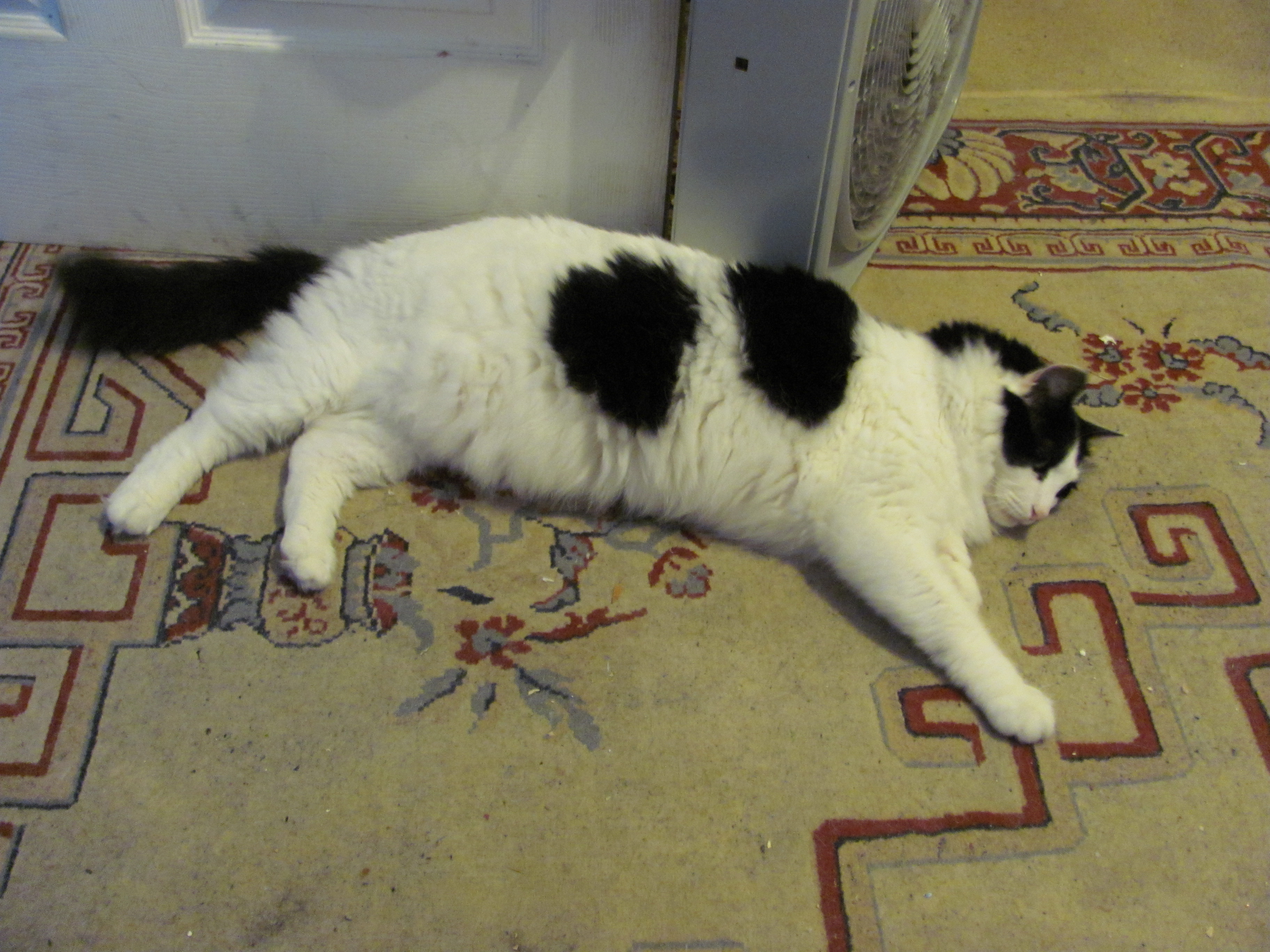
I miss rubbing this floofy belly.
Quid pro quo was a runner-up to Merriam-Webster’s Word of the Year, “they,” as one of the 10 most looked-up words and phrases of 2019. According to its Words at Play blog, “The investigation into President Trump’s phone conversation with Ukrainian President Volodymyr Zelensky became something of a vocabulary lesson for many Americans, and the term quid pro quo was heard countless times from newscasters, pundits, politicians, and the president himself. …
“The current use dates to the late 16th century. In its initial use, a now-obsolete sense from the beginning of that century, quid pro quo referred to something obtained from an apothecary when one medicine was substituted for another. Such substitutions could be either accidental or fraudulent. Soon after its apothecary sense the word took on a more general meaning of substitution. Today, the term is most often encountered in legal contexts.”
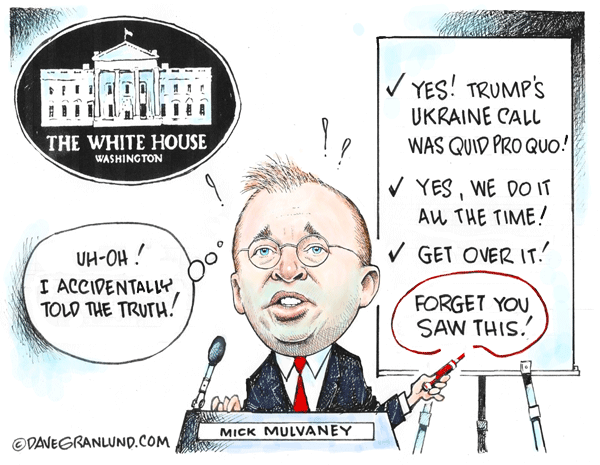
I’d feel sorry for him, but he knew what he was getting into.
Editorial cartoon by Dave Granlund.
Or at minimum, on Twitter. A lot. Lord, so much.
The LSSU committee wrote that recent trends have had social- media words such as “app” and “selfie” showing up on the list for quite a while, but, “Since 2016, a noticeable trend of exhaustion with words rooted in politics and media coverage has emerged: ‘post-truth,’ ‘echo chamber,’ ‘fake news,’ and ‘collusion’ appear on the 2017-2019 lists. This latter trend persists in the 2020 list with the most-nominated word: quid pro quo.”
I can only imagine what lies ahead for the 46th list.
One of the most welcome additions to this year’s Lake Superior State list was one that most would think had already been on the list years earlier: literally. “Surprisingly,” the committee wrote, “this word hasn’t already been banished, but here it is, one of the few words in English that has begun to serve as its own antonym. Many of the nominators cite this word’s use for figurative expressions or emphasis, which is literally annoying.”
As much as I loved Parks and Recreation (all right, still love … a lot of it because of Ron Swanson), a part of me died inside every time Chris Traeger said “literally” (for those unfamiliar with the show, it was a running gag), and I always hear the word in his voice with the extra stress on the “t.” Though it should have literally been on the list years ago, at least it finally is.
Literally was just one of the words chucked because of pretensiousness or imprecision. Others included “I mean,” “living my best life,” and “mouthfeel.” I agree completely as all those give me nausea. Sure, I have a stomach bug as I’m writing this, but still … Yes, I’m guilty of using “I mean” a bit too much, but c’mon … I mean, really.
Other words were banished because they “attempt to make something more than it is.”
Gosh, can’t imagine why someone would want to rid us of “artisanal,” which one nominator called an obfuscation that describes an “actual person doing something personal for another unknown person.” Likewise, “curated,” which apparently is what my Etsy recommendations are (because they’re obviously just like a museum), and “influencer,” which I will never be … because I have better things to do with my life. Reading, watching Netflix, clipping my nails … my life’s a whirlwind sometimes.
And that’s just the weeknights!
I suspect that many of my fellow Gen-Xers as well as a lot of baby boomers were responsible for many of the nominations on the latest list, as so many are stereotypically uttered by millennials (dang whippersnappers).
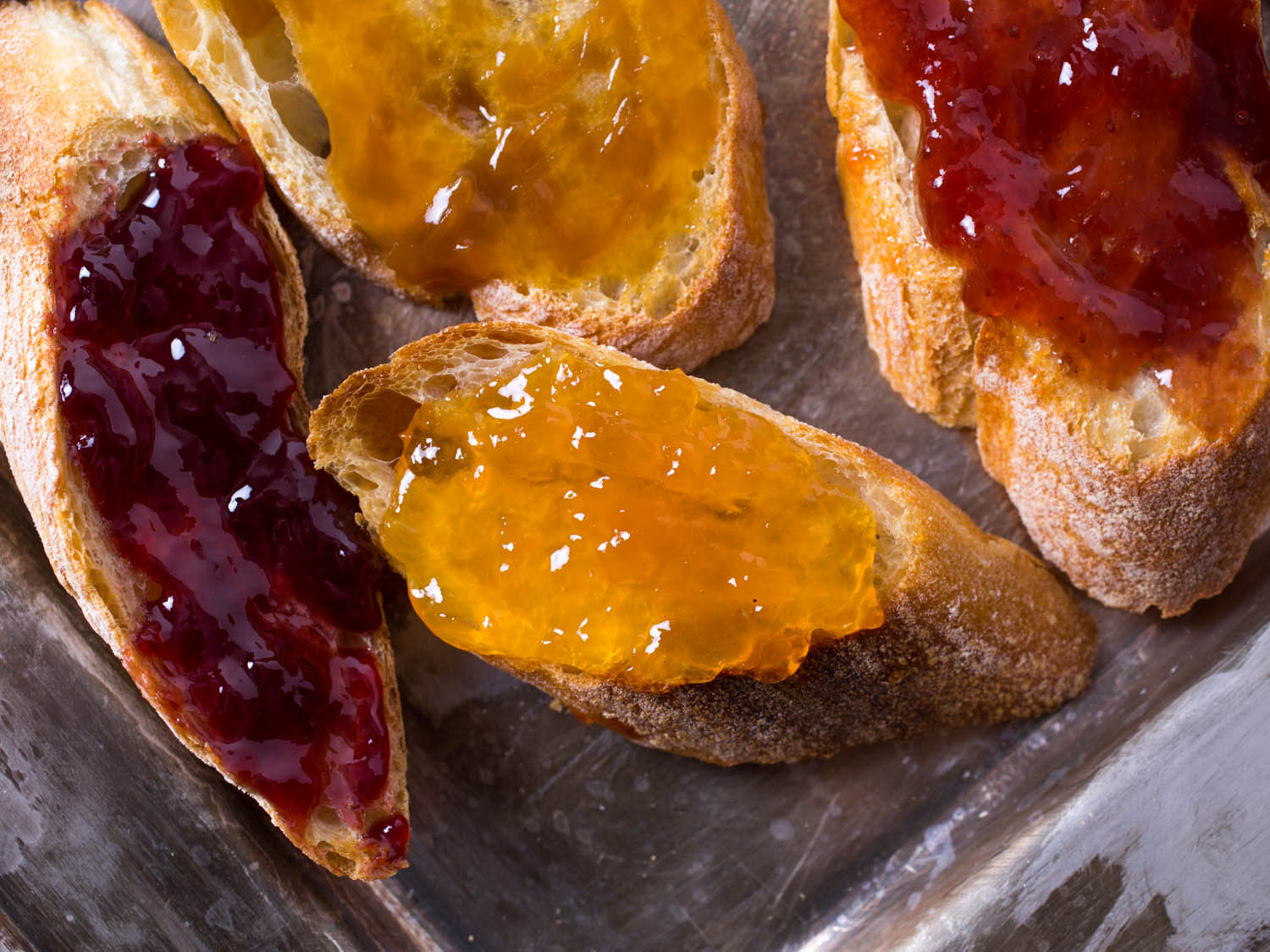
I like some texture and real bits of fruit, so I prefer jams and preserves over traditional jelly. Yummy!
Image found on Serious Eats.
“Chirp,” which in American slang means insult, was one I hadn’t heard of before. In U.K. slang it means to chat up or court someone, and that’s more my speed, but c’mon.
“Jelly,” short for jealous, is one I find especially grating, and as the nominator suggested, better left for toast. I’m especially fond of Dutch apple, pineapple or black currant preserves for my toast. Ooh … or pecan apple butter. “Vibe/vibe check” also made the list; the original use from the 1960s was annoying enough. “Totes” also made the list, but I’m sorry, James Earl Jones made that word OK for me in that 2013 Sprint commercial (I found a compilation of all the ads [below], and it’s worth a watch).
James Earl Jones really totes magotes. But can you blame me?
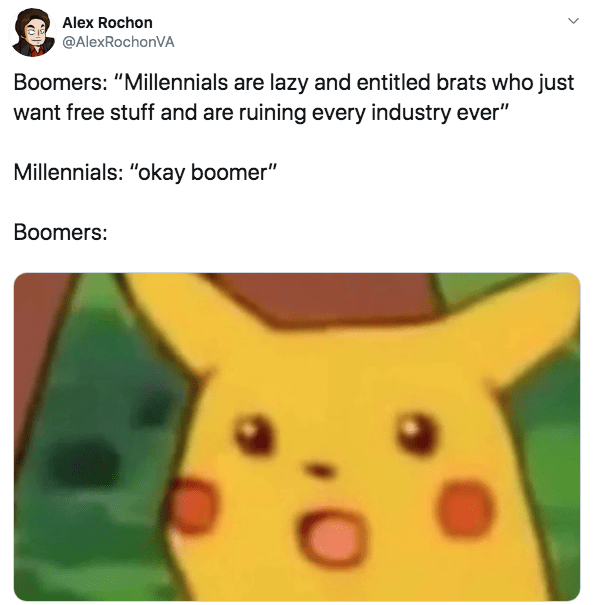
Such snowflakes!
Image found on cheezburger.
The last one should come as no surprise to anyone annoyed this past year by “OK boomer.” “Boomers may remember, however,” wrote the committee, “that generational tension is always present. In fact, it was the boomers who gave us the declaration: ‘Don’t trust anyone over 30!’”
Well, apparently boomers don’t much trust people under 30 nowadays.
Not that I blame them. Those guys look a little shifty to me. Although boomers are largely responsible for Mr. No Quid Pro Quo being where he is, so …
I just want to wish a very happy birthday to a wonderfully witty and wise man I consider a part of my family, which is why I call him Cousin Earl.
Earl Babbie, Ph.D., is a star in the sociology and behavioral research field, and wrote the textbook from my intro to sociology course in college as well as many others (and is still writing, thankfully, as he cracks me the hell up on a fairly regular basis). I hope he’ll be around for a good while yet; I always need a good laugh.
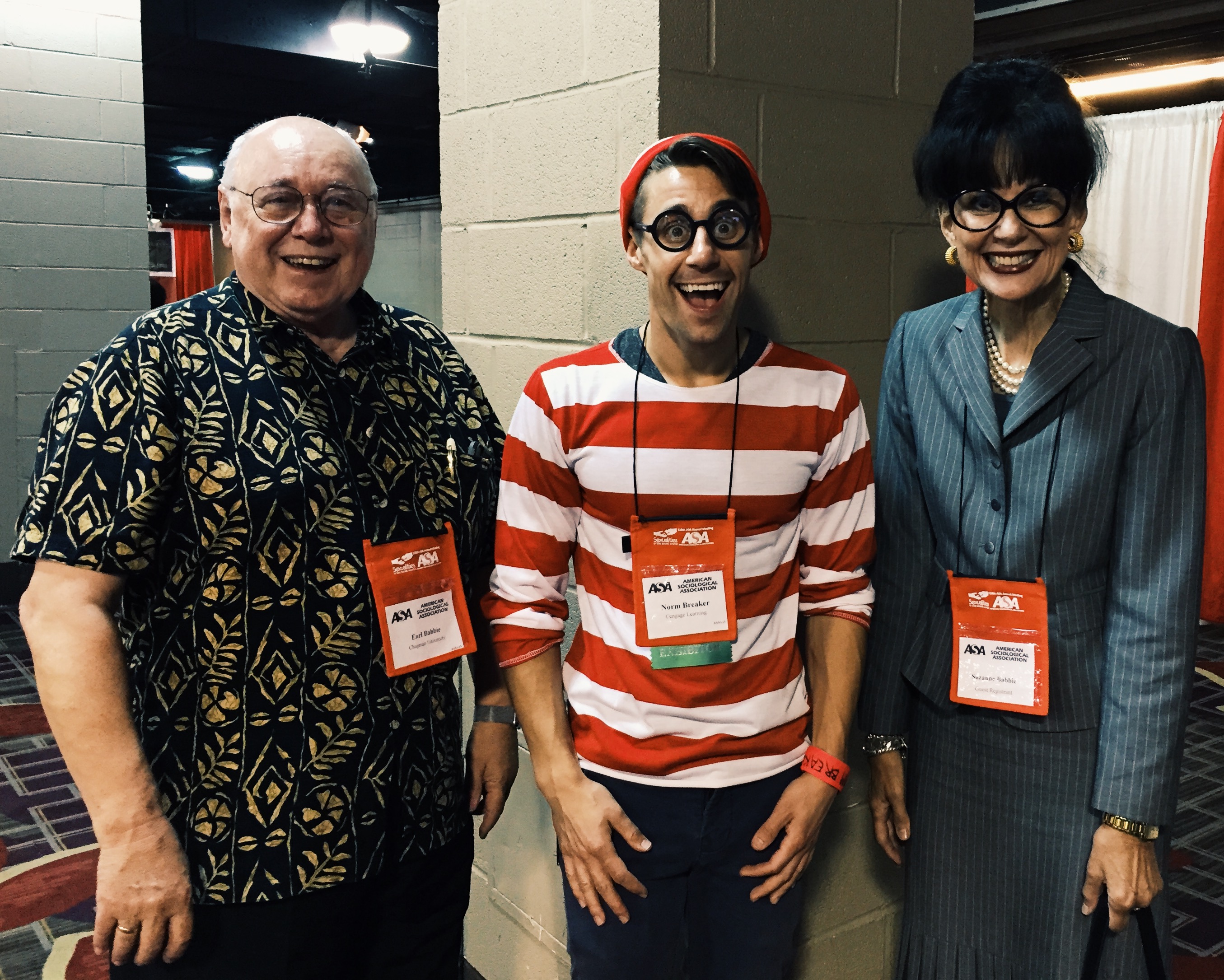
Earl and Suze found Waldo. Good thing; that guy’s a menace to fashion sense. Waldo, not Earl.
Image found on Cengage.
 Serenity is a fuzzy belly
Yikes! What a surprise ending. Since I share this birthday with Elvis, I must say: “Thank you. Thanks you very much.”
(We also share it with Kim Jong-Un, but let’s not go there.)
The discussion of words reminds me of a bumper sticker from the past:
” Eschew obfuscation.”
LikeLike
🤗
I share mine with Julia Louis-Dreyfus. Much better company, and less likely to set off missiles. 😉
LikeLike
And just 5 days from now. Happy Early Birthday, Cuz.
LikeLike
Aw, shucks. Thanks, Earl! 🥳🎂
LikeLike