
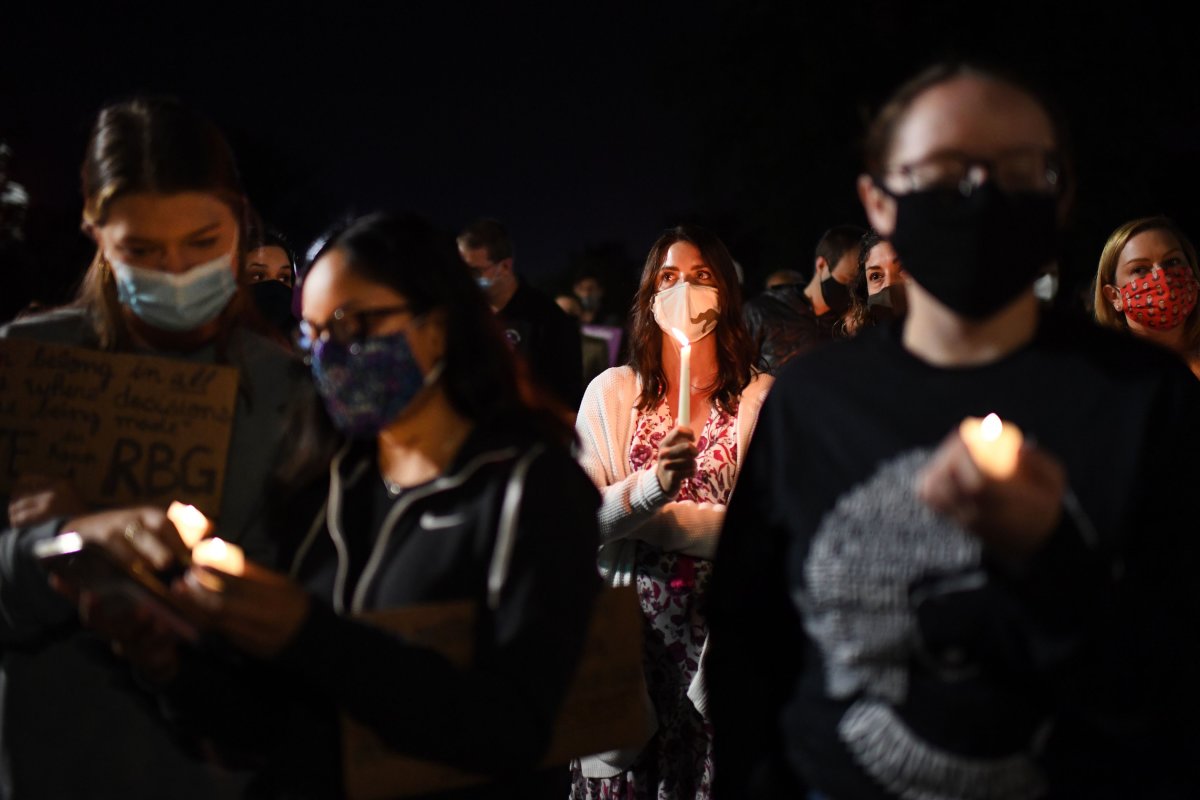
Thousands have gathered since Friday for vigils and to leave flowers and other items outside the U.S. Supreme Court in memory of Ruth Bader Ginsburg.
Image found on U.S. News and World Report.
A little over four and a half years ago, I wrote:
“For someone who abhors rabid partisanship, an election year—especially a presidential election year—is already nightmarish. Add in the death of Supreme Court Justice Antonin Scalia and you understand why right now I’d much rather just shut everything off and cuddle with the furry one.
“What’s most troubling in this hyperpartisan atmosphere is the lack of respect and decorum. A man just died—yes, an often-controversial jurist I seldom agreed with (and that I’m sure I’ve called bat-crap crazy a few times), but he was still a man who mattered in the lives of those who loved him; the least he’s due is a temporary cessation of the partisan carping that’s come to mark American political life.
“Reading online comments on stories about Scalia’s death has been troubling, especially when those who call for some respect in death to be given to someone they might not have agreed with in life are so often shouted down by those who prefer petty rancor. But hey, sure, let’s throw a few more epithets at each other.”
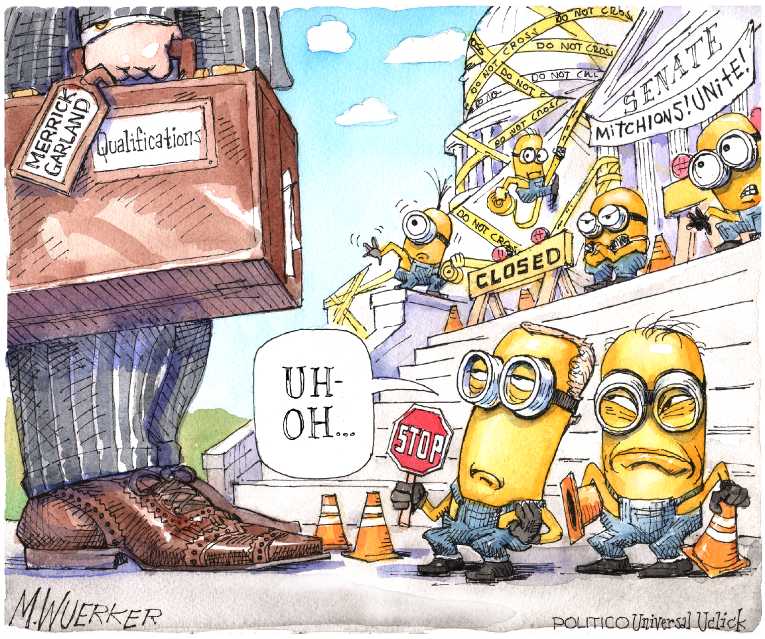
Merrick Garland was eminently qualified and a moderate. But politics are more important to some.
Editorial cartoon by Matt Wuerker, Politico.
That time we were “treated” to a refusal to give the nominee to fill Scalia’s seat, Merrick Garland, even the courtesy of a meeting because it was eight months till Election Day. This time, there’s a move to fill Ruth Bader Ginsburg’s seat almost immediately despite it being only about six weeks to the election and a lot less time than usual to properly vet any nominee.
And I don’t have the furry one anymore to cuddle up with to feel better.
Is it any wonder people are upset? This “rules for thee but not for me” attitude is one of the uglier things about hyperpartisanship in our national politics. Worse, it’s overshadowing the legacy of someone who, like her dear friend Scalia, was a master of dissent and a brilliant jurist.
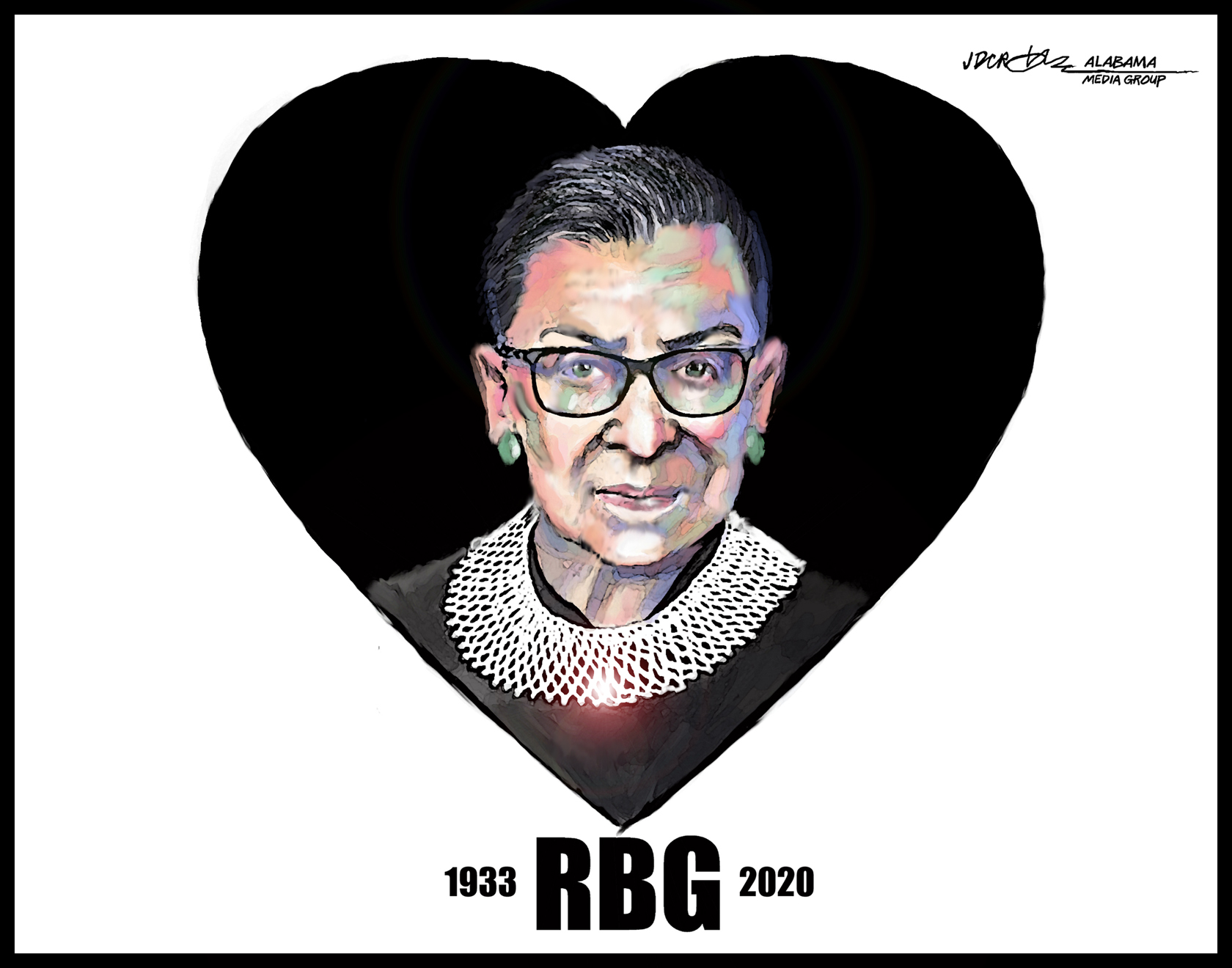
In his blog about this cartoon, artist J.D. Crowe said, “Ruth Bader Ginsburg was a living definition of ‘bad ass.’” She definitely was.
Editorial cartoon by J.D. Crowe, Alabama Media Group.
Ginsburg (she of the stylish neckwear) was nominated to the Supreme Court by Bill Clinton on June 22, 1993, after having spent 13 years on the D.C. Circuit bench (appointed to that seat by Jimmy Carter) and being recommended by both Attorney General Janet Reno and Utah Republican Sen. Orrin Hatch.
Ginsburg was a trailblazer for gender equality before she ever ascended to the federal bench. Jennifer Schuessler wrote Monday in The New York Times:
“Justice Ginsburg’s towering reputation as a legal thinker rests on work she pioneered in the 1970s, through the American Civil Liberties Union’s Women’s Rights Project, which she co-founded. In a string of landmark cases, she successfully challenged the Supreme Court’s view that the equal protection clause of the 14th Amendment guarded only against racial discrimination, but permitted sex discrimination (which was often justified as being for women’s own good).”
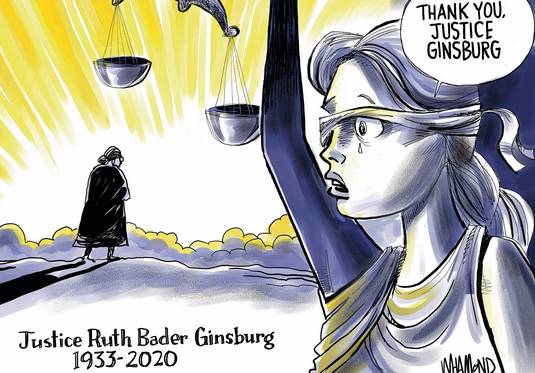
RBG was a legend. She earned her rest.
Editorial cartoon by Dave Whamond.
Jacob Gershman of The Wall Street Journal wrote that one case in particular proved an enduring template for her work even though it was never heard by the Supreme Court. In a 1972 brief for Struck v. Secretary of Defense, which involved a pregnant Air Force captain deemed unfit for service, Ginsburg wrote:
“Laws which disable women from full participation in the political, business and economic arenas are often characterized as ‘protective’ and beneficial. Those same laws applied to racial or ethnic minorities would readily be recognized as invidious and impermissible. The pedestal upon which women have been placed has all too often, upon closer inspection, been revealed as a cage.”
Years later in the 1996 Virginia Military Institute case, Ginsburg would write for the majority (Scalia wrote the only dissent) that inherent differences between men and women “remain cause for celebration, but not for denigration of the members of either sex or for artificial constraints on an individual’s opportunity.”
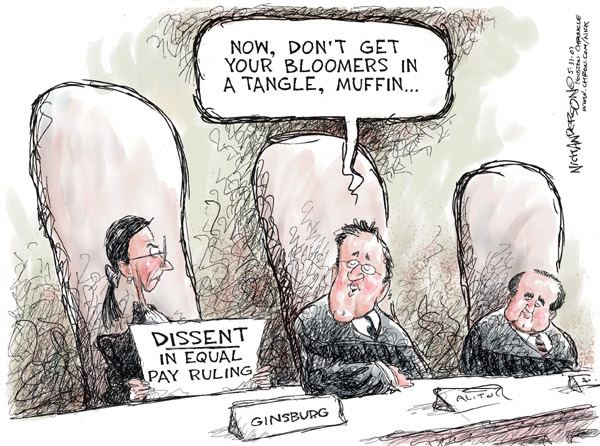
Some people like to pretend this sort of thing doesn’t happen to professional women. Those people are blind.
Editorial cartoon by Nick Anderson.
Much of the fandom surrounding RBG came not from her victories but from her defeats and the fiery dissents she delivered, Schuessler noted.
“In 2013, Justice Ginsburg issued a blistering dissent in Shelby County v. Holder, denouncing the court’s invalidation of central portions of the Voting Rights Act of 1965 on the grounds that they were no longer necessary “like throwing away your umbrella in a rainstorm because you are not getting wet’. …
“In her dissents, [Fatima Goss Graves, the president and chief executive of the National Women’s Law Center] said, Justice Ginsburg repeatedly chided the Court for failing to understand how discrimination worked in the real world. She noted what turned out to be Justice Ginsburg’s last dissent, issued in July, in a contraceptive case, which argued that the court’s ruling would leave many poor women unable to afford birth control.
“’She was deeply unafraid to name the many problems with the decisions coming out of the majority, and to do it in a way that put the lives of regular people forward,’ Ms. Goss Graves said.”
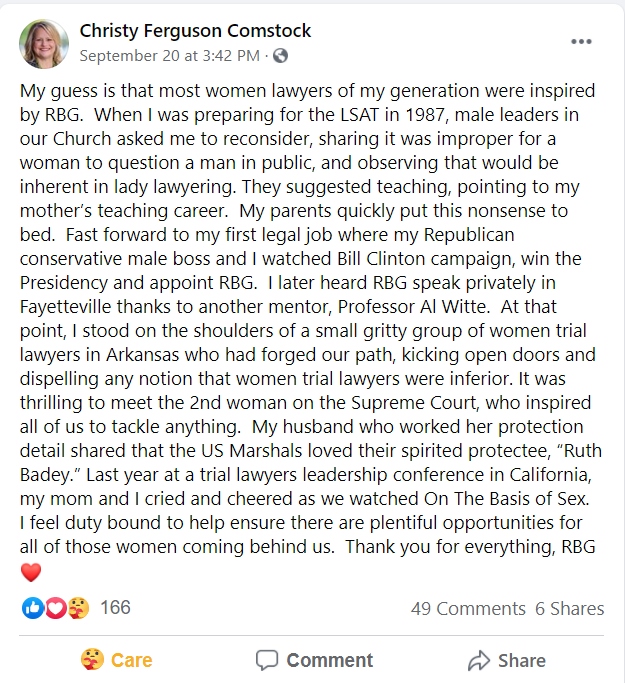
I think Christy was two years ahead of me and her sister was a year behind me; Mrs. Ferguson was my sixth-grade teacher. I spent a lot of time at the Ferguson house.
Image from Facebook.
Fayetteville attorney and friend from back home Christy Ferguson Comstock posted on her Facebook account over the weekend what a lot of people were probably thinking:
“My guess is that most women lawyers of my generation were inspired by RBG. When I was preparing for the LSAT in 1987, male leaders in our church asked me to reconsider, sharing it was improper for a woman to question a man in public, and observing that would be inherent in lady lawyering. They suggested teaching, pointing to my mother’s teaching career. My parents quickly put this nonsense to bed.
“Fast forward to my first legal job where my Republican conservative male boss and I watched Bill Clinton campaign, win the presidency and appoint RBG. I later heard RBG speak privately in Fayetteville thanks to another mentor, Professor Al Witte. At that point, I stood on the shoulders of a small gritty group of women trial lawyers in Arkansas who had forged our path, kicking open doors and dispelling any notion that women trial lawyers were inferior. It was thrilling to meet the second woman on the Supreme Court, who inspired all of us to tackle anything. My husband who worked her protection detail shared that the U.S. Marshals loved their spirited protectee, ‘Ruth Badey.’ … I feel duty-bound to help ensure there are plentiful opportunities for all of those women coming behind us. Thank you for everything, RBG.”

If RBG weren’t the only woman in this picture, I would have to point out where she is. I don’t, and that’s wrong.
Image found on Pinterest.
Christy’s experience was much different than that of Ginsburg, who was one of only nine women admitted to her Harvard Law School class of over 500 students. “In the days when I went to law school … [t]here was no anti-discrimination law, so employers were totally upfront in saying, ‘We don’t want any lady lawyers here,’ or, ‘We once hired a woman. She was dreadful.’ And how many men have you hired that didn’t live up to your expectations for them?”
RBG’s legacy was the fight for equality for all, and is encapsulated, I think, in something she said at a 2017 talk at Stanford University: “To make life a little better for people less fortunate than you, that’s what I think a meaningful life is. One lives not just for oneself but for one’s community.”
If only more people thought that way, especially in Congress.

Her legacy will live on if we’re wise enough to carry it out.
Editorial cartoon by Rob Rogers.
Near the end of that Stanford lecture, RBG mused:
“I wish there was a way I could wave a magic wand and put it back when people were respectful of each other and the Congress was working for the good of the country and not just along party lines. Someday, there’ll be great people, great elected representatives who will say, ‘Enough of this nonsense. Let’s be the kind of legislature the United States should have.’ I hope that day will come while I’m still alive.”
Unfortunately, that hasn’t happened.
I ended that 2016 column on Scalia, after citing the trials Barack Obama would have to endure to get his nominee a fair hearing in a Senate riven by hyperpartisanship and seemingly without shame, with this: “Sadly, I think the Senate may be beyond the capacity for embarrassment.”
It still is. God help us all.
 Serenity is a fuzzy belly