

Rather than expanding on the excellent editorial printed by my colleagues Tuesday on the subject of a letter printed on the Voices page last Friday (that would be the “carpet-bomb” letter), I’m going into word-nerd mode on a letter appearing on Voices today.
Because of course. Politics have encroached into Every. Single. Area. of our lives. And in the fight over the definition of “insurrection,” we’ve headed there again.
Dang it. Just give me one day without politics messing up a delightful pastime. The days my word-nerdy social media feeds are infected with politics are days that are better spent playing Words With Friends or putting together a jigsaw puzzle. Even Threads, which is usually fully of nerdy, beautiful things and critters, sometimes gets too big a bite of politics to digest well. So here we are, trying to decide if my one-day-a-week social-media sabbatical needs to be extended.

I won’t touch the writer’s complaint about the legal system being used against Donald Trump (that’s a whole other barrel of monkeys). The word nerd in me (and likely several of you) takes issue with today’s letter-writer’s definition of “insurrection”: “A true insurrection is perpetuated by a very large number of armed citizens in revolt against a government, using violence, with the purpose of a complete overthrow of authority. Think of the American ‘insurrection’ against Great Britain, or the poor of France overthrowing the ruling monarchy in France. It is not a protest with a few who get out of hand.”
What you’ll find when you look for a definition of insurrection usually falls along the same lines as Merriam-Webster’s definition: “an act or instance of revolting against civil authority or an established government.” The dictionary goes further in a section about choosing the right synonym for the word (nuance is important, ya know; and those ellipses are for the dictionary’s examples, not actual definition content).
“Rebellion, revolution, uprising, revolt, insurrection [and] mutiny mean an outbreak against authority. Rebellion implies an open formidable resistance that is often unsuccessful. … Revolution applies to a successful rebellion resulting in a major change (as in government). … Uprising implies a brief, limited, and often immediately ineffective rebellion. … Revolt and insurrection imply an armed uprising that quickly fails or succeeds. … Mutiny applies to group insubordination or insurrection especially against naval authority.”
So revolution is the proper word for what happened in the American and French revolutions (well, look, already in the name!). Rebellion, uprising, revolt and insurrection remain correct for what happened Jan. 6. But let’s go further.
Oxford defines insurrection as “a violent uprising against an authority or government.” Cambridge says it is “an organized attempt by a group of people to defeat their government and take control of their country, usually by violence.” FindLaw Legal Dictionary defines it as “the act or an instance of revolting [especially] violently against civil or political authority or against an established government; also the crime of inciting or engaging in such revolt.”
Black’s Law Dictionary notes that “insurrection is distinguished from rout, riot, and offense connected with mob violence by the fact that in insurrection there is an organized and armed uprising against authority or operations of government, while crimes growing out of mob violence, however serious they may be and however numerous the participants, are simply unlawful acts in disturbance of the peace which do not threaten the stability of the government or the existence of political society.”
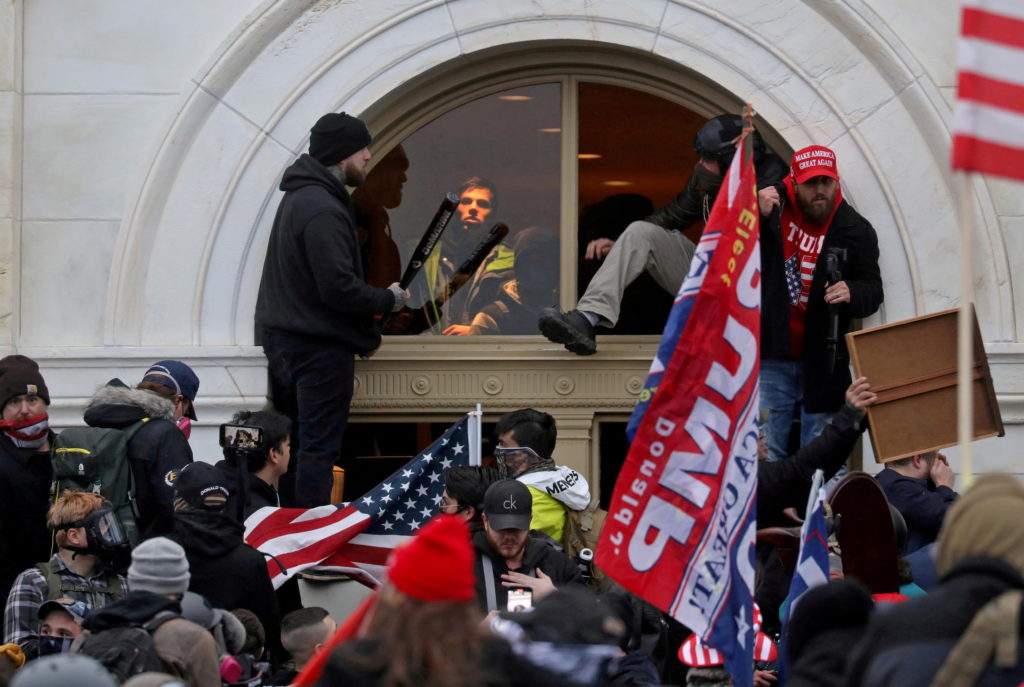
We can debate the letter-writer’s “very large number” till the cows come home, but the Capitol was literally overrun with people, intent on stopping the electoral certification, who broke windows and doors and fought anyone who tried to stop them from getting in, and many of them were, in fact, armed. We won’t even get into the debate about rioters not being armed because they didn’t fire any guns. Armed means having anything (knife, stun gun, bear spray, pipe bombs, etc.) that could be used as a weapon, not specifically guns. There were guns found on at least three people arrested that day; the bulk of the rioters weren’t searched. And the violence wasn’t something spur-of-the-moment, either, arising simply from the excitement of being there (which is why the George Floyd protests on the whole can’t be called insurrections, as Trump wanted to declare), but was part of the plan all along.
While the core definition from the letter-writer is mostly correct, as far as I’m concerned, calling something like what happened Jan. 6, 2021, “a protest with a few who get out of hand” is downplaying that day’s events.
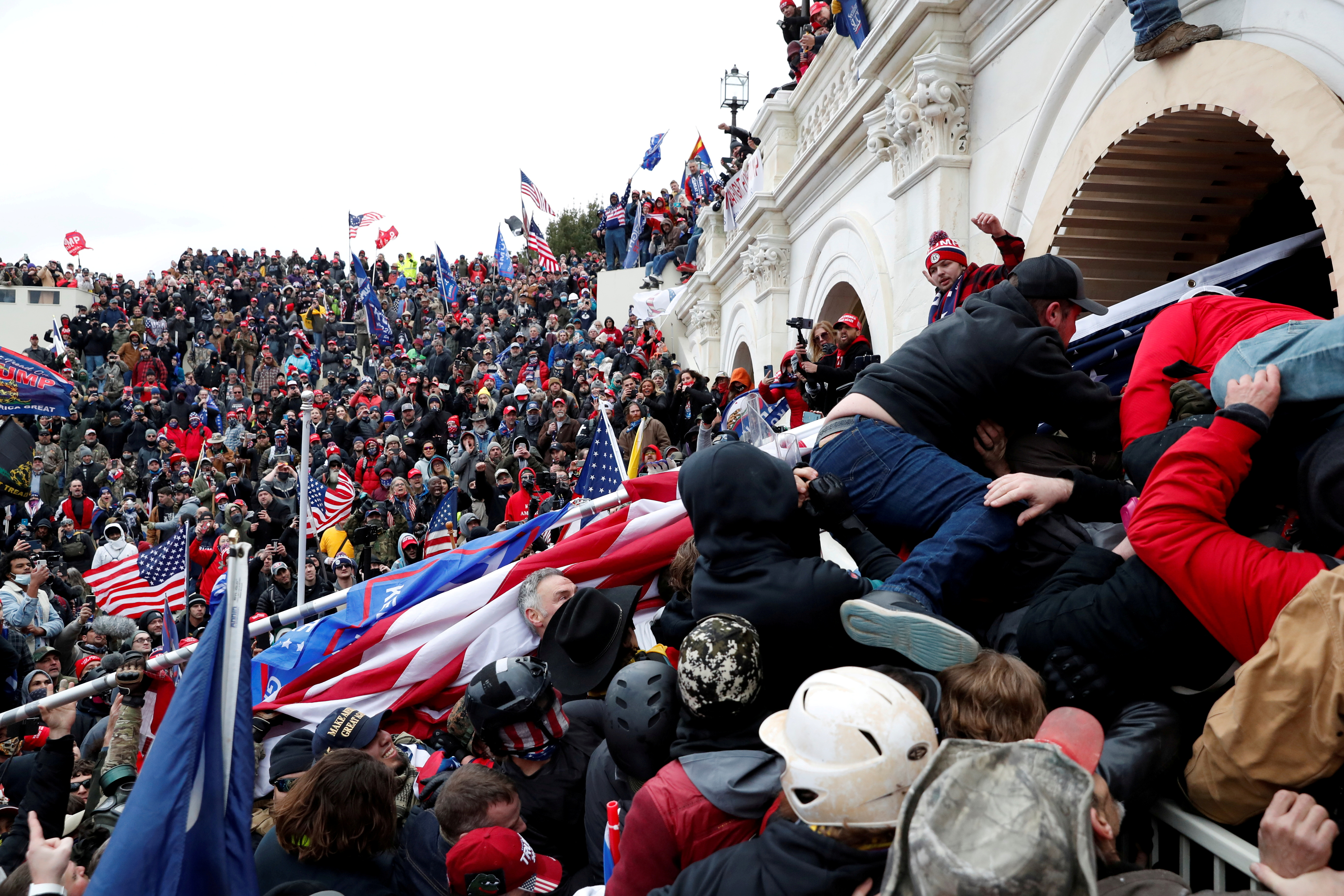
A year after that day, Time magazine published a piece discussing the history of the word “insurrection” in the U.S., specifically as it applies to Black Americans, by Hawa Allan, an attorney and author, in which she wrote, “[T]here has been an ongoing and heated debate over whether to call the event an ‘insurrection.’
“This much is undisputed: hundreds of rally attendees—some armed with metal flagpoles, baseball bats, pepper spray and stun guns—smashed their way into the Capitol building and loitered in the halls, splintering off to rummage through offices or maraud an empty chamber of Congress. Five people died [within 36 hours of] that day as a result of the clash between the crowd and Capitol police, and at least 140 were reportedly injured. However, the interpretation of those facts has largely diverged into polar opposites.”
Wrote Allan: “An ‘insurrection,’ by definition, is a ‘violent uprising against an authority or government.’ It is clear that Capitol stormers who dissented against the election outcome, or even sought to obstruct Congress’ certification of the election, were rising up against the government. The crux … lies in whether the crowd was truly violent—an attribution that has faced resistance. This distinction determines whether those who breached the Capitol are to be accurately described as ‘rally goers’ or ‘rioters,’ ‘patriots’ or ‘terrorists,’ ‘peaceful protesters’ or ‘insurrectionists,’” noting that the labels are neither benign nor interchangeable. (Seriously, the work she put in on the history of the war of words on insurrection and how the debate usually applied to Black Americans is fascinating; read it at the link above or here.)
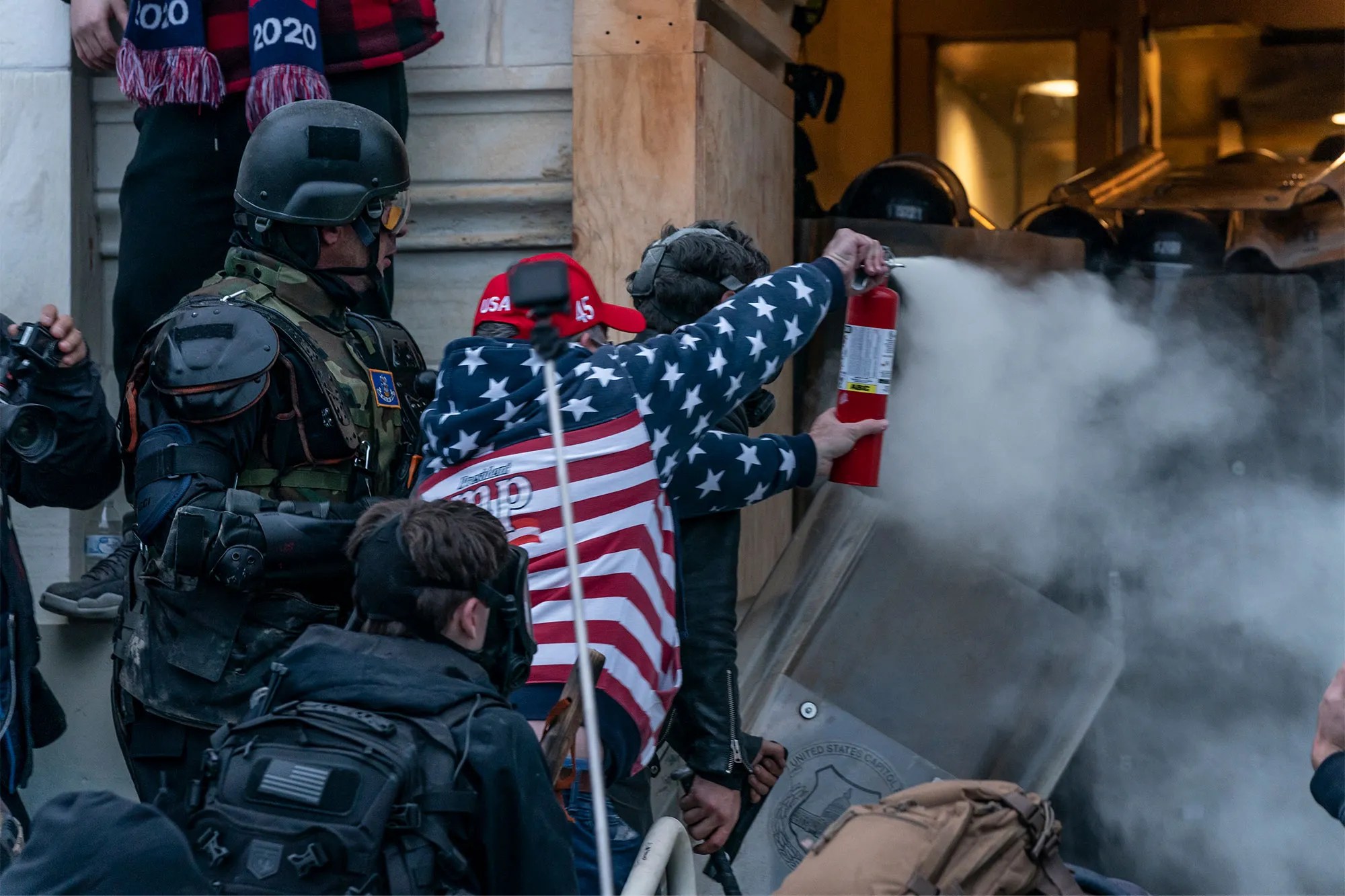
There were definitely people there who did get caught up in the excitement, and many never entered the Capitol, which at most would make them rioters if they did any damage, and would be reflected in their charges. However, many went there with an expressed intent to disrupt proceedings in a violent manner (as I’ve said before, if you show up to a protest or a rally with weapons, you don’t intend peaceful protest). Considering the damage done to the Capitol, the injuries and deaths that resulted, hours of video showing officers and others being beaten with flagpoles and whatever else could be brought to hand, as well as the convictions of 14 Proud Boys and Oath Keepers members and leaders for conspiring to use violence to overturn the election (the Oath Keepers started planning as the election ended, the Proud Boys after a Trump tweet about the coming rally, according to the indictments), I’m going out on a limb and calling Jan. 6, 2021, an insurrection, confident that the mostly apolitical world of word nerds would agree.
Others won’t, of course, but differences are what make conversations like this vital.
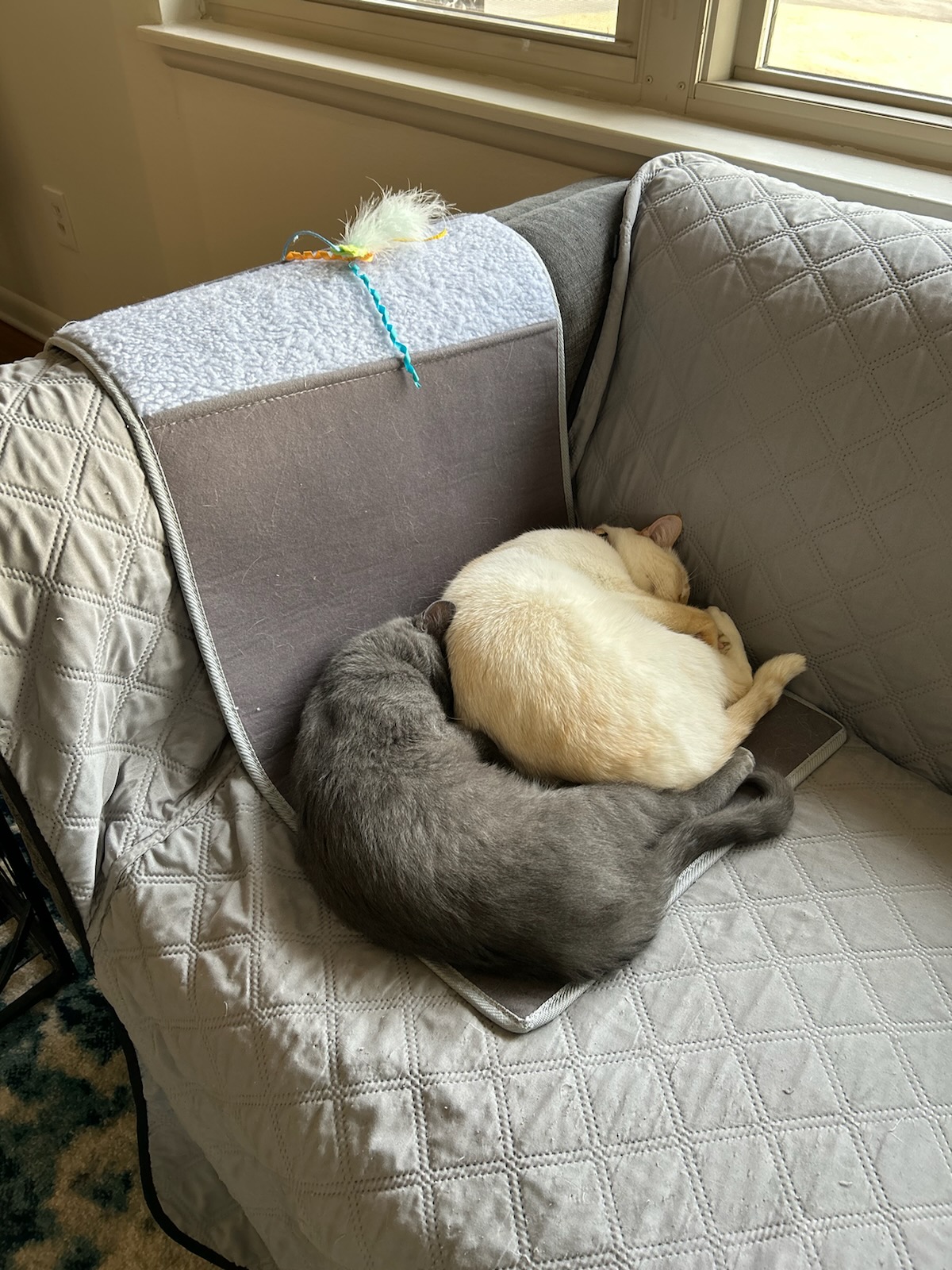
 Serenity is a fuzzy belly
My stomach will twitches when I recall Kellyanne Conway’s reference to ‘alternate facts.’ Now, ‘alternate definitions’ joins the lunatic lexicon of the Right. What a different world this would be if they could have stayed awake during English class. Thanks for being vigilant, cuz.
LikeLiked by 2 people
If it walks like a duck and talks like a duck is good enough for me. Of course, I’ve never seen a duck talk. 😎
LikeLiked by 2 people
Just to give the dead horse another whack, the January 6 event was an insurrection because of two essential factors, organized violence and intent to prevent a legal government proceeding. That the proceeding concerned the very process of democratic governance, i.e. voting, only adds to the gravity of the crime. If nothing else, any illusion that most GOP members of Congress value the interests of the country over their personal political ambitions is now firmly dispelled.
LikeLiked by 2 people
No matter how insurrection is defined, I think the 14th Amendment’s insurrection clause doesn’t apply to keeping names off of ballots; rather, it refers to serving in office, so an insurrectionist can be elected but cannot serve. Fighting the ballot issue is premature.
LikeLiked by 2 people
When someone’s name is removed from the ballot, I resent that because I feel as if someone is telling I am not smart enough to make my own choices as to who or what I want to vote for.
LikeLike
A “whole other barrel of monkeys?” Which barrel would you like for us to deliver?
LikeLike
As the late John Lennon said in his song “Revolution”, if you are talking about destruction, you can count me out.
LikeLike
Part of the problem on January 6, 2021 was that too many of the people who did not like the results of the Presidential election in 2020 still mistakenly believed that using violence would solve all of their problems and keep Donald Trump in office. However, that does not work. Using violence just provokes and begets more violence.
LikeLike
Also I wonder if some of the people who were objecting to the results of the Presidential election were the type of children (as in spoiled rotten brats) who did not like it when their parents actually said “NO” to them?
LikeLike