

When I was writing my column on the joy of Threads last week, little did I know that drama would take over.
In response to a female photographer calling out someone else for past transphobic and racist comments (involving the attic-lady drama), a male on the Internet (I hesitate to call him a man) decided that that woman had gotten too uppity and it was up to him to take her down. That meant threatening her and anyone who defended her in increasingly unhinged posts, even seeming to include the threat of livestreaming her murder.
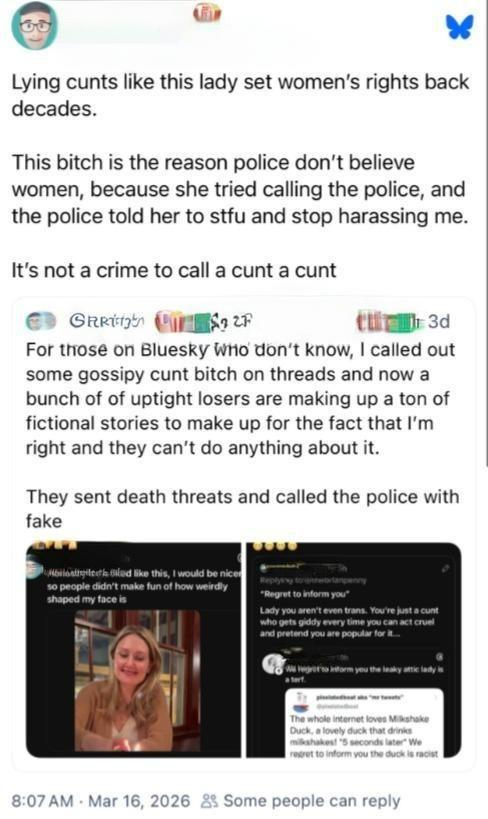
After many, many reports made to Threads and the police where he lives, his account was finally deactivated (though he claims it’s still active). However, he has continued posting on Instagram as well as BlueSky, claiming he was the one getting death threats (dude, you posted your own address and said yourself that no one showed up to challenge you, so … doubtful). He also has continued his harassment of the woman, just not on Threads anymore.
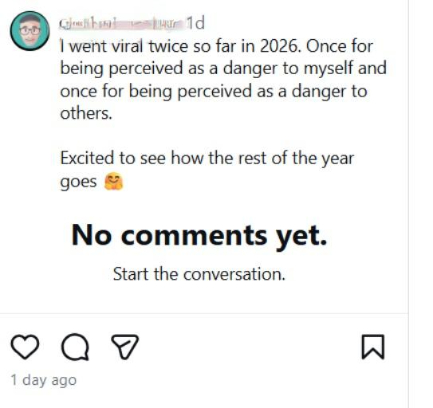
More to the point, he posted that he’s gone viral twice this year so far, once because of supposed suicidal ideation (I’m not convinced in extensive reading of his posts), and the second because people decided he was a danger to others (claiming you can kill with impunity will do that).
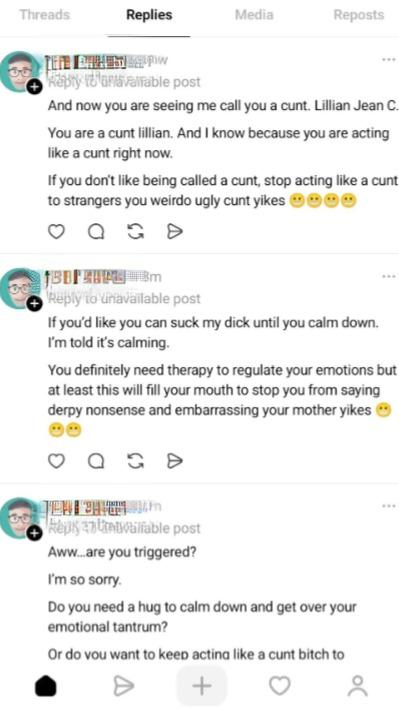
That really says all you need to know about this guy, who on his blog profile describes himself as an Internet troll, which is why I’m not going to say his name, and I’m blocking out his name in the screenshots here (and his target as well). He’s had more than enough attention already, and I’m sure his target would like a respite (too bad he’s still posting about her on other platforms). I’m also keeping in language I would normally black out since I try to keep this a family-friendly place because it’s important to see what those on social media (especially women, people of color and LGBTQ+) deal with every day.
Longtime readers know my opinion of trolls, which, again, I will define because certain elements have the tendency to make up their own definition and attribute it to me (basically anyone with whom I disagree). An Internet troll is someone who deliberately posts inflammatory or otherwise disruptive content with the intent to provoke emotional reactions, derail civil conversation and create chaos. University of Georgia psychologist Joshua Miller, who studies narcissism and aggressive traits, says it’s not just an obnoxious hobby, but a personality problem.
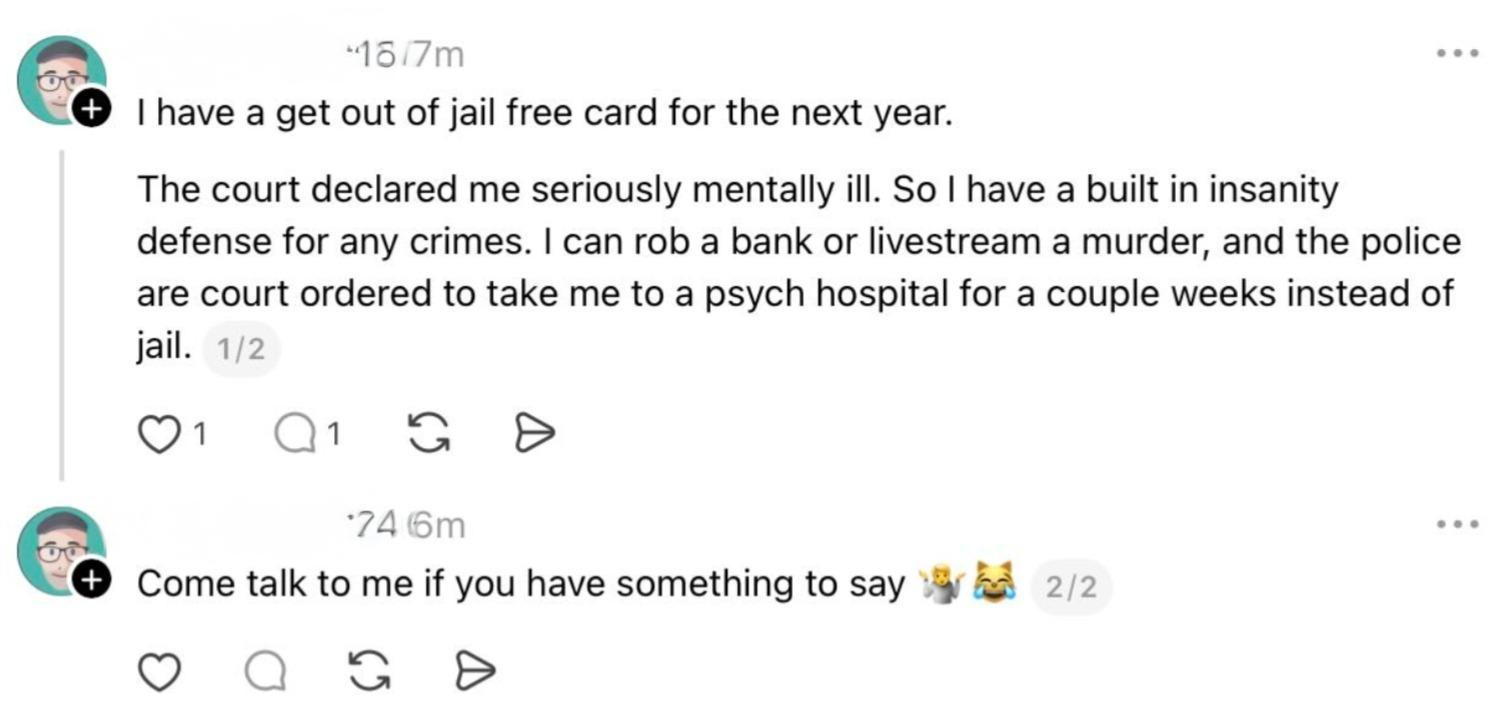
I think those who witnessed the outrageous behavior on Threads last week—such as the troll’s claim that he couldn’t be held responsible by police for anything up to and including murder because he’d been determined to be insane—would agree.
It’s the constant victim mentality combined with an inflated sense of worth (how does that even work?), the irrational arguments that a 5-year-old could puncture, the dredging up of old disputes that quite possibly occurred more in the mind than in reality, the twisting of words and often wholesale fabrication, along with combativeness just to be combative that makes it hard to feel sympathy for trolls. (That pretty much describes the bulk of the trolls on our newspaper’s site. They’re mostly harmless, especially in comparison to the Threads menace, but the attitude and aversion to forum rules is not just annoying, but breaks down social norms every time they’re allowed to lie and harass others with impunity.)
Miller says, “Constructs like psychopathy and narcissism and even sadism are pretty regularly linked to online trolling behaviors. They all share a basic personality trait we call ‘agreeableness versus antagonism.’” Trolls are low on the agreeableness part of the spectrum and thrive on antagonizing others.
While some, like the troll-who-shall-not-be-named, are more than happy to troll under their real name, too many take advantage of Internet anonymity, posting under user names that hold no connection to their real identity (the better to escape consequences; one can always just create a new profile when the old one gets banned for abuse of forums).
“Trolls who are loud online but passive offline may simply lack the physical or social confidence to express their antagonism face-to-face,” Miller says. “However, research suggests that those who consistently troll others online are often difficult people offline, too. Tailgating people when they’re cut off in traffic. Being harsh to their spouses. Things like that.”
Miller notes that trolls who feel powerless in their own lives revel in Internet anonymity and exerting control. “The anonymity of social media has made it too easy to scare the pants off people in real ways that society is going to have to try to get a handle on.”
But sure, it’s just an innocent little hobby … with, in many cases, grown men (it’s nearly always men … sorry, adult-age males) acting like petulant little boys.

It’s one of the things women who write, whether it’s a column, a news or feature article, a blog, or simply a social media post, have to deal with every day. While women do sometimes troll women, more often than not, it’s a male doing the trolling, and it can quickly get out of hand (such as 2014’s Gamergate, which targeted women in the video-game industry, and which Ren LaForme of the Poynter Institute argues created a new playbook for undermining journalism).
Men get trolled too, especially those in media (like John Brummett, also of the Arkansas Democrat-Gazette like me) and prominent in social media (like SpeechProf), but not like women do.
Women Press Freedom notes of women in media, “Women and non-binary journalists are disproportionately targeted by online harassment due to a combination of gender bias, misogyny, and the power dynamics inherent in both traditional and digital spaces.” Don’t believe that? Start paying attention to comments online posted to things women write as opposed to what men write. It’s probably best if you don’t linger too long, though, because you will feel the need to bathe (even newspaper sites where there are supposedly rules can get really creepy).
Further, Women Press Freedom says, “They often face gendered attacks, including sexual harassment and violent threats, aimed at undermining their credibility and silencing them. For women of color and those from marginalized backgrounds, this harassment is compounded by racial and ethnic biases. Women who challenge societal norms or cover sensitive topics such as politics and human rights are perceived as threats to entrenched power structures, provoking even more hostility.
“Online platforms often allow harassers to act anonymously with little to no accountability, amplifying the impact of patriarchal and sexist norms that view women in public spaces negatively. These attacks are not just personal but also professional, with the intent of pushing women out of the media industry and stifling their voices.”
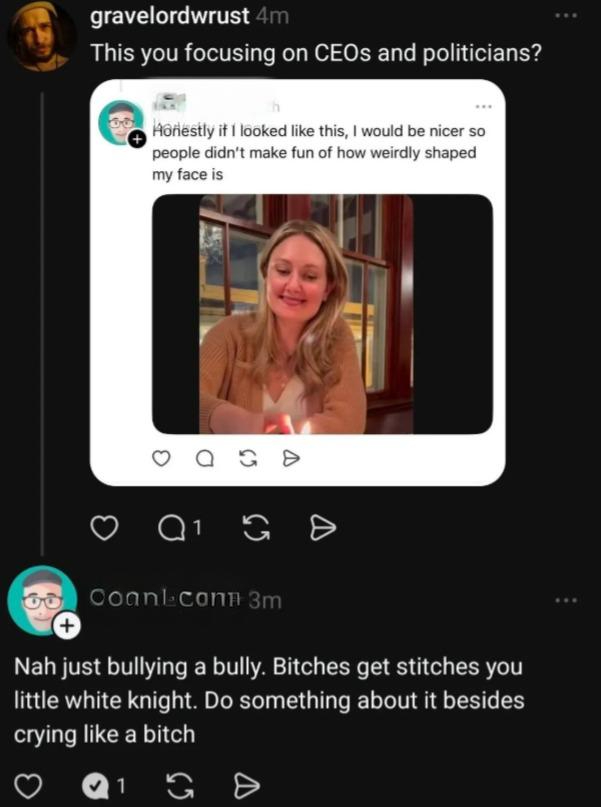
Many trolls will say they’re just bullying the bullies (because apparently calling out bad behavior is bullying) when they attack women online (that’s what our Threads troll claims), but it’s hard to reconcile that with using threats of harm and the kind of language we can’t print in a family newspaper directed at the women, not their arguments (and c’mon, show, don’t tell; if the argument is bad, back up your assertion instead of just saying it’s bad). When consequences come, trolls will say they were bullied (which is one of the reasons I advise not responding to trolls if at all possible; nothing you will say will make them apologize and/or stop being trolls).
The bottom line? If you feel the need to troll someone, ask yourself: Is it really just innocent fun, or is it a compulsion to dominate others?
If it’s the latter, get help.
 Serenity is a fuzzy belly