

Sometimes it’s tough coming up with column topics, especially on a long holiday weekend when you’re thinking more about recreational marijuana for dogs that play the banjo … wait, no. Sorry. That’s what I get for asking friends for ideas. That’s also what I get when I stop mid-typing to type out something funny that someone said so I’ll remember it for later. 😉 And now I’m wondering if fur-nephew Spikezilla plays the banjo (please, no).
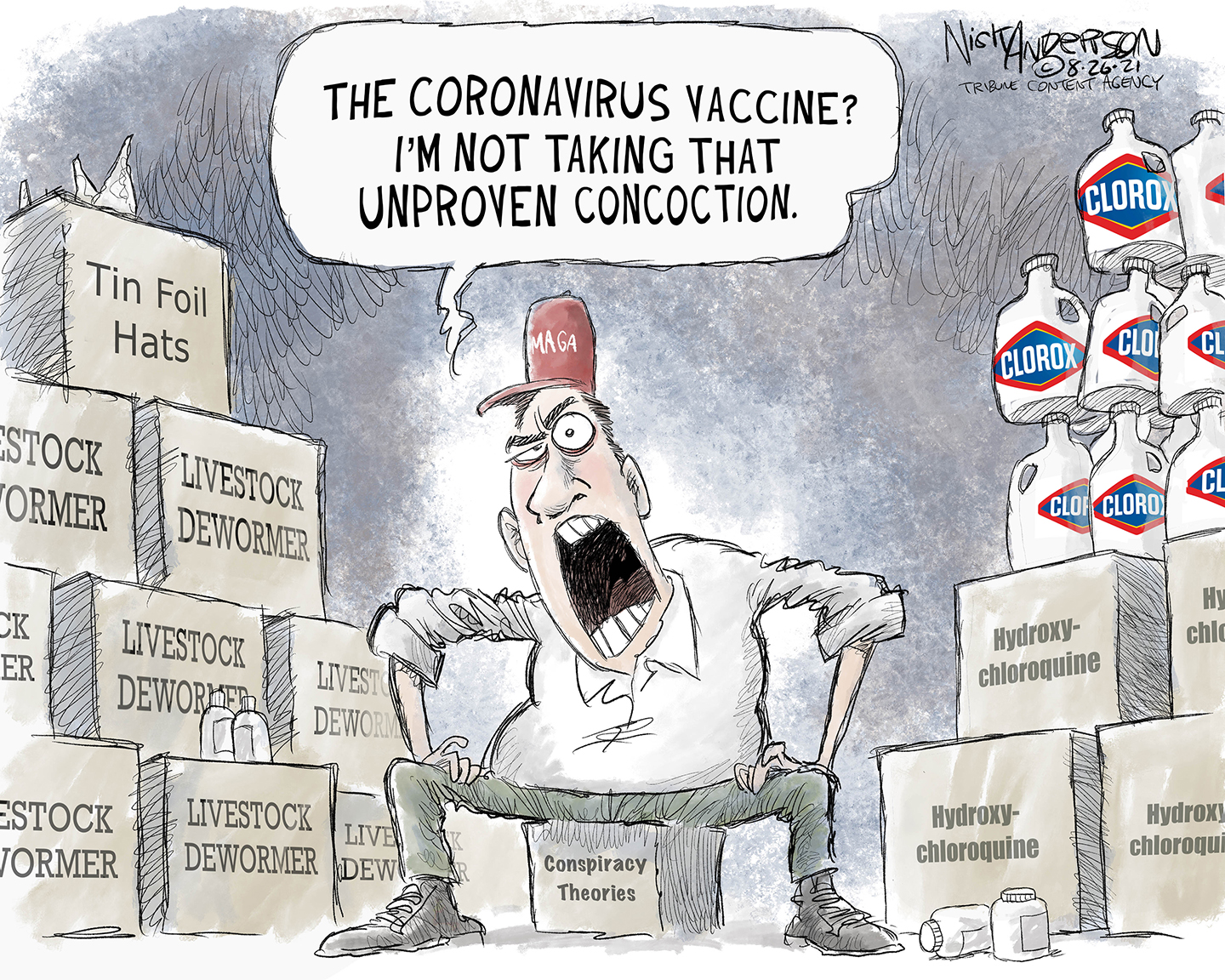
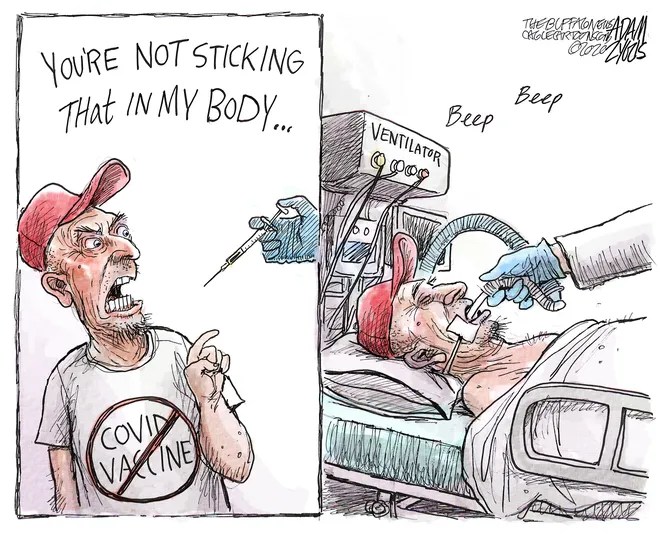
It’s been a while since I last spoke about covid, but it’s been nearly a year since my brother Corey died of it, and the pandemic is still going on, in part because of people who take no precautions whatsoever. (Because they’re not gonna live in fear, dadgummit; I wasn’t aware that following proven medical guidelines to decrease the chance of getting sick is fear, but OK … and we won’t talk about those guns some people feel they have to open-carry to feel safe or to intimidate others.)
So far my friend Sarah and I have managed not to catch it, and remain among the super-dodgers, people who have never contracted covid. That club is getting more exclusive every day, and odds are one or both of us will catch the dominant BA.5 omicron subvariant. We’re both cautious, and believe in doing all we can to escape unscathed. That includes wearing masks indoors in public places and getting the new booster, which targets both the original strain and the omicron variant. Sarah got her second booster before her mother’s recent heart surgery out of an abundance of caution, but I waited, apparently for the FDA to approve the new booster, which I plan to get as soon as I can arrange it.

It’s pretty obvious that covid is here to stay, but it’s not yet endemic (like the flu is, meaning we would need boosters every year); researchers predict it will be by 2024. Marc Zarefsky wrote on the American Medical Association public health blog in April: “There is not a set threshold that dictates when a pandemic becomes endemic, Dr. [Stephen] Parodi said. While the omicron variant of SARS-CoV-2 led to an enormous surge in positive cases across the U.S., Dr. Parodi said there were encouraging signs connected to endemicity. For the most part, people who were vaccinated and then tested positive had mild symptoms or were asymptomatic. The more people who are vaccinated, the better.
“‘We can move this in a way that the disease is milder,’ he said. ‘At least so far, vaccine-based immunity appears to provide very broad-based immunity against multiples of variants.’”
The CDC updated its covid guidelines recently to track risk in communities, and is now focusing on minimizing severe illness (which vaccines help with) and preventing health-care facilities from getting overwhelmed. “This shift to looking at it from a severity-of-disease standpoint is important,” Dr. Parodi said in an interview. “A measure of endemicity really is going to look at how many people are developing severe disease at a given time. If we’re seeing increases in that, we’ve got to take action. If we’re not, that’s a different set of actions, and that’s similar to what we do for influenza year over year.”
Getting a flu shot every year is wise; I’ve caught flu a few times, but because I started getting the shot every year, my downtime has been significantly shorter than if I just skipped the vaccine. The year I forgot about it … hoo, boy. That wasn’t fun. My furry one could attest to that if he were still alive.

And here’s usually when someone pipes up and says, “It’s a shot, not a vaccine, you idiot!” That’s when I bring out fur-nephew Charlie so he can give that someone his best RAF (resting annoyed face).
Which brings us to the myth that the dictionaries are changing definitions of words like “anti-vaxxer” (introduced in 2018 by Merriam-Webster, according to PolitiFact, and still the same as it was then, “a person who opposes vaccination or laws that mandate vaccination”) and “vaccine,” all to support the narrative the government endorses.
Seriously? You’re gonna take the word of RT, a well-known purveyor of disinformation and conspiracy theories?
Merriam-Webster did recently revise the definition for vaccine, but it expanded it. PolitiFact wrote last November that a Facebook post claimed, “Vaccine used to be defined as a substance that provides ‘immunity’ to a specific disease. Now, Merriam Webster has literally changed the definition of ‘vaccine’ and removed the ‘immunity’ portion to possibly cover for the fact that covid ‘vaccines’ don’t actually provide immunity from covid.”
Except that’s not quite so, reported PolitiFact: “Merriam-Webster has revised its entry for the word ‘vaccine’ as part of its continual revision of entries, but it did not remove references to immunity. Rather, it changed the phrase ‘increase immunity’ to say, ‘stimulate the body’s immune response.’ The current entry better captures how mRNA-based vaccines work compared with traditional vaccines.”
PolitiFact further reported: “‘This definition has been revised to reflect both more scientifically accurate language and the fact that we have more space in the online dictionary,’ said Peter Sokolowski, editor at large of Merriam-Webster.com. ‘We are now able to provide much more context and detail than previously possible in print dictionaries. The wording had originally been drafted in order to accommodate the space restrictions of our print editions, where definitions necessarily had to be as brief as possible.’
“The dictionary further explains and links to related terms such as ‘attenuated’ and ‘adjuvant,’ as well as ‘messenger RNA’ and ‘immune response.’ These explanations and links, Sokolowski said, serve to give broader coverage to the term being defined.
“‘In particular, the definition for immune response provides a detailed description of how a vaccine actually works, and is therefore more specific, scientific, and complete than the more general term immunity,’ he added.”
Both traditional and mRNA vaccines stimulate immune response. No vaccine is 100 percent effective, but by teaching your body’s immune system what to guard against, it provides a better chance of avoiding the worst effects of disease, which in some cases includes death.

Corey was, like me, likely a super-dodger since he was around so many unmasked, unvaccinated people for so long, but his luck eventually ran out. Since he refused to be vaccinated (believing way too much in natural immunity) while also taking few precautions, covid hit him hard, and self-medicating with over-the-counter cold medicine didn’t help.
I’m still angry not only because he could have been more cautious, but because the last time I spoke with him, we argued about the vaccine. That weighs on my mind every day.
Why couldn’t it have been about dogs playing the banjo? At least then we would have had a few laughs.

 Serenity is a fuzzy belly