

With an actual chill in the air, I can finally say it’s autumn, which is one of my favorite times of year, and not just because of the leaves turning and it being cold enough to start making cocoa and soup (first up, for Tuesday’s lunch, chicken and dumplings; cocoa TBD).
This time of year is Halloween, Christmas, and birthdays all in one for word nerds like me. We’re getting really close to the time when major dictionaries choose their words of the year, and Lake Superior State University publishes its list of words to be banished from the English language.
But oh … it’s also when dictionary sites announce words added to the online versions of their dictionaries for the quarter. It makes me giddy just thinking about it.
Did you forget I’m a big ol’ nerd?

And why not, when Merriam-Webster finally added “cromulent,” meaning acceptable or satisfactory, and dating to the 1996 “Lisa the Iconoclast” episode of “The Simpsons.” “Embiggen” from that same episode was added in 2018. So many words from the series have entered the lexicon over its 34 (!) seasons (d’oh, okely dokely, glavin, doodily, etc.), so it’s nice to have dictionaries recognize how broad the use of several of them has become.
And here I’ll remind you that dictionaries don’t determine definitions; they merely record words commonly used and the meaning they have in usage. (Don’t get me started on the “vaccine” kerfuffle, which was much ado over nothing, politicized to cause division; the definition was broadened, not changed, to take into account how mRNA vaccines work. The core definition stayed the same. Language evolves, and dictionaries record that evolution.)
In its “Help” section, Merriam-Webster.com notes that what gets words in the dictionary is usage: “To decide which words to include in the dictionary and to determine what they mean, Merriam-Webster editors study the language as it’s used. They carefully monitor which words people use most often and how they use them.
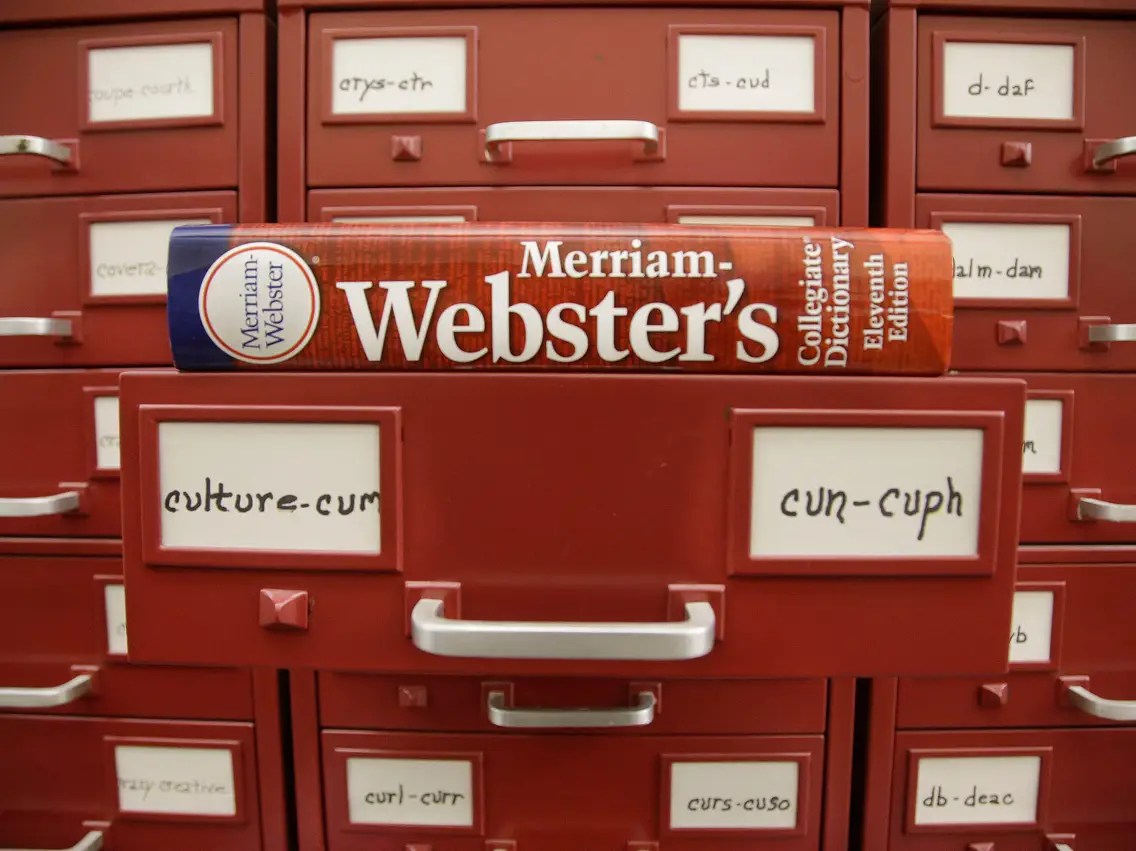
“Each day most Merriam-Webster editors devote an hour or two to reading a cross-section of published material, including books, newspapers, magazines, and electronic publications; in our office this activity is called ‘reading and marking.’ The editors scour the texts in search of new words, new usages of existing words, variant spellings, and inflected forms—in short, anything that might help in deciding if a word belongs in the dictionary, understanding what it means, and determining typical usage.”
Editors gather citations of words and phrases in files, the dictionary notes. “Merriam-Webster’s citation files, which were begun in the 1880s, now contain 15.7 million examples of words used in context and cover all aspects of the English vocabulary. Citations are also available to editors in a searchable text database (linguists call it a corpus) that includes more than 70 million words drawn from a great variety of sources.”
But how do words make it out of the citation files and into the dictionary? First, the editors review groups of citations to determine what entries can stay the same, what ones need revision, what can be dropped, and what can be added. The site says, “To be included in a Merriam-Webster dictionary, a word must be used in a substantial number of citations that come from a wide range of publications over a considerable period of time. Specifically, the word must have enough citations to allow accurate judgments about its establishment, currency, and meaning.”

Usually, as with cromulent, it takes a lot of time. But others make it in much quicker because of epidemics and pandemics or other big events that change the language, as with “AIDS” and “coronavirus” or “covid-19.”
Cromulent was just one of the 690 new words and phrases and definitions added this go-around. Others included “UAP” (unidentified aerial phenomenon; sorry, I prefer UFO), “doggo” (Internet talk for a pupper … er, dog), “beast mode” (extremely aggressive and/or energetic manner adopted temporarily to best an opponent; I remember this from someone who appeared both on “Survivor” and “Big Brother,” and who used it almost to the point of annoyance), “zhuzh” (a small improvement/adjustment/addition that completes the overall aesthetic), “rage quit” (the definition is what you’d expect), “cold open” (scene before the title sequence in a show; I really could have sworn this was already in there, but then again, I came from broadcast and have been familiar with the phrase for a long time), and “chef’s kiss” (kissing the fingertips of one hand, then spreading them outward in a sign of satisfaction or approval).

“Hallucination” gained a definition in the technology sense thanks to artificial intelligence: “a plausible but false or misleading response generated by an artificial intelligence algorithm.” As with “vaccine,” that doesn’t change the overall definition, but just adds another sense in which it’s used.
You can find more of the new words here.
Merriam-Webster wasn’t the only dictionary adding to its corpus this quarter. The Oxford English Dictionary added more than 1,000 new and revised words and phrases, among them “black site” (secret facility where covert military or intelligence operations are performed), “porch pirate” (someone who steals unattended packages from porches), “frontlash” (reaction to a backlash), “greater good” (advantage that accrues to the whole community rather than to an individual or subset), “CODA” (children of deaf adults), and “spidey sense” (do I really need to say what this is?). Read more here.
Dictionary.com also added 566 new entries, 348 new definitions and 2,256 revised definitions, including “Blursday” (when all the days just seem to run together), “nepo baby” (chiefly the child of a celebrity who is seen to owe their status to their parent’s industry connections), “stress eating” (emotional eating triggered by stress, tension or anxiety; I’ve become very familiar with this this one over the past couple of years), and one that seems especially relevant now, “information pollution” (the introduction of falsehood, irrelevance, bias, and sensationalism into a source of information, resulting in a dilution or outright suppression of essential facts). Read more of Dictionary.com’s additions here.
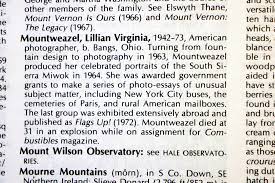
(An interesting aside here: “Mountweazel” was also added, meaning a decoy entry in a reference work intended to catch other publishers who copy content. The word was coined by New Yorker writer Henry Alford in reference to the fictitious entry in the 1975 New Columbia Encyclopedia on Lillian Virginia Mountweazel, a celebrated photographer born in Bangs, Ohio, who died “at 31 in an explosion while on assignment for Combustibles magazine.” In the second edition of the New Oxford American Dictionary, the editors included their own mountweazel, “esquivalience,” subsequently catching Dictionary.com not only copying the entry, but also attributing it to the wrong source.)
Information pollution reminds me of some wannabe edgelords (those who make wildly dark and exaggerated remarks with the intent to shock) on certain comment boards. What a coinkydink; Merriam-Webster added “edgelord” this go-around. (But not coinkydink yet, dang it.)
Meanwhile, I’ll ponder the ’grammable (also added by Merriam-Webster this quarter, meaning suitable to be posted on Instagram) with fur-nephew Charlie. He’s definitely ’grammable.
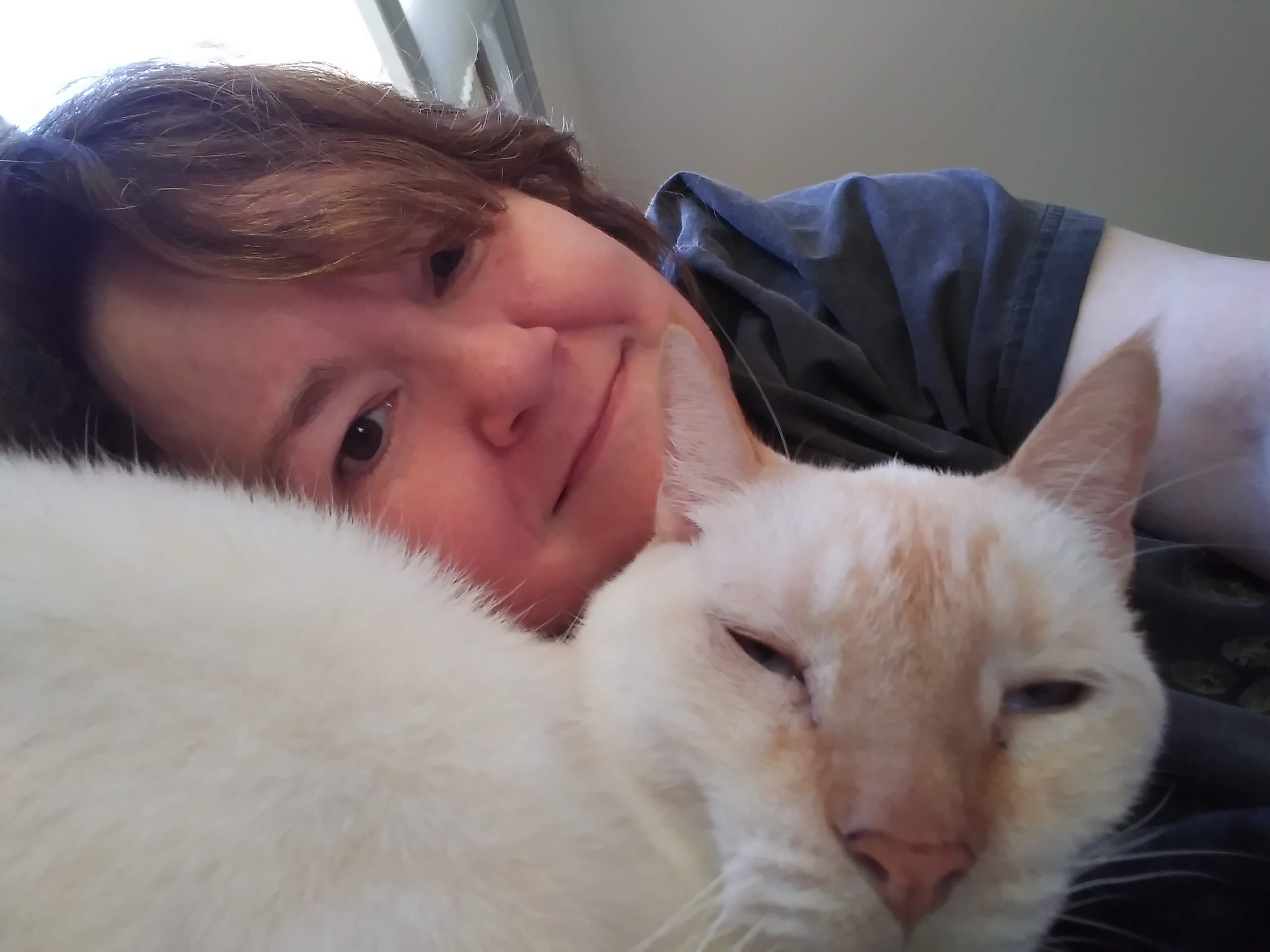
 Serenity is a fuzzy belly