

It’s the time of year every word nerd worth their salt is salivating madly, with words of the year starting to come fast and furious. This word nerd missed one already, but she’s had other things on her mind.
That missed one was Dictionary.com’s 67 (pronounced six seven, not sixty-seven), which is a nonsense phrase kids started using this year. I was rolling my eyes over the fracas over it, and then some Internet wit in one of the Facebook groups I belong to, having to do with Douglas Adams and a certain well-known book of his, noted that six multiplied by seven equals 42, which we know is the meaning of life. (It’s doubtful, as my page designer at the paper noted, that these kids know anything about Douglas Adams; they’re just happy to have something that annoys adults.)
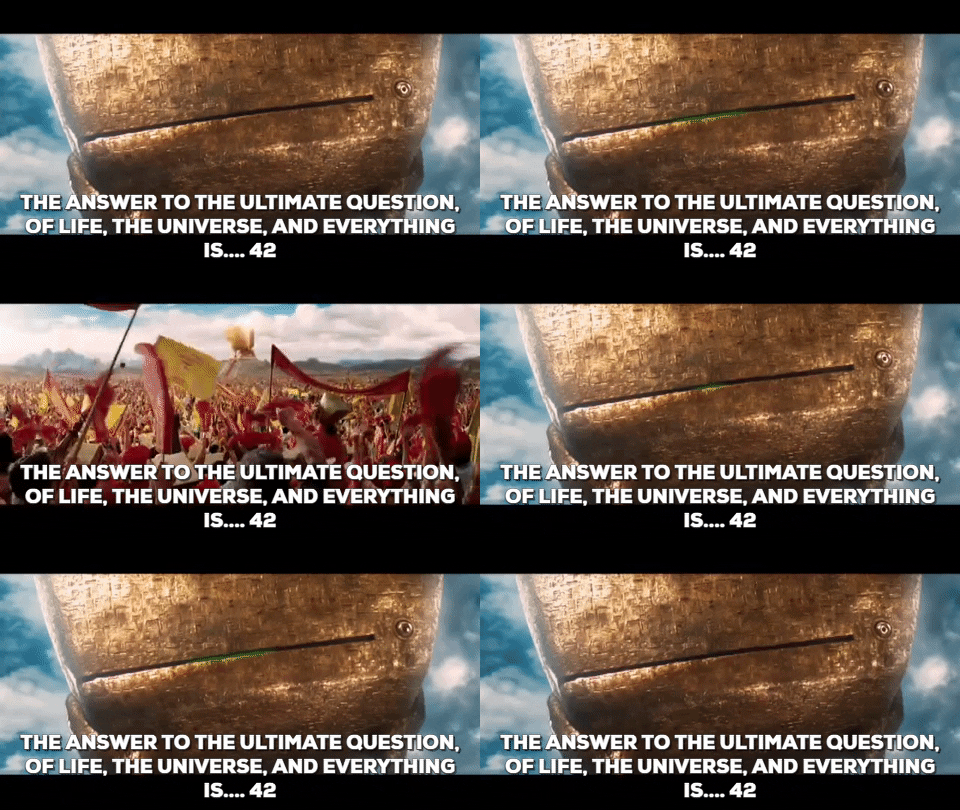
Yeah, I’m a science-fiction/fantasy nerd too (though more Star Trek, Hitchhiker’s Guide, Lord of the Rings, Marvel Universe, A Wrinkle in Time and Doctor Who than Star Wars and Babylon 5). Deal with it.
And now comes the Oxford Languages Word of the Year for 2025: rage-bait. Rage-bait, according to Oxford, is “online content deliberately designed to elicit anger or outrage by being frustrating, provocative, or offensive, typically posted in order to increase traffic to or engagement with a particular Web page or social media account.”
Basically, it’s the cousin of the Internet troll, someone who posts outrageous, demeaning, false and/or off-topic content with the intent to disrupt civil discussion. And you know how I feel about trolls.

Oxford noted: “With 2025’s news cycle dominated by social unrest, debates about the regulation of online content, and concerns over digital well-being, our experts noticed that the use of rage bait this year has evolved to signal a deeper shift in how we talk about attention—both how it is given and how it is sought after—engagement, and ethics online.”
And yes, it’s two words, but dictionaries have not historically been averse to choosing a phrase as a Word of the Year, as it’s a single unit of meaning.
Casper Grathwohl, president of Oxford Languages, said, “The fact that the word rage bait exists and has seen such a dramatic surge in usage means we’re increasingly aware of the manipulation tactics we can be drawn into online. Before, the Internet was focused on grabbing our attention by sparking curiosity in exchange for clicks, but now we’ve seen a dramatic shift to it hijacking and influencing our emotions, and how we respond. It feels like the natural progression in an ongoing conversation about what it means to be human in a tech-driven world—and the extremes of online culture.

“Where last year’s choice, brain rot, captured the mental drain of endless scrolling, rage bait shines a light on the content purposefully engineered to spark outrage and drive clicks. And together, they form a powerful cycle where outrage sparks engagement, algorithms amplify it, and constant exposure leaves us mentally exhausted. These words don’t just define trends; they reveal how digital platforms are reshaping our thinking and behaviour.”
And thoroughly exhausting us as well. It’s why I take Saturdays off (sometimes the whole weekend) from social media. My brain needs the rest.

Rage bait beat two other shortlisted words put out to a public vote on Instagram to win the nod as Word of the Year from Oxford: aura farming and biohack.
Aura farming, according to Oxford, is “the cultivation of an impressive, attractive, or charismatic persona or public image by behaving or presenting oneself in a way intended subtly to convey an air of confidence, coolness, or mystique. …
“Aura farming has been growing in use since its first appearance online in 2023. It surged this year, reaching a peak in July, largely as a response to a viral video of 11-year-old Rayyan Arkan Dikha from Indonesia looking effortlessly cool as he carried out his role as a motivational dancer for the crew of a traditional racing boat. Its increase in usage seems to show us that sometimes, a conscious effort goes into producing that ineffable attractive something that some people just seem to have.”

Think of so many social media influencers. Between the filters, the behind-the-scenes shenanigans and the often dishonest presentations, there’s an awful lot of effort going in to trying to appear cool. I think that’s why most of the people I follow eschew such machinations and are their honest, often-goofy selves.
Biohack is, according to the dictionary, “to attempt to improve or optimize one’s physical or mental performance, health, longevity, or well-being by altering one’s diet, exercise routine, or lifestyle, or by using other means such as drugs, supplements, or technological devices.”
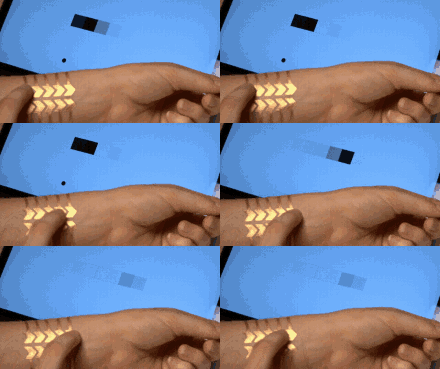
Biohack, said Oxford, “has come to prominence over recent months with increased attention to the efforts of some of us—especially the rich and powerful—to turbocharge our mental or physical performance, or to halt or reverse the aging process.
“As a result, we’ve seen a doubling of usage in the past year, suggesting that, while some of the treatments and interventions used by hard-core biohackers are beyond the reach of most of us, we seem to be endlessly fascinated by efforts to cheat ill health, old age, or death itself.”
I’d be satisfied just making it to another year without breaking any more bones or having some other medical emergency.

And it turns out I missed a couple of other words of the year as well, though like Dictionary.com, they’re not major announcements; they’re also chiefly British publications. Collins Dictionary named “Vibe coding, an emerging software development that turns natural language into computer code using AI” as its Word of the Year, saying, “The term was popularised by Andrej Karpathy, former Director of AI at Tesla and founding engineer at OpenAI, to describe how AI enables creative output while he could ‘forget that the code even exists.’”
Not bloody likely. “Aura farming” and “biohacking” also made the Collins shortlist, as did “broligarchy” (a small clique of very wealthy men who exert political influence), “clanker” (derogatory term for computer, robot or source of artificial intelligence), “coolcation” (a holiday in a place with a cool climate), “glaze” (to praise or flatter someone excessively or underservedly), “HENRY” (high earner, not rich yet), “micro-retirement” (break between periods of employment to pursue personal interests), and “taskmasking” (giving a false impression of productivity in the workplace).

Cambridge Dictionary named “parasocial” (the feeling of knowing people you don’t actually know, such as celebrities and influencers and being invested in their personal lives) as its Word of the Year, with Colin McIntosh of the dictionary saying: “Parasocial captures the 2025 zeitgeist. It’s a great example of how language changes. What was once a specialist academic term has become mainstream. Millions of people are engaged in parasocial relationships; many more are simply intrigued by their rise. ”
For anyone who feels parasocial toward me, I’m very sorry. My life is not that interesting, and I don’t have the money to make it more so (heck, I don’t even have a couch, or most furniture). I’m sure you can find more exciting people to admire than an editor/columnist who tries to make ends meet with house/cat-sitting on the side.
 Serenity is a fuzzy belly