

You know it’s possible for positive news coverage to be fake news, right?
Image found on Press Freedom Tracker.
I hear complaints all the time about overall negative news coverage (and the obligatory claims of “fake news”) of the president by the media. I tend to apply Occam’s Razor to many of these complaints. Seriously, what’s more likely: that all of the reports—especially those that are well-sourced and fact-checked—perceived as negative are fake, or that the coverage is merited by the actions and words of the president?
For some readers, the answer is that it’s all fake, even though negative doesn’t automatically equal fake. I know I’ll never be able to change your minds or get you to even consider other explanations. For the rest of you, let’s talk negativity.
“I’ve fought more damn battles here than any president in 20 years with the possible exception of Reagan’s first budget and not gotten one damn bit of credit from the knee-jerk liberal press. I am damn sick and tired of it.” You might think that our current president said that, but no. That was Bill Clinton 25 years ago—the first year of his presidency—in an interview with Rolling Stone. There were a lot of parallels between Clinton and the current president’s first 100 days … but yeah, that’s probably fake news.
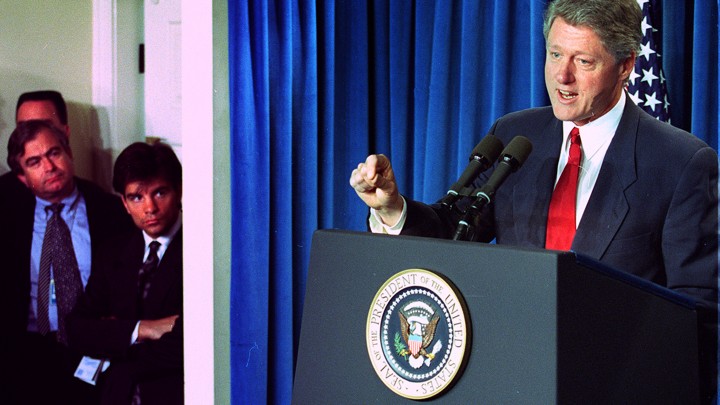
Bill Clinton didn’t have a great relationship with the press, but he never called it the enemy of the people.
Associated Press image by Wilfredo Lee found on The Atlantic.
Imagine if the media environment then was more like today’s.
With Clinton, negative coverage outweighed the positive throughout his presidency, though admittedly not by as large a margin (a ratio of about 3-2, compared with the current 4-1). Harvard’s Shorenstein Center reported last year: “There was not a single quarter during any year of Clinton’s presidency where his positive coverage exceeded his negative coverage, a dubious record no president before or since has matched.”
If the current president doesn’t match it, it won’t be for lack of trying.
Clinton found out that any leader in a land with free press (unlike, say, North Korea, Russia, Saudi Arabia) is going to face his or her share of negative headlines; it’s part of the job, and unless you’re the embodiment of perfection on earth, you will have opposition, and reporters who seek out their comments in addition to those of supporters. As Callum Borchers of The Washington Post wrote in June, “A president is not entitled to coverage that is half-positive and half-negative; he deserves whatever split his governing warrants.”

I would remind you that The New York Post is a conservative publication.
Image found on Chicago Now.
And really, how do you put a positive spin on some of the things the president does? Charlottesville (among other instances … *cough* Helsinki *cough*) wasn’t exactly his finest hour.
What typically happens with a lot of studies on coverage (and this happens in every administration) is that people cherry-pick numbers to make a point. Sure, go ahead and use that 90 percent or so negative figure in recent studies and ignore the fact that it’s only among stories with clear tones. Neutral reports made up about a third of both the Harvard and Pew Research Center studies; not counting those creates the illusion of more negativity than there is.
Harvard reported: “Have the mainstream media covered Trump in a fair and balanced way? That question cannot be answered definitively in the absence of an agreed-upon version of ‘reality’ against which to compare Trump’s coverage. Any such assessment would also have to weigh the news media’s preference for the negative, a tendency in place long before Trump became president. Given that tendency, the fact that Trump has received more negative coverage than his predecessor is hardly surprising. The early days of his presidency have been marked by far more missteps and miss-hits, often self-inflicted, than any presidency in memory, perhaps ever.”
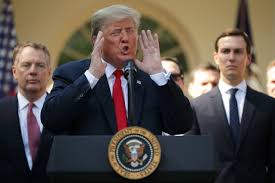
Belittling reporters who write negative (but true) things about you isn’t exactly the way to foster good relations with the press. Neither is calling those you disagree with “babies.”
Image found on Spin.
Barack Obama’s first 100 days elicited more positive coverage than any other recent president, but a big part of that can be attributed to the historic nature of his being the first black U.S. president. The first female president, whenever that happens, will likely receive similar coverage … unless it’s Hillary or Elizabeth Warren. (The divisive tend to draw negative coverage … come to think of it, the unlikability and divisiveness of the major candidates in 2016 pretty much guaranteed negative coverage. Clinton, by the way, outpaced other candidates in percentage of negative coverage in that campaign … but she’s female, so I guess it doesn’t count.)
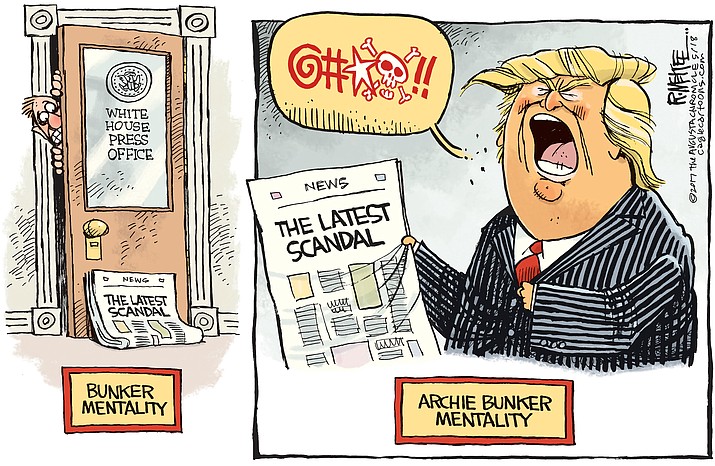
This is one of those cartoons that can just be used over and over again. That’s the cycle we’re stuck in.
Editorial cartoon by Rick McKee, Augusta Chronicle.
With the current administration as opposed to earlier administrations, Pew found that character (or lack thereof), not policy, has been the focus of more coverage, which helps explain the negative press. When you have a president seemingly obsessed with staying in the news, who attacks anyone who displeases him, whose administration leaks like a sieve, and whose documented prevarication has only increased since he came into office (hell just this week), it’s little wonder that coverage is more negative. Add to that a disregard and/or lack of awareness of societal norms and his habit of making pronouncements with no basis in fact, and it’s a near-miracle that any coverage is positive.
Seriously, can someone get him off Twitter, please? Between all the conspiracy theories and outright lies, I keep half-expecting him to start a war any time now.
Pew reported that outlets with right-leaning audiences had more positive reporting on the president, but also cited fewer sources than did outlets with left-leaning or mixed audiences. Which says something about the audiences those outlets seek.
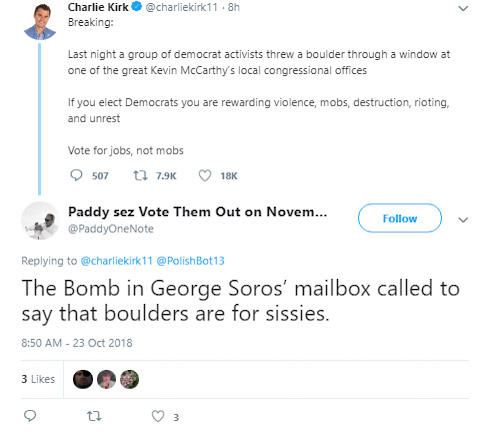
When you get all your information from one part of the spectrum, you might be getting a huge dose of conspiracy theories and an absence of stories reporting on the people who respond to those theories.
Screenshot from @PaddyOneNote’s Twitter page.
I always come down on the side of widening your news diet. If you can’t take criticism of the president—no matter who it is at any given moment—you should definitely add other voices to your diet, as you should if you can’t stand to hear the president praised. We as voters should be open to all of it—the good, the bad, and the in-between—and analyze the information without regard to ideology (remember: person, not party).
Or you can stay in your little safe space where nothing will ever hurt you. Well, except for reality. It can be a real bitch. And she is pissed.
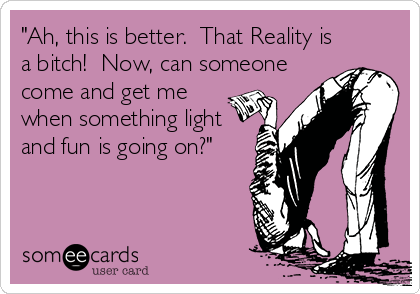
Go ahead and hide. Reality can be scary if you live in a partisan bubble.
Image found on someecards.
 Serenity is a fuzzy belly