
 It’s often a surprise to us here what prompts the biggest responses on the Voices page.
State treasurer on trial? Yawn.
Russia invading the Crimean Peninsula? Next!
Between dropped comics, columnists people love to hate/hate to love, grammar debates on “lie” versus “lay,” and long, involved discussions over elderly drivers, I think most of us at the paper, and probably a lot of our readers, never would have expected most of those parleys.
Such is the case with curly paper.
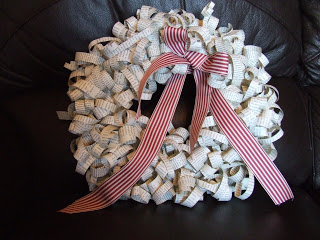
Newspaper curling? Use it to make a wreath!
Image from Karas Crafty Corner.
It was only a few weeks ago that we printed a letter from Rolland and Georgia Dockham of Cherokee Village in which they complimented other aspects of the paper, but noted that the paper stock used for printing it often curls. A seemingly inconsequential thing, but more than a month later, we’re still receiving letters on those unwanted curls.

I may be small, but I’m big-time creepy. Here’s proof.
And that just goes to prove that little things mean a lot.
After big votes, politicians often will tell constituents that they didn’t vote for this bill or that one because it would affect a relatively small amount of people, would only make minor changes to the status quo, or that if everyone doesn’t participate in a program small steps will do little.
Bull.
Any progress moves us along. Moving an inch a day may not get you somewhere quickly, but when the day ends, you’re still an inch closer to your goal. Saying that incremental progress is no progress at all serves no one but the obstructionist.
If the light bulb in the refrigerator dies, we change it so that we can figure out where in the recesses of the fridge those chicken breasts we bought the day before disappeared. We don’t unplug it and say it’s useless to even try to replace the bulb, nor do we head to the appliance warehouse for a new refrigerator, because we’re not made of money. We change the freakin’ bulb!
I replaced the bulb, you idiot. You’re welcome.
Image from egotvonline.com.
The 2010 documentary A small act explored the many positive effects stemming from a scholarship given by a Swedish woman to a young Kenyan student. That student, Chris Mburu, now a Harvard-educated lawyer and United Nations human-rights advocate, later decided to seek out his benefactor, and then started a scholarship program of his own in her honor. Closer to home, that was the point of the late Jennings Osborne’s furthering the idea of “committing a random act of kindness”: One beneficial act for someone else with no thought of how it might help you can have deep, abiding effects down the line.
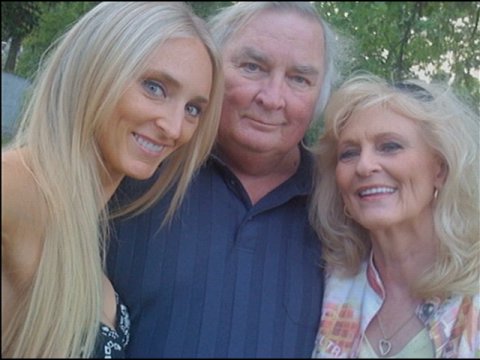
Jennings Osborne with daughter Breezy (left) and wife Mitzi. Osborne died in 2011.
Image from KATV.com.
Also in 2010, The Dragonfly Effect by Jennifer Aaker and Andy Smith examined how people have been using social media to connect and promote change throughout the world. In the Stanford Social Innovation Review, the authors said “the Dragonfly Effect demonstrates that one doesn’t need money or power to cause seismic social change. With energy, focus, and a good wireless connection, anything is possible.”
In 2006, economist Muhammad Yunus won the Nobel Peace Prize for his micro-loan strategy for the poor; the idea of micro-credit spread, and now has helped lift many millions around the world from poverty.
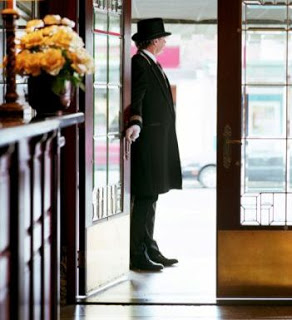
Opening a door for someone is a welcome gesture. Uniform not necessary, though. Image from suburbkid.com.
Just a little effort can indeed produce great results (and suddenly, the Sinatra song, “High Hopes,” popped into my head … must be a sign). Someone just has to be willing to make the effort, even if it’s only to open a door for someone laden with packages or to offer a smile and a nod to your fellow man.
And besides, isn’t the world a bit better when we treat others with the same respect (or better) that they give to us?
****
Speaking of respect, the other day, I broke a vow I made to myself to never raise my voice to a letter-writer. For that, I’m truly sorry. However, it again necessitates some reminders:
* Not every letter is published, nor has that ever been the case; for one thing, there is simply not enough space to do so. At times when the pickings are slim, a greater percentage makes it in, but most of the time, perhaps 40 percent of the letters received are published. If a letter doesn’t get printed, it does not mean the writer is being discriminated against, or that there is a conspiracy afoot.
It simply means try again (preferably with a new topic).

This is how it feels sometimes.
Image from SAFE California.
* Even among letters picked for publication, some don’t make it in because of issues with documentation. Letters that require extensive documentation take longer, and sometimes have to be put on the back burner because of that.
With hundreds of letters received every month, we have neither the staff nor the time to do an unlimited amount of research and still get a page out every day.
And since not everything is available on the Internet, there are still a lot of things we don’t have access to: Much of live TV or radio (believe it or not), member-only publications, and even things like our own archives before the mid-1980s are not accessible to us on the Web.
 * You may ask or request, but you may not demand that a letter be printed.
We do our best to accommodate our letter-writers, but a line has to be drawn to serve the greater number of readers. Strong-arming might have been the way to get a letter in in the past, but it won’t work any more.
Treat us as you would want to be treated because bullying is not an option.
****
Our hardworking Voices clerk, Stephanie, does a stellar job under sometimes difficult circumstances, and still manages to keep a smile in her voice even when under stress. While most of our letter-writers are gracious, sweet and funny, there are always a few cranky people. But let’s keep that crankiness to a minimum, OK?
Those of us with cats get enough of that at home.
For the last time, I’m not cranky!
 Serenity is a fuzzy belly