
 ****
****
Just about everyone who sends multiple letters to the Voices page will get one or more rejected at some point, and the reasons can vary.
Sometimes we receive so many letters that we have to be even pickier about what we print (like now … wow).
Regardless, the decision to print or not is made on a case-by-case basis.
But even when we have the occasional drought, there are some letters that in most cases we just can’t, in good conscience, print (though occasionally one may still slip through), especially as campaign season ramps up.

The Voices page doesn’t have a logo, but if it did, I’d want it to be along the lines of this one from the St. Louis Post-Dispatch. It really cracks me up.
Besides those that accuse others of crimes or otherwise libel them, we can include among them:
1. Unmerited insults of other named readers. What it means is that when you speak of other readers in your letters, be respectful, and back up any assertions you make; attack the argument, not the person. And leave their mamas alone, please.

Image from demotivation.us.
No, this does not mean that words like “stupid” or “idiot” are banned. If I were to ban words other than those already verboten under AP or our own house style, they’d probably be ones like “amongst” or “ole” (instead of ol’) as they’re like nails on a chalkboard for me.
Want to really annoy me? “Verb” some nouns (“authored” should be wiped off the face of the earth), misspell and/or misuse there/their/they’re, it’s/its and your/you’re, then stick “swath” in there for good measure. Then you will be dead to me.
On the other hand, creatively use “persnickety” and/or “amok,” and land yourself on my Christmas card list. If you can’t smile when you say those words, something’s wrong. While you’re at it, for extra points, stick in “discombobulated” and explain why you never see “combobulated” or “gruntled” people. (Want to read another rant about words? Go here.)

Image credit: Nieman Journalism Lab.
2. Letters that contain unattributed disproven assertions stated as fact. One claim that can be easily corrected or edited around without changing the meaning of the letter we can usually deal with; multiple disproven/false claims or single ones that are the crux of a letter will land those posts in the “no” pile.
3. Claims made in campaign commercials for the candidates you favor. For some of them, the other side will say the claims are a matter of interpretation whether they’re true or not. For others, they’re just plain wrong.
For all of them, such letters most often turn into free advertising.
Indulge in some healthy skepticism and seek the truth with nonpartisan sources such as OpenCongress. Did he really vote for that law? Did the bill say what the commercial said it does? If you don’t know for sure, find out. An informed electorate is our best defense.

Cartoon by Nick Anderson, Houston Chronicle.
4. Letters that parrot talking points. Parties and candidates often encourage supporters to send letters that include specific points they want to hit on, but that often results in letters that all look the same. When we see the same turns of phrase in multiple letters from multiple writers, it’s a huge red flag. If you’re going to include those talking points, at least back them up with examples.
Republicans are heartless? Tell us why. Democrats are the spawn of Satan? Prove it. OK, those aren’t talking points as far as I know (I could definitely be wrong), but they are pretty indicative of some of the letters we’ve gotten. You get the point.
Along those lines, John Vowell, whose letter appears in Wednesday’s edition (right under this column in the print edition), notes my “reluctance” to print letters critical of Mark Pryor.

While you may not agree with everything he’s done over the years he’s held political office, at least Mark Pryor seems to try to listen to Arkansas constituents, monied or not. Photo by Danny Johnston, Associated Press.
Wait … what? What paper is he reading?
OK, let’s run the numbers (and darn you, sir, for making me do this). As with most topics, we received more letters about Pryor than we printed, but several (positive and negative) didn’t make it to print, mostly for the reasons cited above.
Of the 23 letters mentioning Mark Pryor that ran from Jan. 1 to March 15, two mentioned him only in passing, eight were positive in their remarks about him (35 percent), and 13 (57 percent) were negative, some exceedingly so. We also ran one each negative (by Sheffield Nelson) and positive (by Marion Berry) guest columns on Pryor.
No, I didn’t count words or column inches, but it’s safe to say the negative outweighed the positive.
So I guess he’s right, as clearly … uh … hmmm … never mind.
All right, he got me in counting mode, darn it, so let’s address another reader’s concern that we print far more atheist and agnostic letters than we do from Christians (or those speaking favorably of Christianity).

Image from Wikipedia of stained glass at St. John the Baptist’s Anglican Church, Ashfield, New South Wales.
I’m fairly sure Jesus didn’t command followers to inundate newspapers with cranky letters to prove they’re better Christians than everyone else. But maybe I slept through that lesson at Sunday School.
For the same time span as the Pryor letters, we printed 82 (!!) religious letters, 63 of which were of the latter variety, 18 from atheists or agnostics and one that was overall neutral.
Pardon me while I recover from the revelation that we printed that many religious letters in two and a half months.
January alone was a heavily religious month on the Voices page, claiming more than half the total (44 letters, 32 of which were Christian).
It’s months like that that earned us the moniker “Demogogue-Gazette” from at least one reader. (Thank you, dear reader, whoever you are. I needed a laugh that day.)
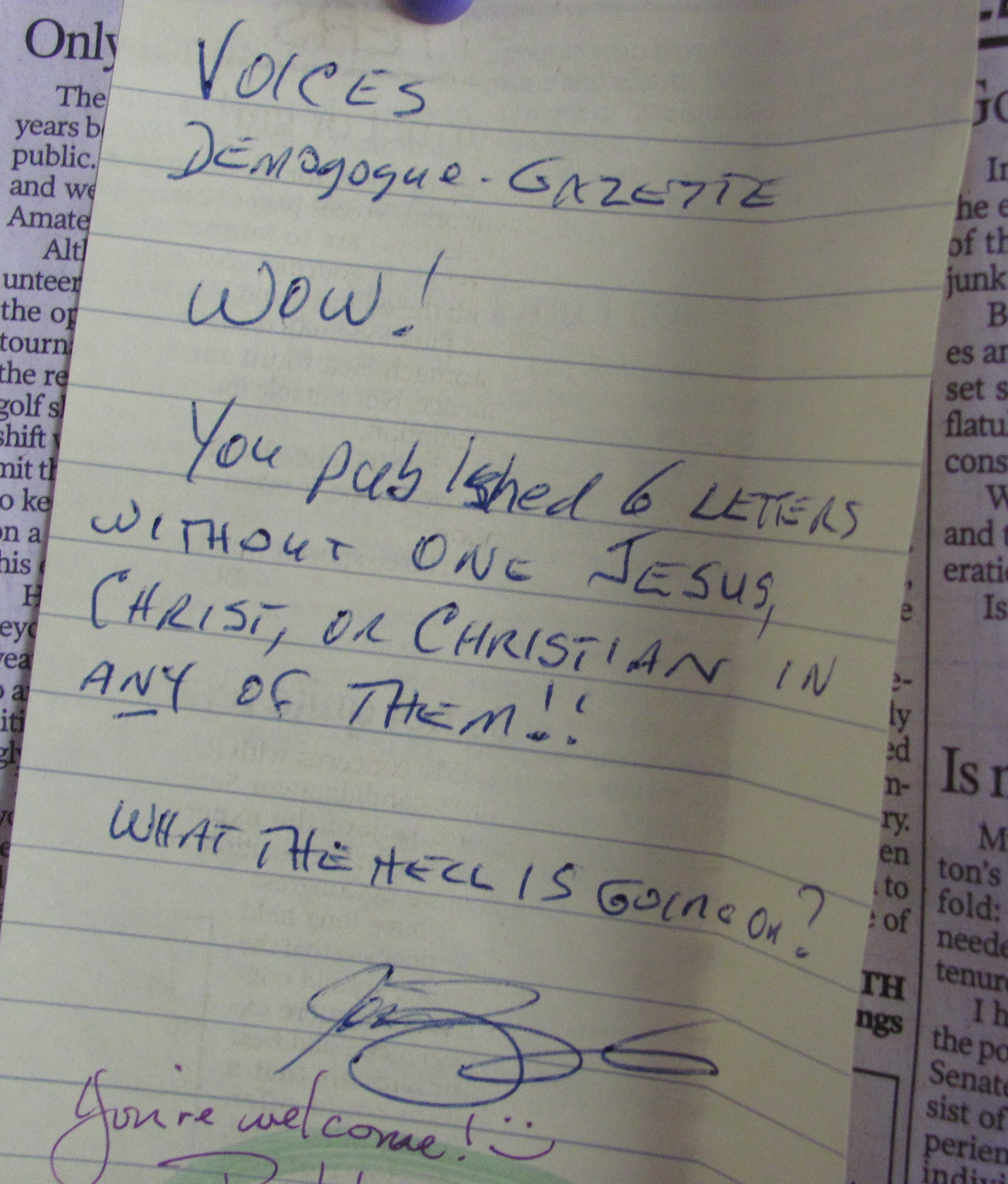
In case you thought it was hyperbole. This letter to the “Demogogue-Gazette” arrived in an envelope with no return address and a scrawled signature that appears to read “Jim Bob.”
I really love Jim Bob for this.
In both of these cases, it seems the readers have fallen victim to a sort of reverse confirmation bias in which they see only the letters with which they don’t agree.
Don’t turn your back or close the closet door unless you really want 10,000 wire hangers by morning.
Image from creativity103.com.
The same way one liberal letter on a page often turns into five somehow.
Kinda like wire clothes hangers (where do they all come from??).
****
Another reader brings up a policy matter, that of not printing anonymous letters.
While many online forums still allow anonymous comments, in our print edition we publish letters only from those willing to sign their names.
While good can come of information in unsigned letters as we do sometimes pass them along to the news side, they pose a problem for many letters editors.
The chief issue that confronts us is that of credibility. How would readers be assured that the writer isn’t actually the person the letter is about, or that the writer doesn’t have an ax to grind or would benefit from the publicity?
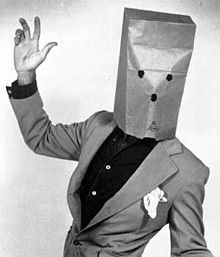
Sure, that letter COULD be from a whistle-blower … or it could just be from a weird guy wearing a sack on his head who thinks he’s funny.
Image from Wikipedia.
Being willing to stand behind your words by identifying yourself instantly makes a letter more believable. Otherwise, people might think we just made these things up.
We get enough of that from the National Enquirer and TMZ (and fake TMZ … poor Wayne Knight). And Fox News.
I’ll give The Onion a pass this time since it’s usually funny.
 Serenity is a fuzzy belly