

And he alone can fix it, or so his minions believe … but who’s going to fix what he “fixed” when he’s gone? Oh, wait, the world won’t be here. Never mind.
Editorial cartoon by Lalo Alcaraz.
When the news of the world is too depressing—not just because of wars, death and famine, but also the fact that some people insist on living in their own version of reality that has nothing to do with the real thing, and with an orange blob as their god—I have a place to retreat to in my mind.

Who wouldn’t love this? Oh, but I can’t bend that way … but KITTENS!!!!
Image found on Notey.
No, not kitten yoga (and I’m still mad that I wasn’t able to go to a session this past weekend because of an IBS flare-up … I’ve never done yoga, but cuddly kittens? Yes, please!). Nor is it the endless puns a friend “tortures” me with on my blog (it’s no torture, really; you know I love it, Laurence). Even Monty Python falls short, though some of its sketches do come close.
What is it? Words that are fun to say.
Longtime readers know of my love of “persnickety,” “bumfuzzle,” “tump,” and the like. It’s almost impossible for me to say or hear these words without smiling. They’re a bright spot in a day when you might be dealing with inane tweetstorms, world leaders threatening other nations (or their own people), and assorted other miseries.
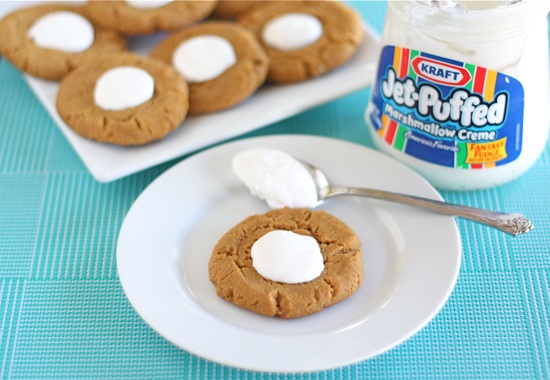
This is just one of the many recipes I found for fluffernutter cookies.
Image found on Two Peas & Their Pod.
My mom reminded me of the joy found in our language when she mentioned fluffernutter cookies in a call this weekend. How can anybody stay in a bad mood when confronted with the goofiness that is “fluffernutter”?
OK, yeah, there’s always that one guy who finds no humor anywhere. Let’s ignore that guy. He’s a real buzzkill.
When I was a kid, there was a period when I loved saying “triskaidekaphobia” (fear of the number 13) for no reason other than that it amused me. Probably didn’t amuse everyone around me, though.
Maybe my love for that word had something to do with the “k” sounds in it. You know that old saw: Words with a “k” sound are inherently funny. Sure, some “k-sound” words aren’t (carrot isn’t), but some of my favorites—like amok—are (especially when repeated in the movie Hocus Pocus).
Words don’t even have to be inherently funny for me to love saying them. For instance, I can’t resist saying “puppy” every time I see a dog of any age (and I’m not even a dog person), and usually in the goofiest voice possible.
I’ve often wondered just why some words amuse me more than others. So, of course, I have to bring science into it because I’m never nerdy enough.
Psychology professor Chris Westbury of the University of Alberta, while conducting a study on whether people with aphasia could tell the difference between real and fake words, found that his subjects laughed every time they saw or heard the nonsense word “snunkoople” (there’s that “k” sound). He then got together with linguists to come up with a list of nonsense words and find which ones evoked the most laughter.

This is me so much of the time.
GIF found on giphy.
They found that the more unusual a word looks or sounds, the funnier it is. Westbury theorized that it’s because of the word’s entropy, a mathematical measure of how predictable it is. The university reported that entropy as a predictor of humor ultimately comes from 19th century philosopher Arthur Schopenhauer, who suggested that humor comes from violated expectations (I’m suddenly remembering Monty Python’s “No one expects the Spanish Inquisition” bit, or maybe a bunch of clowns coming out of a tiny car).
In a video produced by the university about the study, “Telling the world’s least funny jokes: On the quantification of humour as entropy,” published in 2015 in the Journal of Memory and Language, Westbury said, “[Subjects are] going on their gut feeling, going, ‘It feels funny to me.’ And we’re showing that feeling is actually a kind of probability calculation. … Emotion is helping us compute the probabilities in the world.”
Non-words with uncommon combinations of letters have low entropy, and are more likely to result in chuckles. Theodor Geisel, otherwise known as Dr. Seuss, was a master at this.
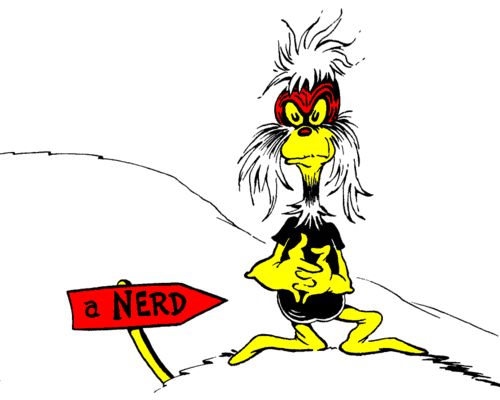
If the legend is to be believed, Dr. Seuss originated the word “nerd” in the book If I Ran the Zoo. I’m sure you’ve heard he was a nerd and invented many a word.
“We did show, for example, that Dr. Seuss—who makes funny non-words—made non-words that were predictably lower in entropy. He was intuitively making lower-entropy words when he was making his non-words,” Westbury reported. “It essentially comes down to the probability of the individual letters. So if you look at a Seuss word like yuzz-a-ma-tuzz and calculate its entropy, you would find it is a low-entropy word because it has improbable letters like ‘z’.”
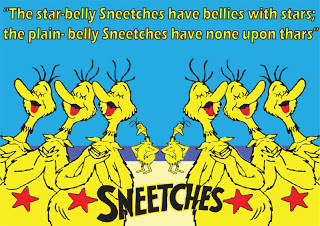
But no, Dr. Seuss did not write Sneetches Get Steeches.
Image found on The Man and the Wall.
Using all the information they’d gathered, Westbury and his fellow researchers set out to predict mathematically, based on entropy, what non-words people would find humorous, and they were able to do so with high rates of accuracy. Thus they were able to quantify an abstract concept, and test Schopenhauer’s hypothesis made nearly 200 years ago.
Trust scientists to boil a form of humor down to numbers. Now just add a “k” sound, and you’ll be unstoppable.
📧📧📧📧📧
Just a reminder: As always, the Voices page needs your letters. If you’re an Arkansas resident and haven’t had a letter published in the past 30 days, drop us a line, please; the page only works when you contribute.
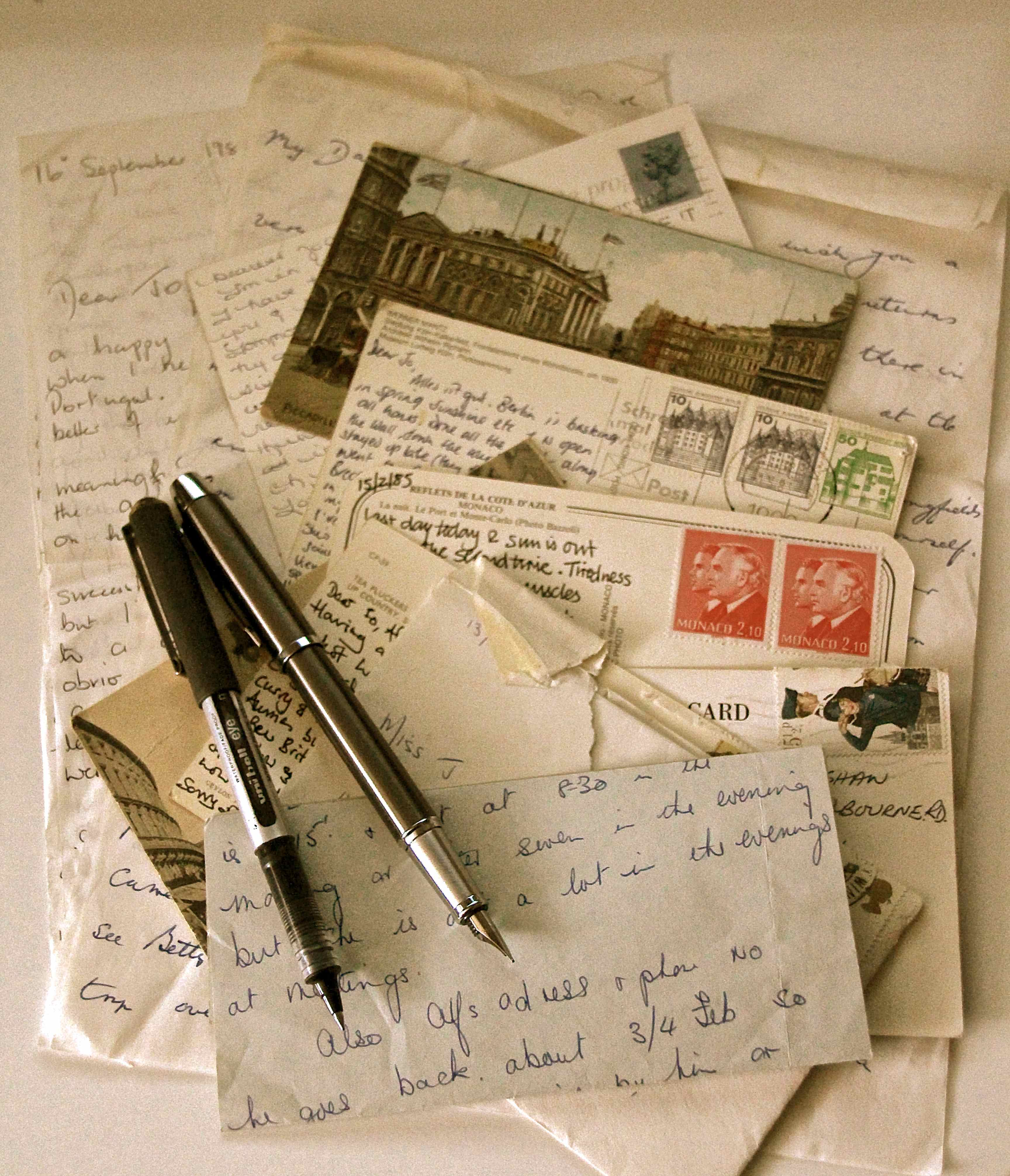
All I ask is, if your handwriting is illegible, have someone else write it, or find a typewriter or computer. I’m not great at reading scrawl.
Image found on Very English.
Write a letter of 300 words or fewer, and send it by mail to Voices, P.O. Box 2221, Little Rock, Ark. 72203; by email to voices@arkansasonline.com; or through our Voices form. You can also fax it to (501) 372-4765 (be sure to mark it to the attention of Voices). Keep it clean, don’t personally attack other letter-writers, and just put a kibosh on discussion of personal/business disputes.
Beginning next month, I’ll start recognizing a “Letter of the Month,” which will be chosen from letters published in the previous month. While the final choice will be made by opinion staff, I welcome nominations of stellar letters (and, of course, your own great letters for publication and possible selection as the next month’s Letter of the Month).
There’s no prize, really, but hey, if your letter is picked, you’ll have bragging rights for the month and your letter republished under that designation (which doesn’t count against your 30 days).
That’ll show all those people who said you’d never make it.
Speaking of fun words to say:
I pause today to pay tribute to an Arkansas-born jazz artist who provided some of my favorite memories growing up.
Singer-songwriter-pianist-conductor-composer-producer (whew!) Bob Dorough, 94, died at his home in Pennsylvania on Monday. For the uninitiated, Dorough was the musical director for Schoolhouse Rock, an educational series of short cartoons, from 1973 to 1985, and wrote and/or performed many of the songs. Those ditties, which I still can be caught singing today, helped build my love of learning. Without Schoolhouse Rock, many of us might not know the Preamble to the Constitution, or know what interjections are. And thanks to Bob Dorough specifically, we understand conjunctions, adverbs and that three is a magic number.
If that weren’t enough, his song “Devil May Care” was recorded by Miles Davis. He also collaborated with Davis on the song “Blue Xmas,” and sang on “Nothing Like You” on Davis’ album Sorcerer.
There will never be another quite like Bob Dorough.
All I can say is: “Darn! That’s the end.”
 Serenity is a fuzzy belly