
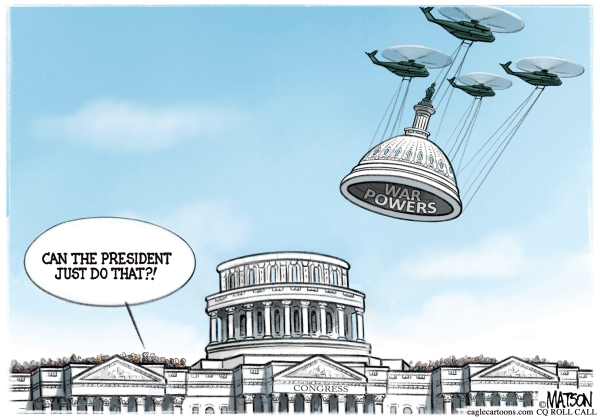
Saturday was my social-media break, so it wasn’t until Sunday that I could share my thoughts on what happened in Venezuela, which were not appropriate for a family newspaper (about now, the trolls on the newspaper site are probably claiming I support Nicolas Maduro because of my anger over what happened; they’re wrong, as I’m angry about the illegality of the move, which usurped, yet again, the power of Congress).
So I find my solace in words again, and in the Lake Superior State University’s 50th Banished Words List, released a couple of days prior.
And here’s an early suggestion for the next list: Donroe Doctrine. Yeesh. James Monroe is turning in his grave.
Among the banished in this golden anniversary year:

🤪 6-7. Every generation has had its nonsensical phrase that annoys the “adults,” and 6-7 is no different. LSSU quipped in the press release, “The volume of submissions for this one could have taken up the whole list, at least slots 6-7.” (Ba-dum-bum.) One nominator opined, “it’s time for ‘6-7’ to be 86’ed.”
Take heart, as it will disappear as soon as it stops annoying us, and kids will find something new to bug us with after that. It’s the circle of life.
No one ever said the circle of life wouldn’t annoy the bejesus out of us.
😌 Demure. Nominators were tired of this word’s association with the “very demure, very mindful” meme originating with TikTok influencer Jools Lebron in August 2024, with one remarking, “It’s very said more than very done, and we’re all very done hearing it!”
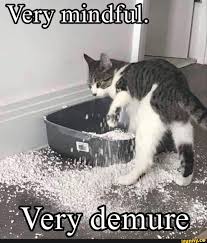
Considering how few of those claiming to be demure actually are, I can understand that. I’m not sure anyone really knows what it means anymore.
😵 Cooked. This is one I hadn’t heard in the sense it’s being used now, probably because my nephews and nieces are mostly grown, so I had to look it up. Merriam-Webster defines it as the description of someone or something in a state of possibly irreversible misfortune and hardship. Other definitions include being exhausted, overwhelmed, burnt out or intoxicated.
That pretty much describes the bulk of us, especially after the weekend we just had. Could someone please point the way back to reality?
📏 Massive. LSSU noted, “This word’s massive overuse has secured its place on this year’s list.” It’s one of those words journalists are generally discouraged from using other than in quotes, as we should quantify with numbers. What may be massive to one person may be piddling to another.
🛑 Full stop. Some people like to emphasize what they say with words and phrases like “period” and “full stop.” It’s redundant, annoying, and not nearly as effective as those people like to think. Just be clear and direct, please.
💯 Perfect. One nominator remarked, “There are very few instances when the word actually applies,” and that’s true. Besides, perfect is so often subjective unless we’re talking about test scores.
📊 Incentivize. LSSU noted, “In the longstanding effort to turn nouns into verbs, this is another culprit,” with at least two nominators likening it to “nails on a chalkboard,” and another asking, “What’s wrong with motivate?”
Absolutely nothing, but some people like the sound of business jargon. I am not among them.
Speaking of the verbing of nouns (as a reader did in a letter printed Tuesday about our editorial colleagues’ use of “suspicion” as a verb), gift/gifted (as a verb) showed up on the banished list this year, but not for the first time (“gifting” was banished in 1994). I remember clearly that before he retired as editorial page editor, Paul Greenberg would take colleagues aside for a reminder that it should be the actual verb forms (give/gave/given) that should be used. I had one columnist (now deceased, as is Paul) who was notorious for his love of that particular word, as well as a few others that I was forever editing out of his pieces. More than a few could use that lesson, and not just with gift/gifted/gifting.
Two more repeat offenders that appeared on this year’s list were “My bad” (banished in 1998, with one of this year’s nominators saying, “It does not convey much meaning in the way of an apology”; back when I worked at a TV station, I worked with someone whose mistakes I would often have to correct after the fact, hopefully before they reached air, and he’d always say, “My bad” … grrr …) and “Reach out” (banished in 1994; one nominator this time around noted, “What started as a phrase with emotional support overtones has now become absurdly overused”).

Sometimes banished words and phrases have to be re-banished in subsequent years (it’s not like the banishment list has the force of law). LSSU noted a few of the words and phrases that, like “gift/gifted,” “my bad” and “reach out,” refuse to die, including “absolutely” (I assume absofreakinlutely is kosher), banished in 1996 and 2023; “at the end of the day” (one I particularly despise), banished in 1999, 2022 and 2024; “awesome” (which has strayed far from its roots), banished in 1984 and 2007; “game changer” (ARGH!), banished in 2009 and 2025; and “hot water heater” (please stop heating hot water; it’s already hot!), banished in 1982 and 2018.
The university remarked, “What began as a whimsical New Year’s Eve party idea in 1976 has grown into a global reflection on the words that wear out their welcome. Since former public relations director W.T. (Bill) Rabe showcased the first ‘List of Words Banished from the Queen’s English because of mis-, mal-, over-use, or general uselessness,’ LSSU has carried the torch.”
And those of us who care, perhaps too deeply at times, for the English language, thank the stars for that. If nothing else, it gives us something to think about when the world disappoints us.
And believe me, the world will continue to disappoint, especially if you believe in the rule of law in the current atmosphere.
 Serenity is a fuzzy belly