

One of my favorite pictures of David as a kid; the image just says so much.
On seeing news last week of first Kate Spade’s and then Anthony Bourdain’s deaths due to suicide by hanging, I had a flashback to the day in October 2014 when my mom called me about my nephew. David, who had had a troubled life but had made many positive changes, killed himself, leaving family and friends to mourn him, but none of the attention being given now to the latest celebrity suicides.
And that’s how it is most of the time when an ordinary citizen commits suicide—unless it was done in a very public or highly unusual manner, or the person is well-known locally. That’s how most local media tend to cover single suicides as well, which is to say almost not at all.
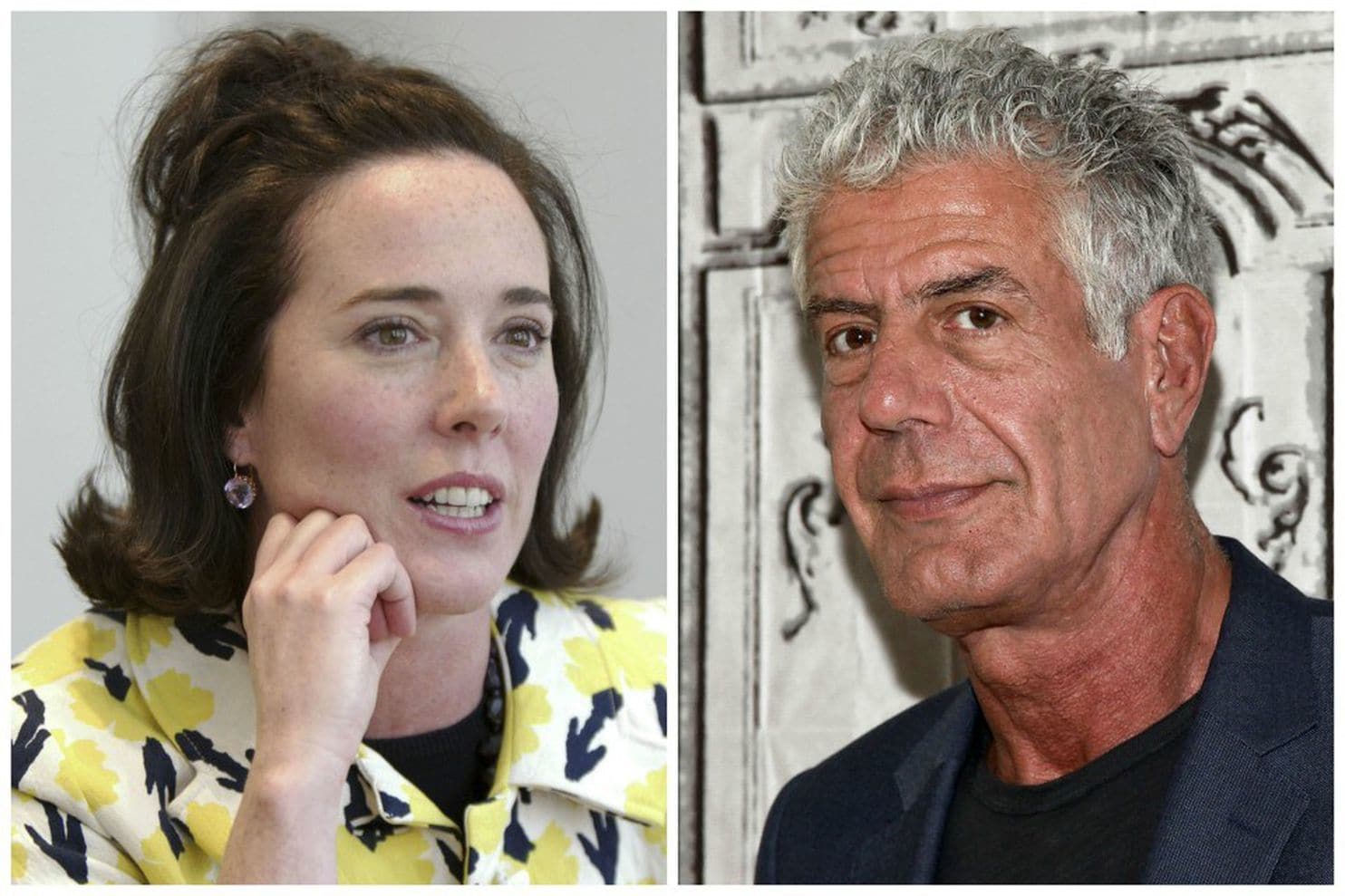
Designer Kate Spade and chef/food writer/adventurer Anthony Bourdain died within days of each other, both having hanged themselves.
Associated Press image found on Washington Post.
The same week that Spade and Bourdain killed themselves, the Centers for Disease Control and Prevention released a study covering 1999-2016 showing that the suicide rate in the U.S. has been increasing for years in nearly all states and across demographic lines. Nevada’s rate actually went down slightly, the only exception, but still had one of the highest rates.
Nearly 45,000 people in the U.S. died by suicide in 2016, more than twice the number of murders, and the most common method was with a gun (another reason reasonable restrictions are needed). Twenty-five states, Arkansas among them, experienced suicide-rate increases of greater than 30 percent; Arkansas’ rate was up nearly 37 percent. The American Foundation for Suicide Prevention states that, based on CDC data, every 16 hours on average someone in the state dies by suicide, which is the 10th leading cause of death.
The CDC found that Montana had the highest rate for the last period studied (2014-2016), at 29.2 suicides per 100,000 residents, followed by Alaska (28.8), Wyoming (28.8), New Mexico (26.0), Utah (25.2), Idaho (24.7), Oklahoma (23.5), Colorado (23.2), Nevada (23.1), and South Dakota (22.6). Arkansas’ rate was just outside the top 10, at 21.2 per 100,000 people. The national average was 13.4.
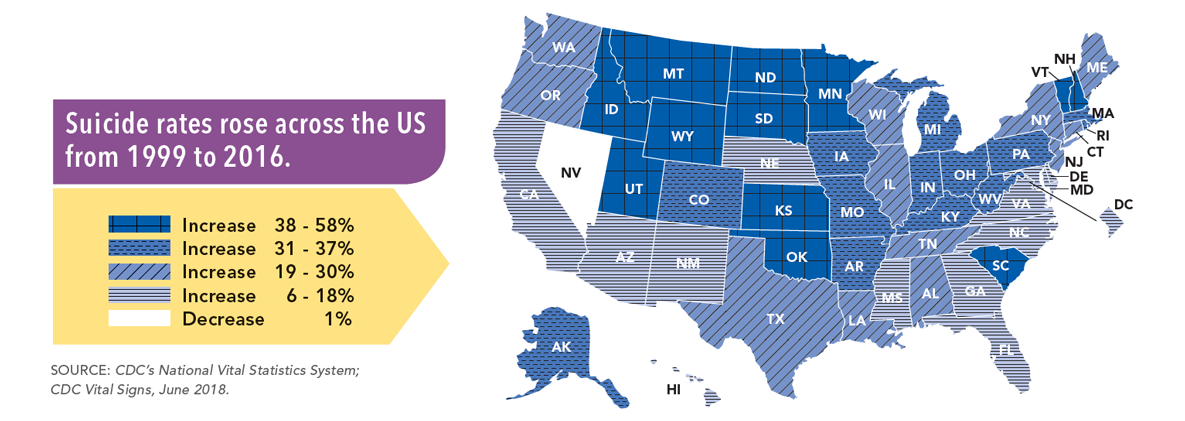
I’m depressed just looking at this map.
Image found on Centers for Disease Control and Prevention.
Mental illness tends to be blamed more than it should. Tens of millions of us—about one in every five Americans—live among you every day without you knowing that we have a mental illness. For years I was a functional depressive—until I wasn’t quite so functional. Getting treatment quite likely saved my life, and there are many more just like me. I still have bad days, but I’m functional again.
Yes, mental illness does have something to do with some suicides, but the CDC reported that in the 27 states that use the National Violent Death Reporting System, 54 percent of suicides were among people with no known mental health condition. Sometimes that’s because those people were never diagnosed, but there are other factors besides mental health that can awaken suicidal tendencies. Stressors like losing a job, a debilitating and/or terminal illness (which, combined with depression, did in Robin Williams), or loss of an important relationship can also come into play.

We tend to forget that not everybody is as happy as they appear.
Image found on Everyday Health.
Christine Moutier, medical director of the American Foundation for Suicide Prevention, told the Washington Post, “I think this gets back to what do we need to be teaching people—how to manage breakups, job stresses. What are we doing as a nation to help people to manage these things? Because anybody can experience those stresses. Anybody.”
In a nation that’s become so highly partisan, it seems we’ve forgotten that we should be looking out for our fellow man—not just the ones who agree with us. The reasons someone may choose to take his or her life are deeply personal. Suicide shouldn’t be used as a political pawn, nor recast to fit an agenda or conspiracy theory (as both Spade’s and Bourdain’s deaths have been—it all comes down to Hillary, of course … do yourself a favor and avoid Liz Crokin’s posts … you’re welcome). And if you have to make up stories about why people killed themselves to further an agenda, you’re part of what’s wrong with this world.

We can all use a helping hand.
Image found on Science of the Spirit.
If someone you know has been talking about wanting to die, feeling hopeless or being a burden, or if he or she has been isolated, experiencing mood swings, sleeping too much or too little, or acting agitated or reckless, experts say you should stay with that person, remove anything that could be used in a suicide attempt, and seek help from an emergency room or mental health professional.
We can do that much, can’t we?
Many of us know someone close to us who has committed or attempted suicide. It could be the friend who was in an abusive relationship or was being bullied, or the father diagnosed with terminal cancer who wanted to go out on his own terms. Or maybe it was the highly creative person who seemed happy-go-lucky on the outside but was broken on the inside.
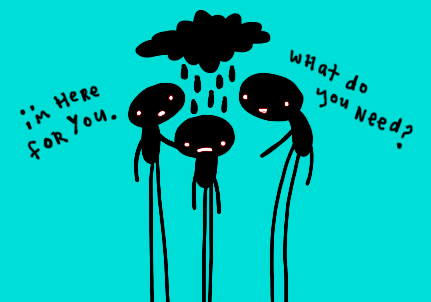
Sometimes just being noticed and heard can make a difference.
Image found on Meant to Live.
If you (or someone you know) feel the world would be better off without you and have been thinking of ending it all, call the National Suicide Prevention Lifeline at (800) 273-8255. Since December, Arkansas has had a local office to field calls (Wyoming is now the only state without one), so can better direct callers to resources in the state that can help, which could be the difference between life and death.
None of us is immune to thoughts of suicide, regardless of status, party, religion, age, or gender. It is a truly human crisis.
And it’s one we must not be afraid to battle.
🥀🥀🥀🥀🥀🥀
I know, this is a pretty depressing post (and not that much different from what appeared in the paper), but it’s been a pretty depressing week. I’ll endeavor to be goofy again next week. I’m open to suggestions.
 Serenity is a fuzzy belly
This may be a depressing post Brenda but sometimes you must be serious and most especially when you are discussing something as serious as suicide. Sometimes you just have to deal with and comment on serious subjects instead of being silly, ridiculous, and goofy.
I wonder how many of those suicides were military veterans?
LikeLike
I haven’t had a chance to really dive into all the data, but I don’t recall any that broke out specifics like that (but should). I know there are a lot of vets struggling.
LikeLike
I don’t know but we do seem to have a lot of patients here who are attempted suicides.
LikeLike
I know there are a lot of people with PTSD, vets or otherwise, who commit or try to commit suicide.
LikeLike
I wouldn’t say this was a depressing column, given the role of depression in suicides. It is, however, sobering and eye-opening. I appreciated your guidance on dealing with the situation when it arises.
Be well
LikeLike
Thanks, Earl!
LikeLike