
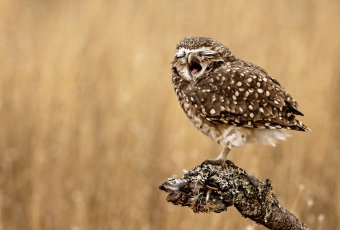
Me, most days. God, I need sleep.
Photo by Mario Fiorucci, 2016 winner of the Amazing Internet Portfolio Award in the Comedy Wildlife Photography Awards.
I haven’t gotten much sleep lately, partially because I just can’t shut off my brain. It constantly comes up with more thoughts to ponder, mysteries to decode, and earworms that won’t leave me alone. (Curse you, “99 Luftballoons” … I want “Bohemian Rhapsody!”)
What’s filling my brain? Oh, crazy things like the sorry state of civics education (good Lord, why do so many not understand checks and balances???), and that some people think consequences are only for other people (especially if they’re of differing ideologies). We have many rights, but seem to forget that when our practice of them infringes on the rights of others, we are subject to consequences such as lawsuits or job loss.
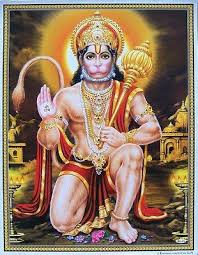
Let’s put this guy on the Arkansas Capitol lawn.
Image found on Wikimedia Commons.
Open up public property to displays for one religion? Don’t be surprised when there are suits to afford others, like the Satanic Temple, the same privilege … because Baphomet deserves a place just as much as the Ten Commandments on the Capitol grounds. If we’re going to open it up like that, I may have to gather my fellow word nerds to petition for Lord Hanuman who, besides being a Hindu symbol of strength and heroism, was also a grammarian and remover of obstacles. Or there’s ancient Egypt’s Bastet, protector of, among other things, cats. If you don’t know why that one would appeal to me, you’ve been napping … a cat nap, perhaps?
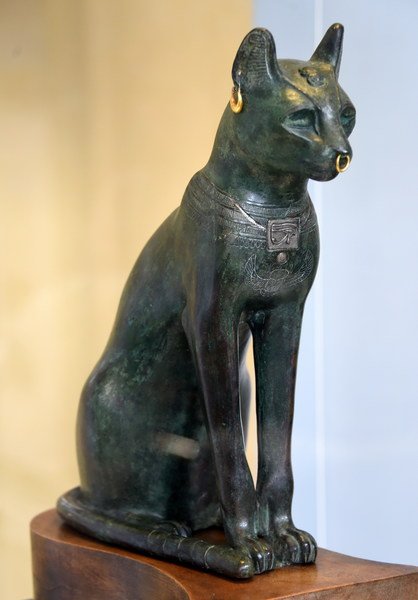
I have a small Bastet bust in my office, which I got when the Egyptian mummy exhibit visited the Arkansas Arts Center several years back.
Image found on Ancient History Encyclopedia.
Others forget that private businesses can fire you if your exercise of rights reflects poorly on them. Sure, go ahead and post that racist/sexist/ fascist/whatever rant on Facebook, but if your boss sees it or it goes viral for some reason, you might not have a job, especially if people know where you work and associate your boneheadedness with the business. Just because you have freedom of speech doesn’t mean you’re free from the consequences of that speech. Colin Kaepernick, for example, doesn’t have a job in the NFL after protesting police mistreatment of blacks by kneeling during the national anthem (no, he was not protesting the flag or the anthem). Roseanne lost her sitcom after a series of inflammatory tweets … sure, the Valerie Jarrett tweet put it over the top, but she’s got a history of similar tweets and furthering of conspiracy theories (and who could forget her anthem performance?).

You’re just gonna sit there and take it, buddy!
Photo by Christopher Schlaf from comedywildlifephoto.com.
The First Amendment, like all in the Bill of Rights, is not absolute (yes, that includes the Second Amendment, according to late Supreme Court Justice Antonin Scalia). It protects you from government suppression of free speech, but since most people are “at will” employees unless they’re in a union, private businesses can fire you for something you post on social media or elsewhere. Numerous public and private individuals have found that out the hard way, such as the Milwaukee police officer involved in the arrest of the Bucks’ Sterling Brown in January who was fired last week over his social media posts.

You are in so much trouble, mister.
Photo by Achim Sterna from comedywildlifephoto.com.
Cathie Anderson of the Sacramento Bee wrote in April that, according to legal experts, “private employers may well have an obligation to take a disciplinary action if an employee’s speech is injurious, offensive, threatening, intimidating or coercive.” Yes, labor law protects you if you’re using social media to gather employee support for changes in the workplace, but the National Labor Relations Board has upheld firings of employees who made incendiary posts online. “The NLRB,” Anderson wrote, “has said that employers can ban the use of provocative language as a precaution against bitterness and discord in the work environment.”

Oh. My. God. I can’t believe you said that …
Photo by Jakob Strecker from comedywildlifephoto.com.
But … but … I want to tweet highly offensive photoshopped memes that disparage women/ Republicans/Democrats/cat lovers/whatever, I hear you say. (Man, the pickup on these mics is awesome! Uhhhh … forget I said that. You are not being tapped. 😉🤨) Well, feel free, but don’t come crying to me when Human Resources calls you down for a “talk.” If you can’t face the consequences of possible disciplinary action, firing, social rejection, etc., though, I’d think about it first. Libel, true threats, and language that incites violence are among the speech not protected by the First Amendment.
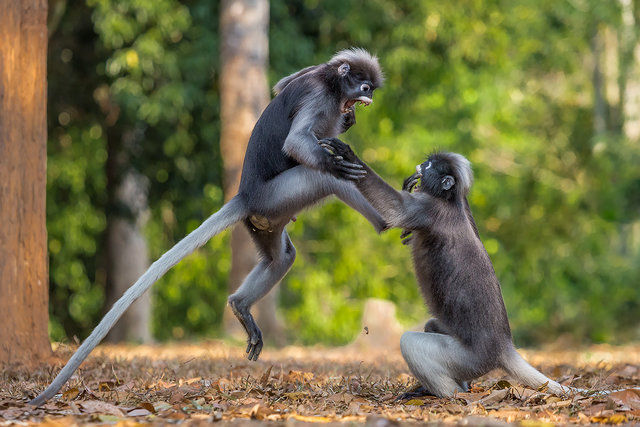
How could you support that orangutan???
Photo by Sergey Savvi from comedywildlifephoto.com.
Along the same lines, if you’re tossed off a social media platform, it’s not a First Amendment issue since it’s a private company. Social media companies like Facebook and Twitter aren’t constitutionally obligated to let someone continue to spout threats, conspiracy theories and lies; users, though, are obligated to follow the terms of service if they want to continue using the platforms. Violate those, and the companies are within their rights to toss you. Of course, it may take a while … and a lot of reports of violations from other users.
Really, Twitter? It took you that long to boot Alex Jones? Sandy Hook? Pizzagate? Parkland?
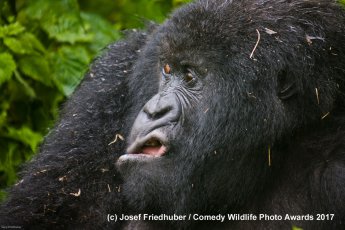
Everybody else banned the crackpot a month earlier … what was the holdup?
Photo by Josef Friedhuber, finalist in 2017 Comedy Wildlife Photography Awards.
So let’s review. Like Newton’s Third Law (for every action, there is an equal and opposite reaction), our actions have consequences, and we should be prepared to accept them, whether that’s opening up public grounds for displays from all religions, or getting fired or banned for something you’ve said.
Private organizations are not censoring or suppressing your free-speech rights by deleting your posts, not publishing your writing, or banning you from social media platforms. If the government were doing those things, it would be a First Amendment issue.
Private companies can discipline an employee for things said online or in public. It’s a stickier situation if the employee works for a publicly funded entity. It’s the same situation if a university cancels a controversial speaker; there’s likely no First Amendment issue if it’s a private university, but it could be if it’s a public one.
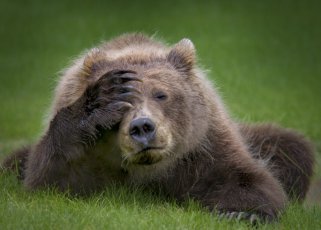
Good Lord … won’t they ever stop????
Photo by Danielle D’Ermo from comedywildlifephoto.com.
And one more thing: The First Amendment doesn’t protect the rest of us from having to suffer through cries of victimhood from people who didn’t follow the rules and had to face the consequences of their actions.
Dang it.
(By the way, most of the images accompanying this essay are from The Comedy Wildlife Photography Awards website, and unless otherwise noted, are up for the People’s Choice Award. Go vote, people!)


To quote from The American President, one of my favorites, “Democracy is hard. You gotta want it bad.” (paraphrase from memory)
Free speech is particularly complicated. As you point out: (1) you are free to say what you want; (2) a private employer is free to fire you for saying it; (3) your supporters are free to boycott that company, etc.
Spoiler alert for those burning their Nike clothing, by the way: you DO know they already have your money for that clothing, right?
No wonder the appeal of authoritarianism to those of limited intellectual ability, like Agent Orange. Democracy is hard . . . but worth the effort.
LikeLike
Hear, hear!
I despair at the number of people so willing to believe whatever he says without evidence, but know that there aren’t as many like them as they believe.
LikeLike
Some people (no to mention any names) seem to think Donald Trump is Ghod.
LikeLike
“(not to mention any names)”
LikeLike
🤢
LikeLike
Whenever my Golden Retriever yawns, I jokingly suggest that maybe he should take a catnap.
LikeLike
Does Marley give you a dirty look when you do? 🐕
LikeLike
No he just gives me a confused look because he doesn’t understand what I am saying. However, on the other hand, it is good for him psychologically, emotionally, and mentally because he knows that I am talking to him and paying attention to him instead of ignoring him. He likes that.
LikeLike
Awwww.
LikeLike