
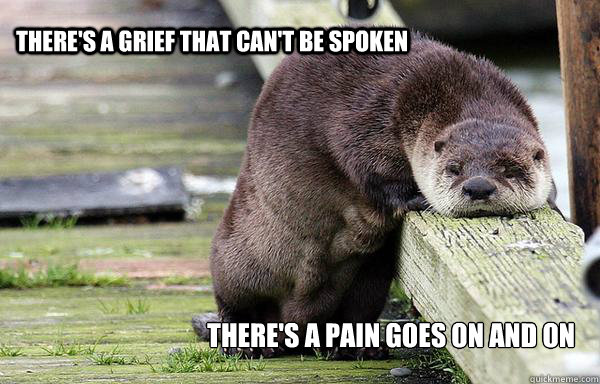
Grief is otterly horrible.
Sorry, Mom, for the bad pun.
Image found on QuickMeme.
When someone you love dies, it takes time to get back to normal. And when you weren’t all that normal to start with, well …
Mom would probably tell me to remember to hydrate, as grief can suck the moisture out of you in so many ways (but at the moment I could probably furnish water to a small village, provided it has a desalinator). Then she would chide me gently for missing an error on the page. That is, if I hadn’t already beaten myself up about it.

Good effort, Ralph, but keep trying.
GIF found on tenor.
My mom always supported my urge to learn more: How photosynthesis occurs (there’s this whole business with sunlight and chlorophyll … I used to know the equation by heart, but now, well …). Why proportional or district allotment would create a fairer electoral college than winner-take-all (neither small nor large states would have as much of an advantage as small states now appear to have, and people, not land, would have power). Who said, “Let the hospitality of the house, with respect to the poor, be kept up; let no one go hungry away” (that old socialist George Washington, who also cautioned against encouraging idleness). Why Stephen King is not given the recognition he deserves (well, duh, horror writer, and yet he’s capable of making you feel like you’re actually witnessing the events in the story … the man is a captivating writer).
And when it came to words, grammar and usage, she wasn’t alone in the family. I was lucky enough to have a cousin by marriage, Mary Lou Looper, who taught English at my high school for decades (including to my brothers and me), transmitting her love for words, poetry and prose to more than one generation.
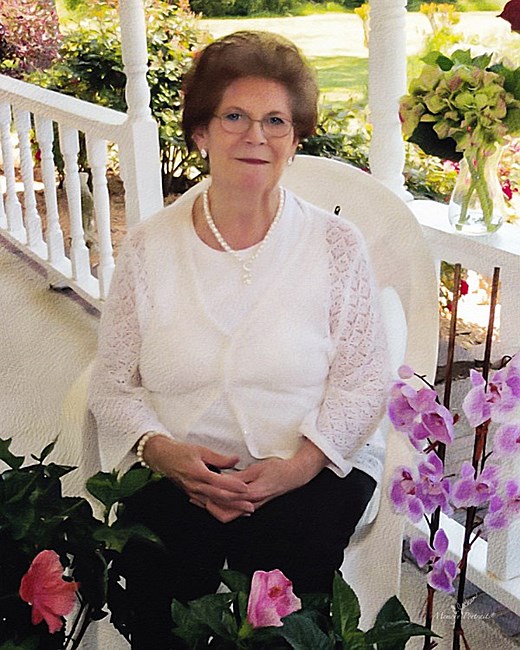
Mary Lou and her husband Charles also used to organize our family reunions for a while after the death of one of my great-aunts. I’m sure she and Aunt Irene are giggling together now.
Image found on Dignity Memorial.
Beowulf made her cry, and Shakespeare (especially the Scottish tale) provoked passionate readings. She made many love the classics, and she wasn’t afraid to laugh at herself. I was saddened by her death late last year, but I’m glad she’s no longer in pain.
I often feel her presence any time some sort of word usage irritates me or is in the news, whether it’s someone using a word improperly, or perhaps horribly mispronouncing something. I always remember her telling us, “Make sure you put the em-PHAS-is on the right sy-LLAB-le.”
I think, though, that we might have had a little contretemps over the word that caused me to cuss a bit last week: entitled. Yes, even laid-back word nerds get annoyed by words. Try continually mispronouncing “havoc” around me. Just try it, I dare you.
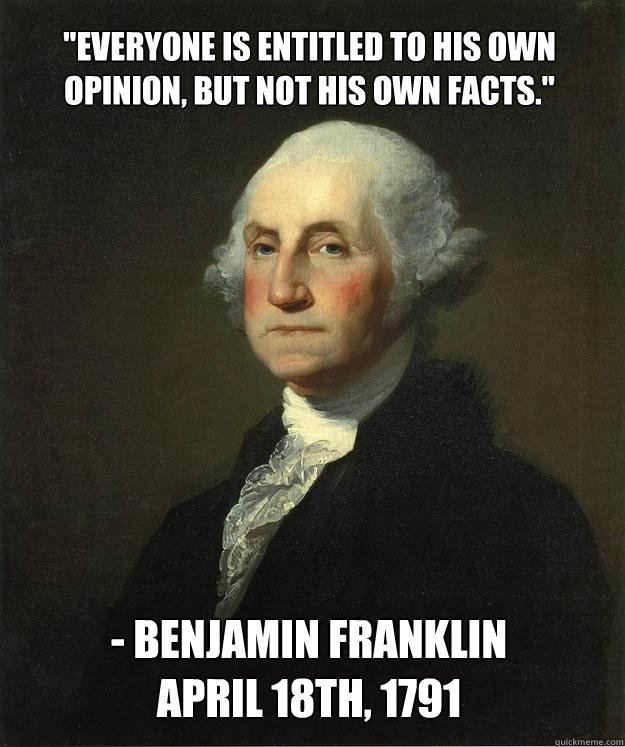
Whoa … ol’ Ben doesn’t look quite right … that kite must have fried his hair.
Image found on QuickMeme.
At the Democrat-Gazette, we follow Associated Press style, but we also have our own house style rules, which in some cases supersede AP’s. AP style (and ours) holds that “entitled” should not be used when referring to naming something, but rather when someone has a right to do or have something. According to AP rules, you couldn’t say, “The book is entitled Tales of Hogsnort.” You could say, though, “You are entitled to your own opinion, but not your own facts.” (God bless you, Daniel Patrick Moynihan!)
Grammar rules and dictionaries would tell you “entitled” and “titled” are virtually interchangeable, but I, a newspaper weirdo, disagree. The Grammarly website notes: “[I]t’s not the verb title that people find strange when talking about naming books or papers or works of art. Entitle is the verb that some deem objectionable for use in the context of giving names, even though this is one of the meanings the verb can have. … The thing about entitle that rubs some people the wrong way is the other meaning the verb might have—‘to give the right’.”
Darn right. Newspaper style rules are there for many reasons, one of them being to keep meanings clear, and sometimes sticking to strict grammar rules can make things muddy or far more complicated than need be. Yes, you can split infinitives and not use “whom,” just so long that your meaning is clear.
Hey, I’m entitled to my own reality, so stay out of it!
Image found on someecards.
Grammarly concedes the point that such a broad use of “entitled” can cause confusion: “Clearly, the reputation of entitle as a verb that means ‘to give a name’ is damaged by the other meaning of entitle—‘to give a right.’ And the adjective entitled isn’t helping either. So, while you technically are entitled to use the verb entitle in both its senses, a case can be made that title would be a better choice for the sense the two verbs share.”
So there. Nyah.
Sometimes the weird newspaper types have a good point. High-flown language may impress, but simple, direct statements and clear definitions make stories much easier to understand (not that people don’t read their own meanings into stories regardless …).
Plus, those newspaper style quirks give word nerds something to talk about when they’re stuck.
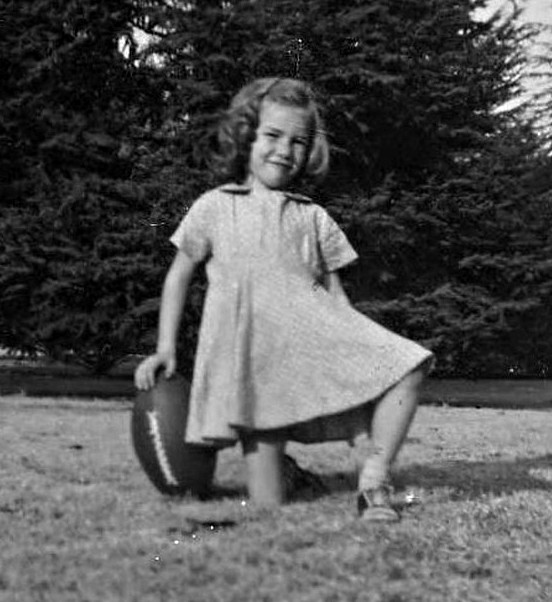
Mom was Lucy before Lucy.
A personal note now, to everyone who has called, emailed and written by snail mail or Internet comment after the death of my mom: Thank you so much for your care and concern, and for sharing your own losses with me. I can’t tell you how much each message of comfort meant to me and my family.
Mom was a huge influence in my life, and she gladly took credit for my weirdness. I have yet to figure out what to do at those times I used to talk to her every day, and often think, “I need to tell Mama about this” before I remember I can’t.
But I’m fairly sure her spirit is hanging around, if just to snicker every time I trip over my own feet. Not that it happens a lot. I’m grace personified, you know.
Annnnd, stepping away from the inevitable lightning bolt …


I love the struggles over not ending a sentence with a preposition. As Churchill said, “This is the type of errant pedantry up with which I will not put.”
Or there’s the story of the down-home boy visiting Harvard Yard and asking a passing professor, “Where is the library at?” The response: “Sir, at Harvard, we do not end a sentence with a preposition.” Provoking: “Sorry. Where is the library at, a–hole.”
For myself, I take pride in having ended a book with a preposition. Somehow, my editors let that one slip.
LikeLike
Mwahaha!
A lot of grammar rules are simply personal preferences of the people who made them. Language shouldn’t stress you out if it’s your native tongue. If your meaning is clear, a split infinitive or preposition at the end is nothing to get your knickers in a twist over. Just don’t misplace your modifiers, because I will laugh. 😂
LikeLike
Normality is over-rated. Speaking from experience, I think it is better to be what the attorneys call: “Non Compos Mentis”. That is a fancy Latin term for crazy as in lacking sanity.
LikeLike
Crazy gets a bad rap … you can be fun crazy. 😜
LikeLike
From “Pogo” by the late Walt Kelly: “You couldn’t find Memphis with a compass.” “Memphis don’t need no compass. Ever hear of Non Compass Memphis?”
LikeLike
🤓
LikeLike
This is a typical example of the type of wordplay Kelly liked to indulge in and use in Pogo.
LikeLike
You shouldn’t beat yourself up over your mistakes because some of the people who read your blog probably would like to beat you up for some of the things you say. Especially the people who voted for Donald What’s-His-Name to be our President.
LikeLike
Then my job is done. 😉
LikeLike
My ex-wife and her crazy sister did not like or understand or appreciate either poetry or any of the plays of Shakespeare or Beowulf. Sometimes I wonder how they ever graduated from high school.
LikeLike
I wasn’t as moved by Beowulf as my cousin, but I still love Shakespeare. Those who can’t or refuse to appreciate great poetry and prose are really missing out.
LikeLike
I would quote that line about using your own opinion and your own facts at my former sister-in-law but all I would get from her would be a confused look.
LikeLike
That’s pretty much what I get from the people whose letters can’t pass a simple fact-check.
LikeLike
The former sister-in-law is not literate enough to write a letter which would pass a simple fact check.
LikeLike
Ha! 😂
LikeLike
Occasionally I see or hear something which I think my father or my mother might have enjoyed but I can no longer share it with either one of them.
LikeLike
It’s hell being an orphan, even at my age. 😞
LikeLike
Yes.
LikeLike
You were very blessed to have such great early influences. Grammar is not one of my strong points, but I try not to let it interfere with my storytelling. Fortunately, a couple members of the Grammar Police are regulars at the writers group I attend. They keep me in line and gently correct my ignorance.
Enjoyed your post,
Russell
LikeLike
I’m a big proponent of conversational grammar. While completely proper grammar is necessary in professional settings, when talking to people (which is what my blog and column are), the aim should be understandability rather than perfection. I know my grammar, but I’m not a grammar snob … those guys ruin everything. 😉
LikeLike