
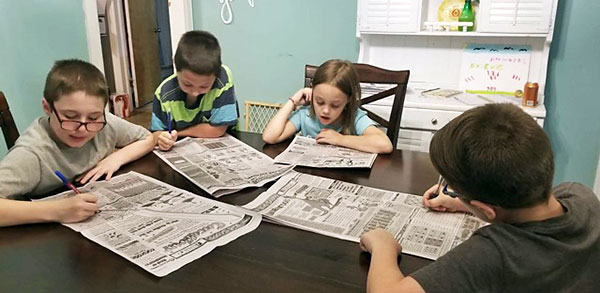
Too bad some papers are moving to mostly or all-digital distribution. Generations of kids won’t have the joy of news ink all over their hands.
Image found on Kidscoop.
Reading John Brummett’s Tuesday column in the Arkansas Democrat-Gazette on his lifelong connection to newspapers in the midst of the change to digital delivery, I couldn’t help but laugh as I was reminded of all the words children (and some adults) have the tendency to mispronounce, sometimes in embarrassing but hilarious ways.
I also read many of the sports articles and revered the bylines. I could figure out from the context the meaning of words even as I mangled their pronunciation.
A rookie had made his major-league “de butt.” That meant his first game, his “debut.”
In a player’s contract dispute, one guy accused another of having “my-zuld” him. That meant telling him something that wasn’t so. It was spelled “misled.”
Last week I talked about words that are a pleasure to say. This week, let’s go for the pain.
Anyone with kids, or who has spent a lot of time around them, probably has stories of funny mispronunciations that go beyond “pasketti and meat bulbs,” many of which probably would not be publishable in a family newspaper.
I know of one mom whose son, a toddler at the time, had a problem with the word “firetruck” … which was rather unfortunate one day in church.
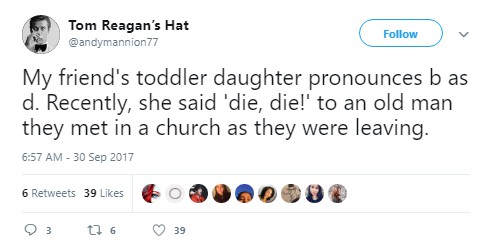
But is he an old man who’s kinda creepy? If so, that would be entirely appropriate.
Screenshot from Tom Reagan’s Hat’s Twitter page.
For a time when I was a kid, I couldn’t pronounce the “r” in “world.” I don’t recall having issues with other words, but I do remember saying “wold” an awful lot. I was cute then and could get away with it. Now I’d probably be called a dunce if I still pronounced it that way. Or maybe “President.”
Then there are the words constantly mispronounced that drive some of us more nuts than we already are, especially when someone adds syllables, or tries to pronounce all the letters when some are silent. I often blame George W. Bush for the NOO-cue-lur pronunciation of “nuclear,” though he was far from the first to do that. Likewise, “realty” is pronounced REEL-tee. If it were pronounced REEL-uh-tee, it would be spelled “reality,” which is an entirely different word … and a completely different reality for some.
Other words look far more complicated than they are, like Worcestershire (ignore the “rce”; think “Wooster” and “sure”). And who can forget the French taunters in The Holy Grail and “kaniggits”?
Is it any wonder that people learning English as a second language—especially the American version—have so much trouble? And that’s before introducing common idioms and regional pronunciations. (They probably think PEE-cans and puh-CAHNS are different nuts.)
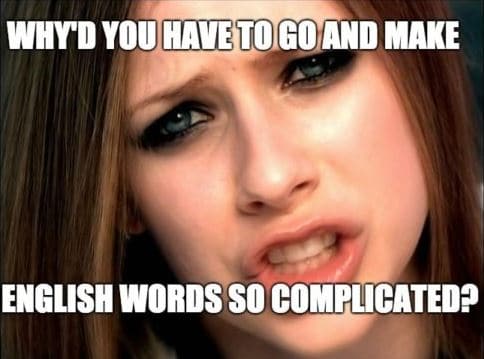
Because we’re Americans and we can, Avril.
Image found on FluentU.
Bookworms like me who learned to read early by sounding out the words without having heard them before probably are a bit more guilty of this (I quickly tired of my brothers’ old primers, so moved on to other books in the house). But hey … it’s not our fault when words aren’t pronounced how they’re spelled. I’ll never forgive the word “blackguard” (BLA-gerd), for example. And you can just imagine how I pronounced many of the names in Greek mythology, which I was obsessed with for several years. Poor PEN-ny-lope … but she was DEE-ter-mined to stay true to her husband ODD-ee-soos.
Yes, word nerds can have issues with words. Deal with it. Maybe that’s why we have such a fascination with them.
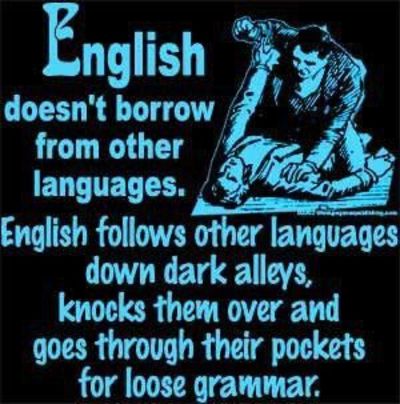
And then it says, “I came up with this all on my own! I’m a stable genius!”
Image found on Juxtapost.
But in our defense, English, which borrows heavily (OK, steals outright) from other languages, has the tendency at times to confuse even native speakers (see blackguard). Sometimes we change the spelling to reflect the actual pronunciation, such as “vittles” instead of “victuals.” And sometimes we leave the words as they are from the languages from which we swiped them, possibly as some sort of cosmic joke for kids who don’t realize it’s not “de butt.” Because “butt” is never not funny to a kid, and to more than a few grown people. (She said “butt.”) Hey, my mom loved “Titicaca” (as in the South American lake) to her dying day. If you listen really hard, you might still hear her chuckling over it.
Some of us never get over being 12. Hell, some of are still functionally toddlers and shouldn’t be left alone with sharp objects or expensive anything. And definitely not smartphones with a Twitter app.
I still have words that I won’t attempt to say in public because I’m afraid I’ll embarrass myself, but I know what they mean because I often read them in print. Ask me to say chiaroscuro (treatment of light and shade in art) and you may get a mumble or a stumbling pronunciation as I go through the syllables in my head, but I can use it in writing with no problem. Sure, I used to do public speaking in high school, but things have changed, especially since my stroke. If I tried to pronounce chiaroscuro now, someone might think I’m having another stroke.
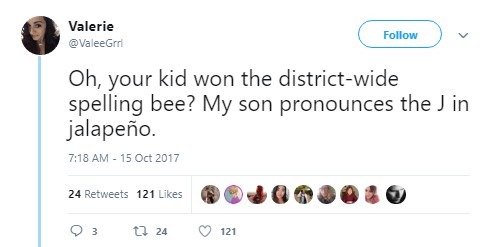
So did I! Book-readers unite!
Screenshot from Valerie’s Twitter page.
Words like genre, faux, quay, and colonel can easily trip up readers if they’ve never heard them because they’ll sound them out according to the letters that are there. I always hear LeBeau from Hogan’s Heroes (which was on in the afternoon in syndication in my area) saying col-oo-NEL, because that’s how I thought colonel was pronounced when I first read it.
Now, with so much of our lives being lived online rather than in the real world, we may see even more of this. We have really got to get out more. Especially if we’ve been pronouncing “satin” as “Satan.”
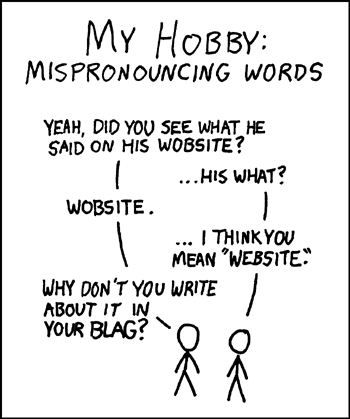
Believe it or not, I didn’t write this comic.
Image found on xkcd.
Unless it’s on purpose to mess with fake evangelicals (they know who they are, and they have no sense of humor). I fully approve of that.
Having learned to read before I was school-age (because I had to be able to do whatever my brothers could do), I share a certain amount of empathy with mispronouncers. Most people learn from their mistakes and pronounce words properly once they’ve been corrected.
Most people.
Some, though, seem to take no small bit of glee in making people cringe by ordering ex-PRESS-oh or picking up their pur-SCRIP-shuns and engaging in HI-per-bowl. They probably also like to call in the Calvary.
Those people get no passes from me, but they will get a stony glare. And maybe a wedgie. Depends on my mood.
 Serenity is a fuzzy belly
When I was working in the hospital kitchen one evening the patients got spaghetti and meatballs in tomato sauce for their meal. When one of the patients asked me what was for supper, I jokingly told him it was Italian worms in blood with balls of dirt. He understood the joke when I lifted the lid off if the plate and started laughing.
LikeLike
It sounds so appetizing! 🤢
LikeLike
Fake evangelicals? Like my former sister-in-law?
LikeLike
Probably so. They’re usually the ones who are loudest and least likely to help their fellow man unless that fellow man agrees with them.
LikeLike
Yes that describes my former sister-in-law.
LikeLike
It describes the majority of the trolls on the paper’s comment boards. People like that are apparently miserable and want everyone else to be the same way.
LikeLike
That accurately describes my former sister-in-law. She is trying too hard to convince herself that she is happy and lucky and Blessed. However, she is actually miserable, unhappy, and depressed–partly because she can’t always get what she wants.
LikeLike
I’ve never seen as many miserable angry happy people as I have in the past few years.
LikeLike
Sometimes when I jokingly refer to creatures as “critters” on Facebook, an infamous Grammar Nazi just has to correct me.
LikeLike
That someone has a stick up his/her whatsit. Language should be enjoyable.
LikeLike
Yes I agree. Language should be enjoyable and we should be able to play around with language and have fun with language. A similar thing happened when I borrowed a word for “lawnmower” from the comic strip Pogo by Walt Kelly. One of the characters in this comic strip referred to the lawnmower as a “longmolar” one day. On Facebook, I commented that I had butchered my lawn with a longmolar and someone didn’t like that.
LikeLike
Probably because molars aren’t good for mowing. Try the canines next time 😉
LikeLike
Did I ever tell you what Lawrence Welk said in rehearsal one day?
LikeLike
If you did, I don’t remember. I also don’t remember what I had for dinner. 🤔
LikeLike
You don’t remember what you had for dinner? Food, I hope.
LikeLike
I’m not sure …
LikeLike
As for Lawrence Welk, he grew up in a home in North Dakota where German was the primary language since his family had emigrated here from Germany. Welk did learn to speak English fluently but he still had trouble understanding idioms and slang. Since trumpets and trombones are referred to generically as “horns”, one day during rehearsal for his show, Welk was unhappy and dissatisfied with the accuracy and the amount of energy and enthusiasm displayed by the trumpet and trombone players. Welk told them to “Play more horny.” No Welk didn’t understand why everyone started laughing at him until someone explained his mistake to him. Then Welk blushed bright red. I heard this story from Jo Ann Castle when I saw her perform at the Scott Joplin Festival in Sedalia, Missouri in June 1985. As part of her act, Castle told this and some other interesting stories as well as playing lots of ragtime piano music.
LikeLike
😂
LikeLike