
Words have always been a comfort to me, whether it’s the loving affirmations or jokes of a parent, sibling or friend, or ink on a page. They make me smile, laugh, and remember better times.
Over the weekend, words both inspired and comforted me in view of the Ukraine invasion.
A few of my Facebook friends posted a guest column that had appeared in the Jonesboro Sun by Dr. Alexander Sydorenko, my old history professor, who is a native of Ukraine. As I expected, he is horrified but unfortunately not surprised by the Russian invasion of his homeland, stating that “Russia was always noted for its barbarism and disregard for human values. … [H]istorically, Russia—tsarist, Soviet or Putin’s—was never a nation but a despotic state intent on aggression and conquest. Russia was and is a virtual nation. It was always a brutal empire. Russia glorifies its bloodthirsty tyrants (Ivan the Terrible, Peter the Great, Stalin), and its people are sustained by a mythical ‘Russian glory’ and ‘invincibility.’

“Clearly Putin equated himself with the likes of Peter the Great and Stalin, but he is neither: He is no more than an evil megalomanic midget—admittedly with a large nuclear arsenal—presiding over agony of a doomed evil empire.”
And clearly Dr. Syd still doesn’t mince words when it comes to Russia, just as he didn’t years ago in that “Communism in Crisis” honors seminar on the collapse of the Soviet empire and its efforts to spread communism.
Along those lines, friends have contributed words for me to ponder, some obsolete or nearly so and many of them from Grandiloquent Words, in recognition of last week’s column concerning “scurryfunge.” Several popped out at me as descriptive of dictators and the like. This week, how about we open the books for some new ways (well, new to most of us) to describe old ways of acting the despot?
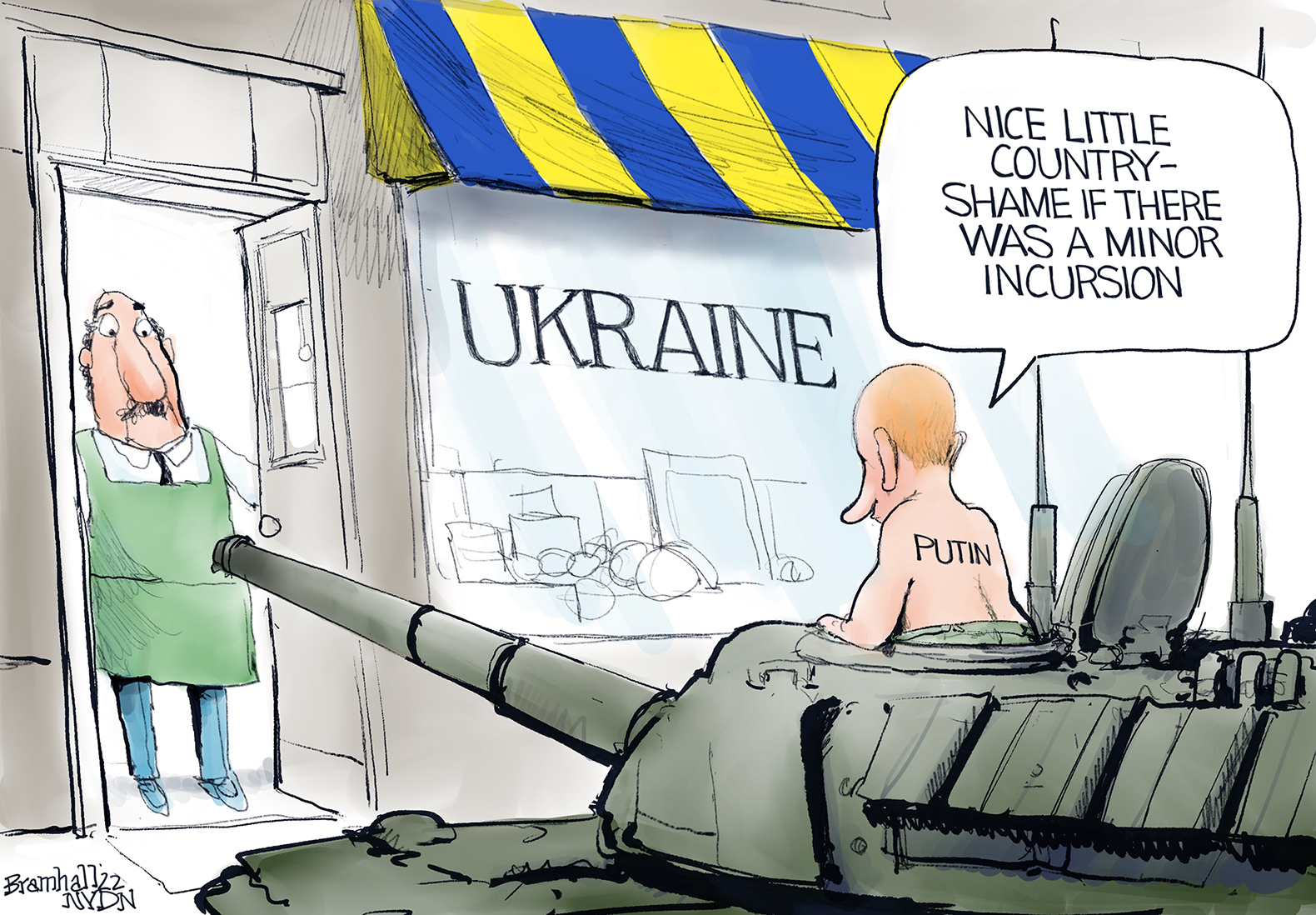
One might be tempted, considering that Vladimir Putin is finding Ukraine to be much harder to conquer than he imagined it would be, to call Vlad a “blatteroon,” meaning a babbler or senseless boaster. But then, he doesn’t babble as much as some (ahem, such as a certain orange-tinged braggart), so maybe not. He is frequently, though, guilty of “fanfaronade”: arrogant, bold bragging accompanied by blustering behavior, which I suppose could include his attempts to cast himself as a mighty conqueror and all-around tough guy (please, no more photos of his shirtless horseback riding). And when he tries to portray Russia as strong and healthy, most know that that portrayal is only “druxy”: having a sturdy outward appearance (though that’s mainly in his mind) but crumbling and rotten beneath the surface.
If you were to label Vlad a “carker” (mischievous child or brat) or perhaps a “smatchet” (an insignificant, impudent and worthless character), no doubt he would take offense, especially if you pointed out that his flimsy pretext for invasion of Ukraine is “flambuginous” (fictitious, fraudulent or untrue).
Honestly, carkers and smatchets should take more offense.
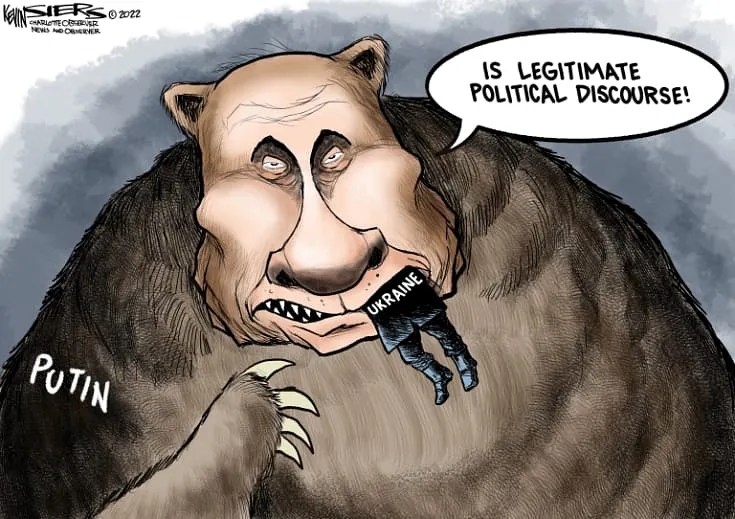
His behavior is more than a little “rebarbative” (causing annoyance, irritation or aversion; repellent), and he displays a ludicrous degree of “pleonexia,” extreme greed for wealth or material possessions, in this case an entire sovereign nation.
There can be little doubt he is a “drawcansir,” a blustering bully, which takes its name from a fictional character in the 2nd Lord of Buckingham George Villiers’ farce “The Rehearsal,” who kills all the combatants in the play, “sparing neither friend nor foe.” I think in Vlad’s case, “friends” are defined as people who are useful to him, while foes are everyone else, especially those who’ve ever spoken a bad word about him (people like him can really hold a grudge).
He’s also a “humgruffin,” a terrible, repulsive, contemptible person … but that sounds almost cute; way too cute-sounding a word for the likes of him. Nah.
Ultimately, perhaps we might say he’s a “handschuhschneeballwerfer” (bonus points because it’s a German compound word!), which literally means one who wears gloves to throw snowballs, but is used idiomatically to mean coward.
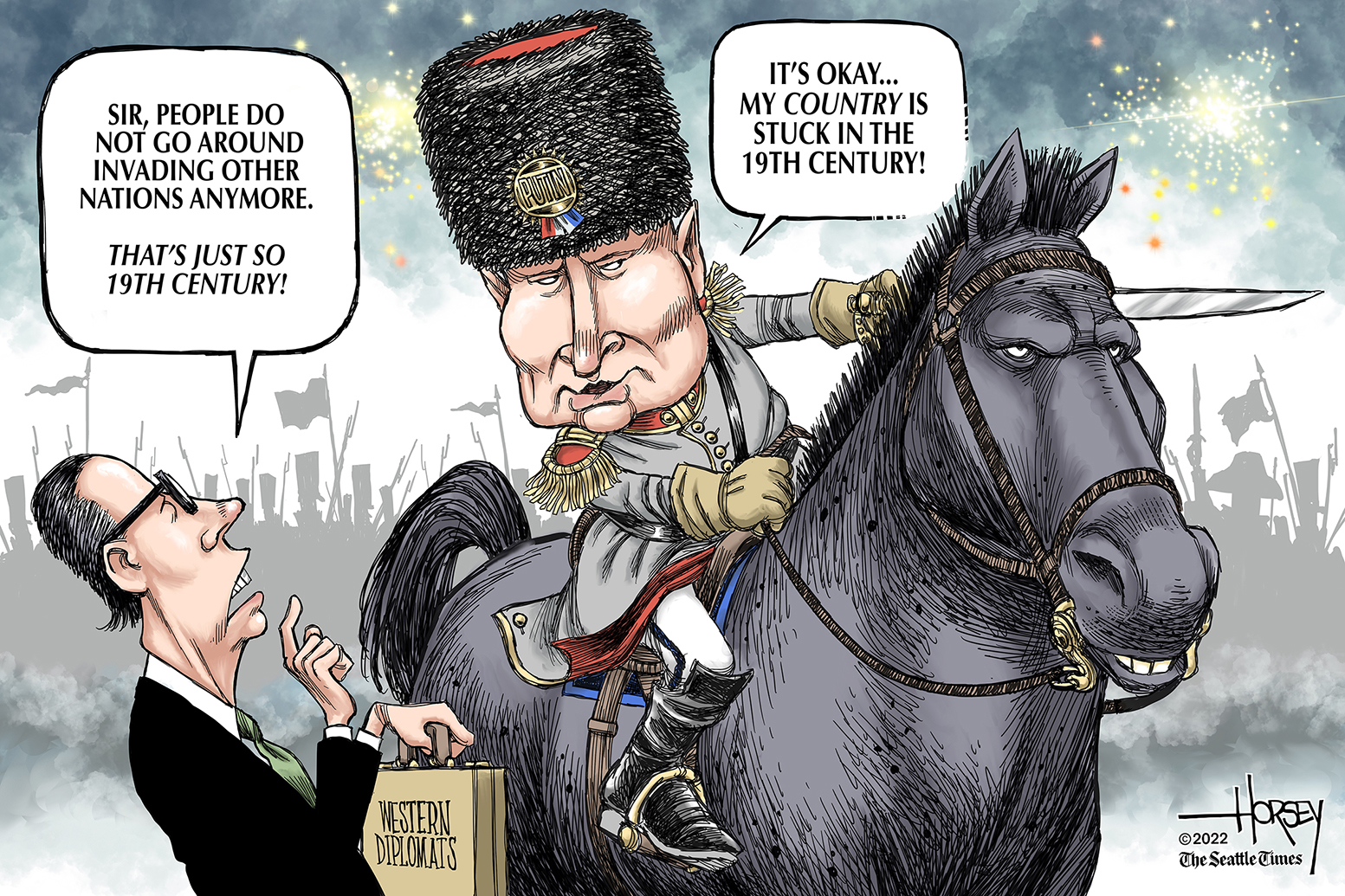
Oh, but I hear some of you say (keep it down over there!), Vlad isn’t a coward. Would a coward do what he’s done?
Uh, yeah. He’s a bully, and bullies are cowards. Cowards do a lot of the things they do because they’re trying to avoid something unpleasant … like, say, reality. I’m sure the “order” of the Soviet system was reassuring to Vlad (I mean, I love structure, but the Soviets were ridiculous), and it rewarded him and others who sought power at all costs handsomely. Facing the reality of what that system did to anyone who didn’t fit in, and the fiscal and societal unsustainability of the model … why would he want to do that?
As Dr. Syd wrote, “His bombing of cities and innocent civilians is not a manifestation of strength, but weakness, an act of sheer rage and desperation, the actions of an isolated and possibly demented petty KGB corporal, bypassed by history and epoch.”
Vladimir Putin’s actions appear to me to be the actions of someone desperate to be remembered as someone … someone who could bring back an empire where dissent is not allowed and humanity takes a back seat. In that world, he wouldn’t be an insignificant remnant of the past because the past would be present.
Yeah, let’s not. Let’s keep the past in the past.
 Serenity is a fuzzy belly
I’ve always appreciated the story of Chairman Khrushchev addressing a large gathering of party officials. As Khrushchev was criticizing Stalin’s bad behavior at length, a voice from somewhere in the audience shouted, “Where were you?”
Looking around the room, menacingly, Khrushchev demanded, “Who said that?”
Complete silence in the room.
Khrushchev responded, “That’s where I was.”
Sadly, I imagine that describes Putin’s Russia today.
LikeLike
Pretty sure he wants the gulags back so he doesn’t have to look at at the people who despise him.
LikeLike
I hope a solid majority of US voters are taking note that Putin was and is greatly admired by our last president. Reason enough to never again let him hold a position of power or authority.
LikeLike
That’s my hope as well.
LikeLike
That was an interesting column Brenda. I think so mainly because I am also a logophile. Unfortunately, though, you made Vladimir Putin sound like he resembles my infamous former sister-in-law (as if they attended the same school). At least she isn’t President of anything much less Russia.
LikeLike
🤣
LikeLike