
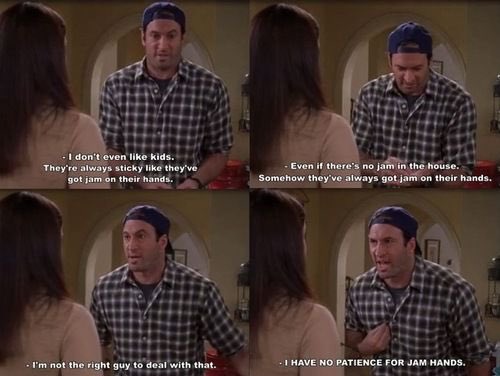
People may think I exaggerate the effects of politics on our lives. And yet, it’s so hard to find an area where it hasn’t stuck its grimy fingers. It’s worse than toddlers with jam hands. At least you can wash the jam hands. Political grime ain’t coming out.
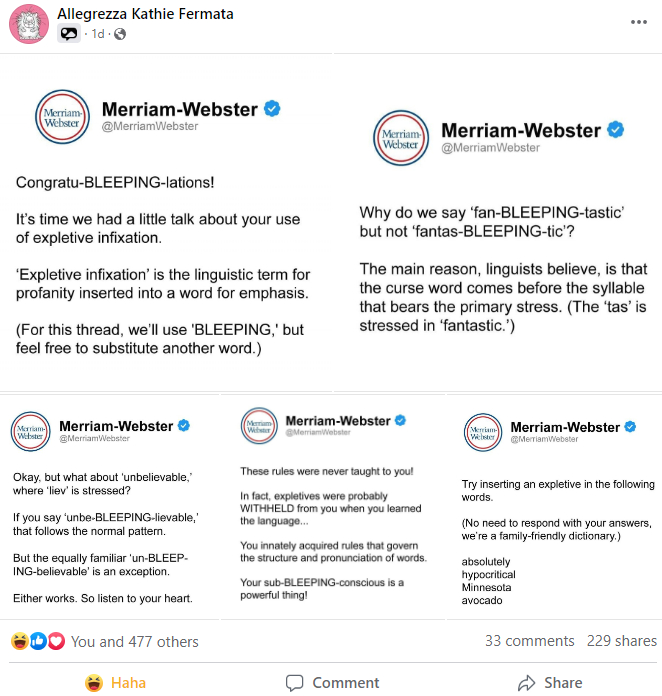
I was reminded of this the other day while reading a post on The Laughing Librarian, a Facebook group to which I belong (because I’m a nerd and I love words … duh), using Merriam-Webster post screenshots to explain the concept of expletive infixation. The post defines that as “the linguistic term for profanity inserted into a word for emphasis,” for example, abso-bleeping-lutely (insert your favorite cuss word in place of “bleeping” … I tend toward “freakin’”).
The first comment I saw was: “I wouldn’t use Merriam-Webster as a source—they define Female as anyone who doesn’t feel like a male. Thereby losing the scientific term for half the population (let alone the animal kingdom).”
Sigh. So many things wrong with that.
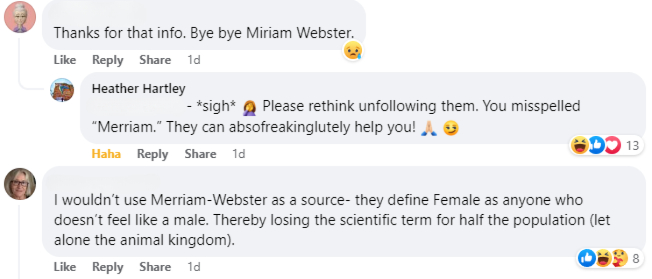
The apparent definition that bothers this person is “having a gender identity that is the opposite of male.” We won’t even get into the chromosonal variances that can result in someone having extra or absent sex chromosomes and being born intersex (having ambiguous sexual anatomy that doesn’t fit binary notions; often the parents of a child born intersex choose surgical intervention to assign a gender). And as one of the definitions of female is one who gives birth, that makes the male seahorse (and its cousin the sea dragon) problematic.
But that’s not the point. The point is that, yet again, people are misunderstanding the purpose of dictionaries. They don’t assign definitions; rather, they record how words are used at a given point in time.
The Oxford English Dictionary’s approach is primarily historical, while other dictionaries focus on how words are used now. As the OED says on its website: “You’ll still find present-day meanings in the OED, but you’ll also find the history of individual words, and of the language—traced through 3 million quotations, from classic literature and specialist periodicals to film scripts and cookery books.”
For a word nerd, that’s like catnip. Pardon my drool. Etymology and historical source material make my heart go pitter-pat.
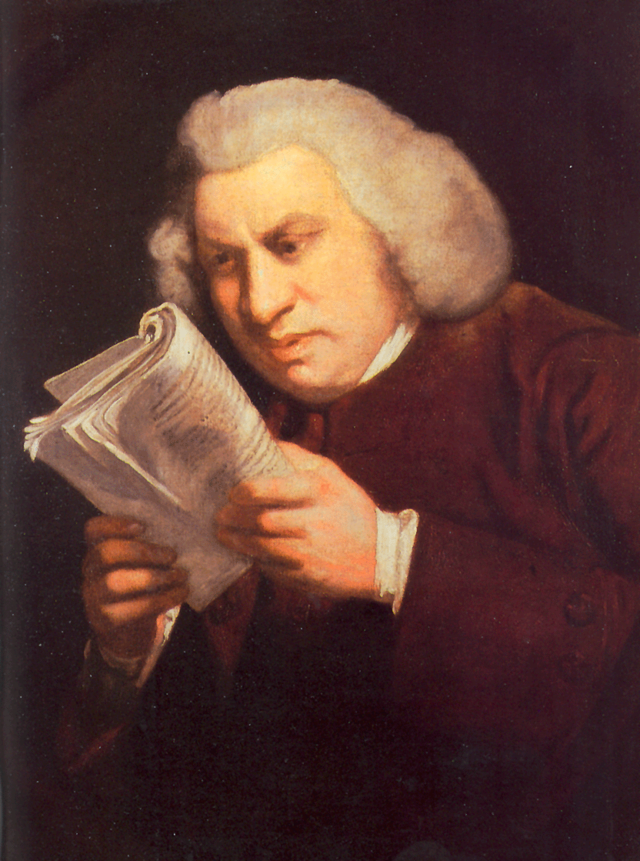
Samuel Johnson, compiler of the 1755 Dictionary of the English Language was probably one of the first to articulate the mission of dictionaries. According to the British Library, “A group of London booksellers first commissioned Johnson’s dictionary, as they hoped that a book of this kind would help stabilise the rules governing the English language.
“In the preface to the book, Johnson explains how he had found the language to be ‘copious without order, and energetick without rules.’ In his view, English was in desperate need of some discipline: ‘wherever I turned my view … there was perplexity to be disentangled, and confusion to be regulated.’ However, in the process of compiling the dictionary, Johnson recognised that language is impossible to fix because of its constantly changing nature, and that his role was to record the language of the day, rather than to form it.”
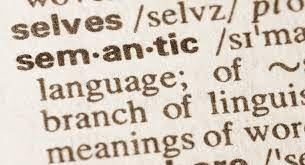
In the eight years it took to compile and catalog 40,000 words, Johnson recognized that new words, phrases, usages and definitions were constantly being added (remember that “terrific” and “awesome” once had very different meanings). Plus English, as the joke goes, likes to accost other languages in dark alleys and rifle through their pockets for loose words.
“However much the lexicographer may want to fix or ’embalm’ his language,” the library wrote, “new words, phrases and pronunciations are constantly appearing, whether brought from abroad by merchants and travellers, extracted from the workrooms of geometricians and physicians, or found in the minds of poets.”
Darn those people! Don’t they know that book larnin’ isn’t a good thing? (Lord, do I need a sarcasm font!) But seriously, where would we be if English didn’t evolve? Would Sir Mix-A-Lot have been singing about “hir nether ye” instead of her booty?
Merriam-Webster keeps a close eye on trends, but the fact that its social media team sometimes like to troll people who use words outrageously wrong has given the impression to some that it has political preferences. As a dictionary, that’s not the case.
“If we define a word,” it notes on its Words at Play blog, “it does not mean that we have approved or sanctioned it. The role of the dictionary is to record use of a language, not to regulate it.
“If we do not offer a definition for a word, or a sense, this does not necessarily mean that the word is not real. Some words are omitted because they are too obscure or specialized, or too new (and do not yet have a solidified meaning), or simply are as yet unknown to us. Just as inclusion in a dictionary does not confer status upon a word, exclusion from this book does not remove it.
“If a word has multiple senses, the first one is not the most important one. It is also not the most ‘correct’ one. The senses of each word are organized in one of two possible ways: beginning with the oldest known sense or the most common one. …”
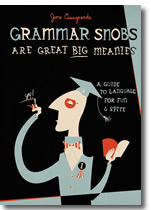
If you want to accuse Merriam-Webster of having an agenda, it does, but it’s simply to record how words are used (the descriptivist approach; full disclosure: I, too, am a descriptivist in most cases), not necessarily how they should be used (the prescriptivist/grammar snob approach that’s no fun whatsoever).
I know. How dare!!!!
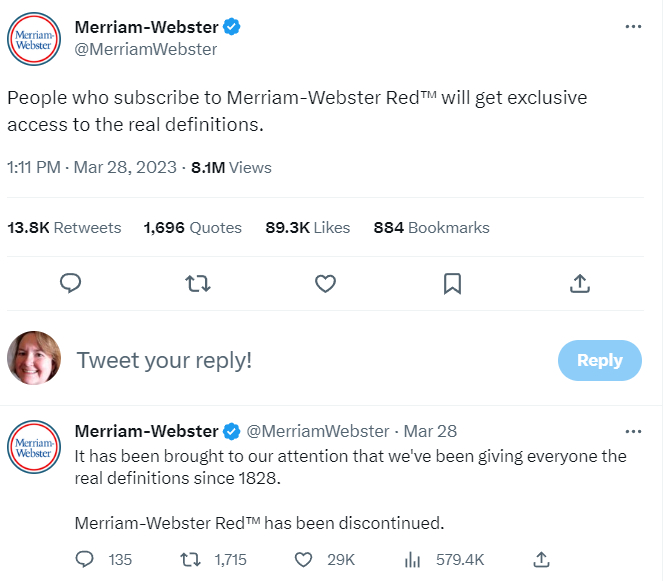
Luis Gomez of the San Diego Union-Tribune wrote in 2016 after Merriam-Webster’s media team clapped back at a Slate editor over his response to a tweet about use of the word “mad,” “Merriam-Webster’s response is an example of how brands have taken on a less scripted approach to communication with their fans on social media. And the dictionary’s brand account is not alone in this. Sometimes brands will even go head-to-head with one another in a show of authenticity that appeals to the average Twitter user. This runs the risk of alienating Twitter, too, of course.
“For the most part, brands show restraint when people directly criticize them or throw snark at them. But when it’s time to turn off the script, some brands don’t hold back.”
And that’s part of the reason many of us follow accounts like Merriam-Webster’s that aren’t afraid to clap back at critics with facts (or offer a mea culpa when merited), and troll those in the public realm with a tenuous grasp of what words mean because they only know what they’re told (again, book larnin’ bad). It’s entertaining and educational (and not nearly as mean-spirited and personal as those trolls you find on comment boards)! Perfect for word nerds!
But apparently, now defining words and talking about how people use them in everyday language is “progressive,” “liberal,” and “evil.” I guess we need a new “The More You Know” PSA … but that would be educational too, and thus apparently liberal, sooooo …
I can’t wait for the day when politics won’t infect abso-freakin’-lutely everything. Words are my refuge, as they are for many others, and having people impart political meanings to definitions with which they don’t agree is frustrating.
Their issue isn’t with the dictionary. It’s with time and language moving on.
OK, it’s a little with the dictionary. Dang book larnin’.
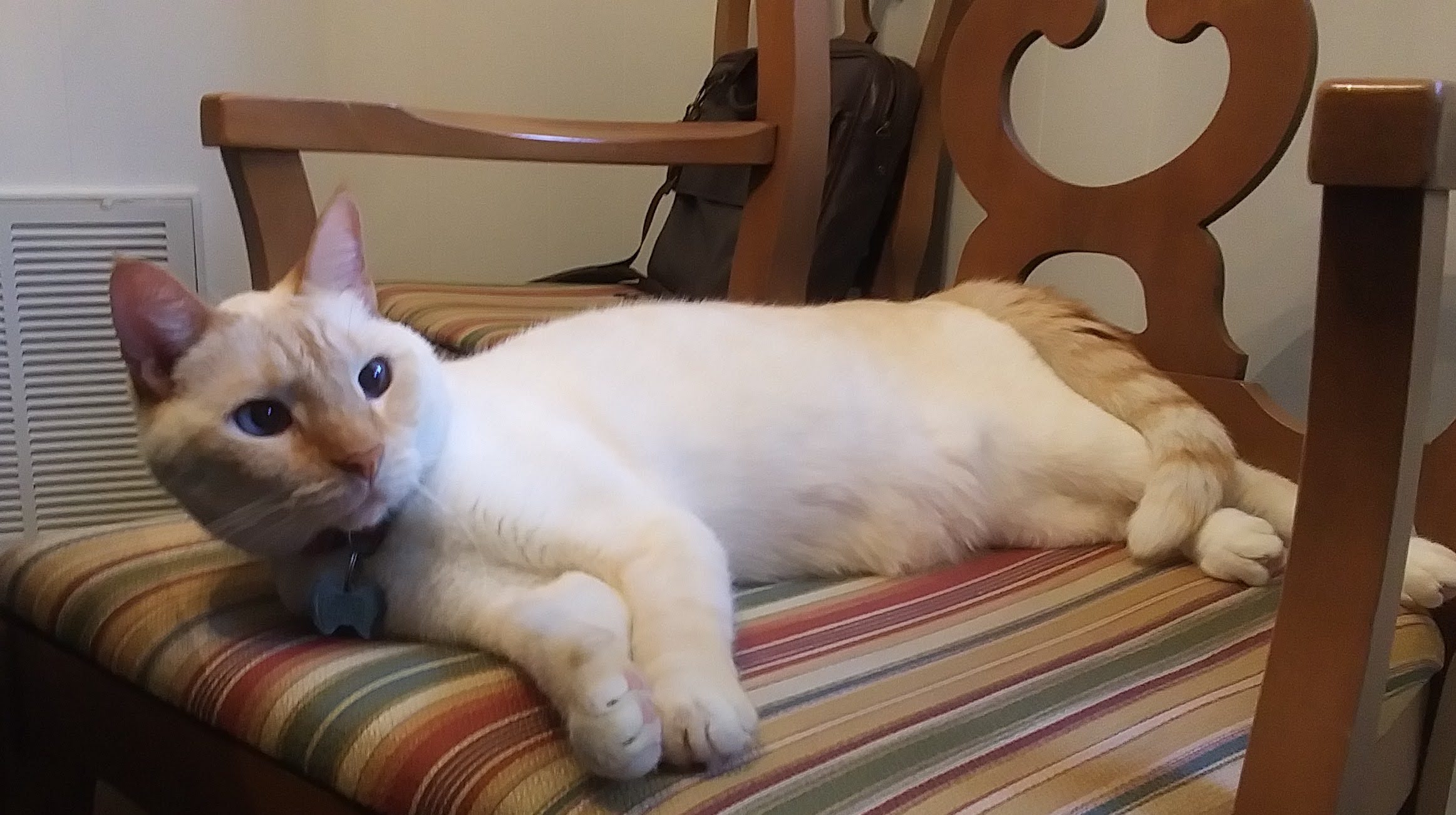
 Serenity is a fuzzy belly
How long will it be that some Florida parent demands that all dictionaries be banned or burned? In fact banning all languages would prevent those pointy-headed intellectuals from indoctrinating our young’uns with science, history, and reason.
LikeLiked by 2 people
Sounds about right. And on Twitter, someone posted that I was redefining what dictionaries do. Obviously she didn’t read the column at the link. 🤦🏼♀️🤣
LikeLike
I was taught years ago that dictionaries are either prescriptive or descriptive. But as language evolves, the distinction blurs. And before either type recognizes a new entry, there’s the online Urban Dictionary leading the way. Useful for us old farts trying to understand the younger generations.
LikeLiked by 1 person
There is one word, well at least one, that is stuck in my brain like a pebble in the shoe because Miriam Webster doesn’t define it like I think it is used. It is “mean” as an adjective. I have always sensed it meaning (!) “cruel” when that context applies, which is often. As in, “You are just being mean to me.” Am I alone in this?
LikeLike
I’ve always thought of Mean as the arithmetic average, as distinguished from the Mode and Median.
LikeLiked by 2 people
Babbie, that’s a noun meaning. I mean it.
LikeLiked by 2 people
Don’t be mean . . . to a heart that’s true.
LikeLiked by 1 person
Babbie “don’t be cruel” either (to quote the late Elvis Presley).
LikeLike
Damn! I knew there was something wrong with that clever comment on mine. Oh well, I surrender. Signing off.
LikeLiked by 1 person
That is okay Babbie. As the priest says when you finish confessing your sins, “You are forgiven my son and may go sin some more.” Also, unlike me, you don’t have a crazy former sister-in-law who worships Elvis Presley. That is why I am more familiar with the lyrics of his most popular songs than I would like to be.
LikeLike
Who is this “Miriam Webster”? Does she work for Dick Martin’s favorite dictionary Funk & Wagnalls?
LikeLike
I think that’s an aka for Rhonda Santis, the Florida drag queen.
LikeLiked by 2 people
Instead of Marjorie Taylor Greene the Georgia Drag Queen?
LikeLike
There are too many people who seem to think that the only book learning we should learn is some book called the “Bible” which you may or may not have ever heard of.
LikeLike
Brenda thank you for explaining the true porpoise of a dictionary to us.
LikeLike