

I well remember the day that Ronald Reagan was shot. Our class had its usual educational TV time (usually “Electric Company,” I believe; loved Easy Reader [Morgan Freeman]) when news came of the attempted assassination. I don’t recall if PBS broke into programming or if Mrs. Ferguson heard what happened and turned it to a news channel, but I remember watching the president wave before shots rang out; after that it’s mostly a blur. And even that may be the Mandela effect. Who can tell nowadays what we actually remember anymore?
When Reagan was shot, we didn’t have 24/7 cable news outfits trying to fill all that airtime. Reagan at that time had only been president a couple of months, and it was just the routine press pool following him after he had given a speech at the Washington Hilton. It was a different time; C-SPAN was only a couple of years old and in a few million homes, and only broadcast House proceedings. No one at that time would consider airing a political rally live; cable had yet to grow to the behemoth it is now, with a constant need for content.
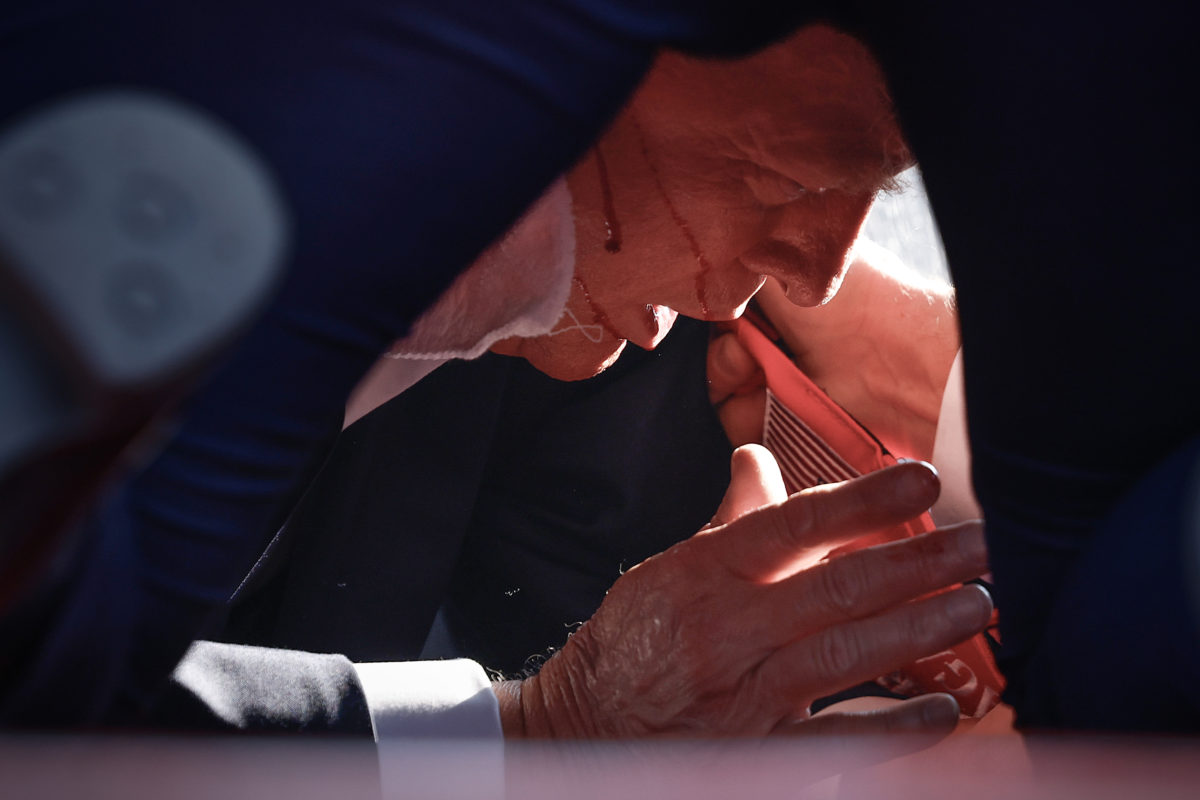
I still haven’t really watched more than a little of the apparent assassination attempt of former president Donald Trump over the weekend; I spent Saturday taking care of cats and watching “Midsomer Murders.” What I have seen on social media (also not around when Reagan was shot, thank God) and elsewhere has saddened me (especially on Threads, where my feed is mostly nonpolitical, but with some news/writer accounts), with conspiracy theories and misinformation running amok. It also reinforced yet again something I’ve long advocated: the need for people to step back, re-evaluate, and mute political vitriol.
Some Republican officials wasted no time in blaming Joe Biden’s rhetoric for causing the shooting, which resulted in the death of spectator Corey Comperatore and the gunman (ignoring, of course, Trump’s own rhetoric; I’m sure on the newspaper’s website I’m being accused of victim-blaming by bringing up MAGA rhetoric). Meanwhile, there is no clear picture of gunman Thomas Crooks’ motivation, so blaming anyone but Crooks is premature at best. We don’t know why Crooks decided to do what he did, and we may never know.
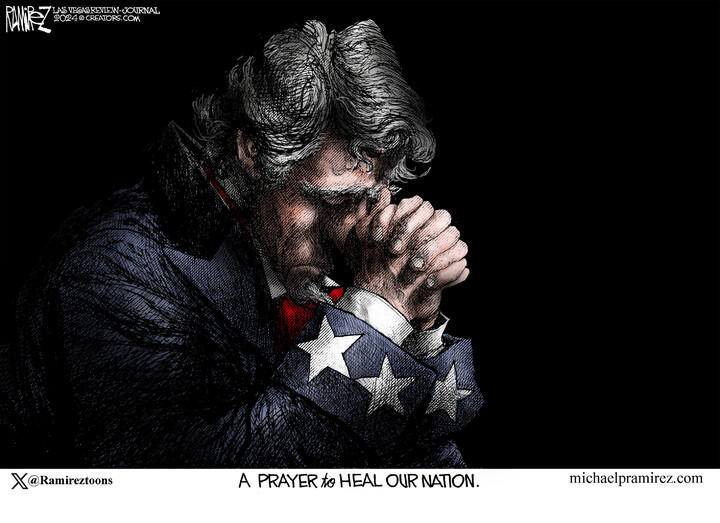
Still, we can’t ignore that political acrimony got us where we are today. Whether it’s “basket of deplorables,” “Uncle Sugar,” “legitimate rape” or even worse (and boy, has there been worse, especially since 2015 and you-know-who), using that sort of rhetoric just leads to more.
Molly Ball of The Wall Street Journal wrote Sunday: “In an instant, it seemed, everything had changed—a nasty, all-consuming political season suddenly pulled up short and confronted with the harrowing mortal core beneath the abstract debates over the nation’s future. The campaign couldn’t go on as before. No longer could the dehumanizing rhetoric, the apocalyptic warnings continue; something had to give.
“And yet it seemed more likely than not that nothing would—that the rudderless acrimony and pervasive alarm that got us to this point couldn’t be soothed or suppressed; that no convulsion could break the fever that continues unabated. …
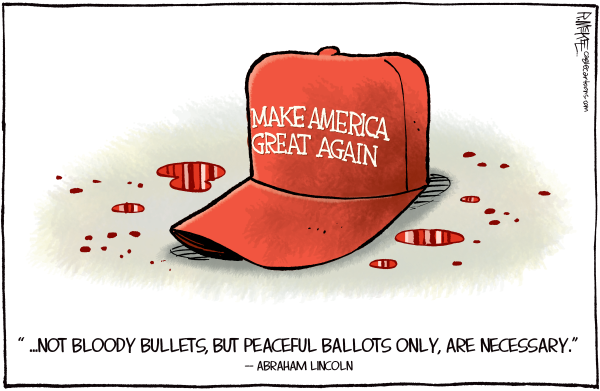
“As shocking as the assassination attempt was, it could hardly come as a surprise in this volatile political climate that someone saw fit to take matters into his own hands. It has been many years since Americans have felt there was a steady hand on the tiller of the ship of state—years in which reality has seemed to fold in on itself and elections don’t settle the question. A plague breaks out, there are riots in the streets, the capitol is sacked, the world is in flames, the system buckles under the strain. For all that the optimistic few cling to the promise of normal political solutions, some have concluded that bullets and mobs must accomplish what ballots no longer can.”
There has always been political vitriol, but until the Internet and social media, it wasn’t as blatant or pervasive. Grover Cleveland certainly didn’t have to deal with TV, radio and the Internet when his sex scandal surfaced (he was a bachelor when he first ran for office, but rumors abounded of a secret son). Gail Collins of The New York Times wrote in May: “It took some of the Republican tabloids of the era about two minutes to figure out a spin. ‘Ma, Ma, where’s my pa?’ they roared. (To which the Democrats later replied, ‘Gone to the White House, ha, ha, ha!’)”
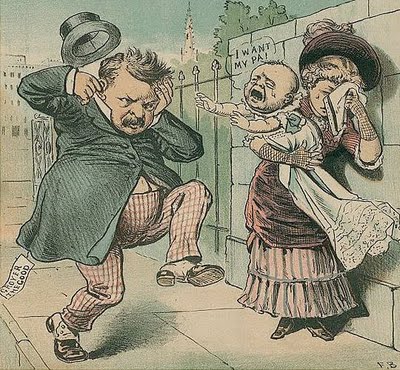
Cleveland told his advisers to tell the truth about the scandal (imagine that!). Collins wrote: “This approach succeeded, possibly because many people at the time assumed the child in question was actually the secret offspring of Cleveland’s longtime friend Oscar Folsom, who died not long before in a carriage accident. His daughter, a beautiful college student named Frances, was the secret love of Cleveland’s life.” Voters were more interested in his public honesty than a secret scandal, and it won him the presidency (and later the first White House wedding). Cleveland lost re-election, but four years later returned victorious to the White House, which is what Trump is trying to do now. Whether he succeeds will depend on a nation he has had a hand in dividing.
No one could honestly disagree that Trump has continually cast himself as the victim of persecution while at the same time he lies about and disparages anyone he doesn’t like (basically anyone who won’t do his bidding) and airs plans of retribution for those he feels wronged him, and his true believers act just as he does. Yes, Democrats and others have done the same, but I don’t think there’s a good example of someone on the left today who comes anywhere close to Trump.
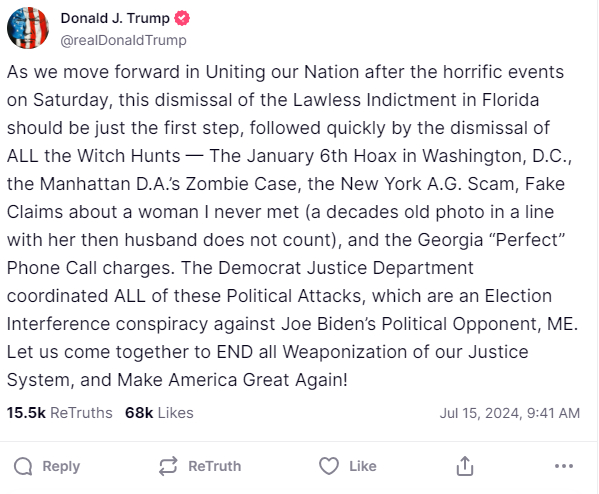
Regardless of where the vitriol originates, we must fight against it while being honest with ourselves about the language and imagery we use when talking about politics. The discourse has coarsened over the past several decades, most especially since 2008, and even more with 2015, with the Internet aiding the spread of lies and conspiracy theories far faster than responsible journalists could spread the truth … not that many voters care about truth anymore (Grover Cleveland would have a tough row to hoe now).
Which is a horrible realization about our 248-year-old democratic republic.
Perhaps most distressing is that too many do nothing but point fingers at the other side, saying that they’ve been portrayed as evil without acknowledging that they’ve said the same about their opponents, and of course to blame the media for … everything. No wonder we’re in such a mess.
Here’s a thought: Take a cue not from those who reflexively blame others, but from those who instead call for unity and less vitriol. Endorse peace, calm and careful thought, not political sniping. Wait for facts before forming an opinion.
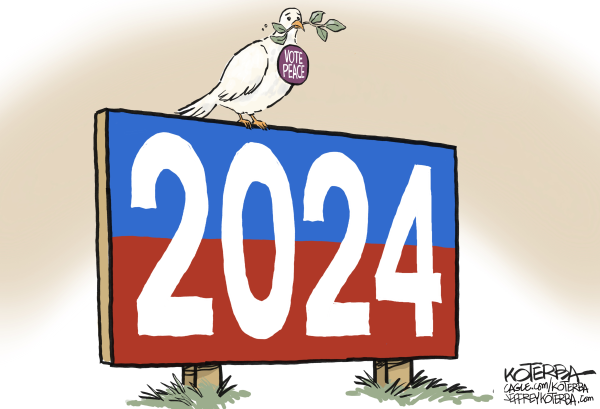
Novel idea, that. Maybe it’ll catch on some day.
As President Biden said Sunday, “While we may disagree, we are not enemies. We’re neighbors. We’re friends, co-workers, citizens. And, most importantly, we are fellow Americans. And we must stand together. … A former president was shot. An American citizen killed while simply exercising his freedom to support the candidate of his choosing. We cannot, we must not, go down this road in America. We’ve traveled it before throughout our history. Violence has never been the answer, whether it’s with members of Congress in both parties being targeted and shot, or a violent mob attacking the Capitol on Jan. 6, or a brutal attack on the spouse of former speaker of the House Nancy Pelosi, or information and intimidation on election officials, or the kidnapping plot against a sitting governor, or an attempted assassination on Donald Trump.
“There is no place in America for this kind of violence or for any violence ever — period. No exceptions. We can’t allow this violence to be normalized.
“You know, the political rhetoric in this country has gotten very heated. It’s time to cool it down. And we all have a responsibility to do that. …
“Disagreement is inevitable in American democracy. It’s part of human nature. But politics must never be a literal battlefield and, God forbid, a killing field.
“I believe politics ought to be an arena for peaceful debate, to pursue justice, to make decisions guided by the Declaration of Independence and our Constitution. We stand for an America not of extremism and fury but of decency and grace.”
It’ll be hard to rein in what we’ve let go wild, but for all of our best interests, we should see this weekend as a wake-up call to, if nothing else, act like responsible adults. You don’t have to like that person with a different opinion than you, but you don’t need to wish harm on them.
And you certainly shouldn’t act on those wishes.

 Serenity is a fuzzy belly
Too many people mistakenly seem to think and believe that using violence will automatically solve all of our problems. I think that if Thomas Crooks had actually killed Trump, I suspect the situation would be worse–much worse.
LikeLiked by 1 person
Supposedly Crooks was also planning to try to shoot Joe Biden and Merrick Garland as well as Trump.
LikeLike
“Mandela effect.” New to me, interesting. I live under a rock, I guess. You have summed up the situation very well, as usual. I’m left with the conclusion that if Trump wins and the GOP takes both houses, that the nation might not be able to recover when the pendulum swings back in 4 years.
LikeLiked by 2 people
There was a lot of print media vitriol when the Federalists and the anti-Federalists fought for political office in the late 1700s and early 1800s. And just a note, CNN began broadcasting June 1, 1980, so maybe your teacher tuned to it when Reagan was shot.
LikeLiked by 2 people
We didn’t have cable at school, so it would have either been PBS or one of the Big Three.
LikeLiked by 1 person
I share you concern, if not your optimism. With Trump, Vance, and Project 2025 looming, I fear for our nation — at least, the nation I have known.
LikeLike