
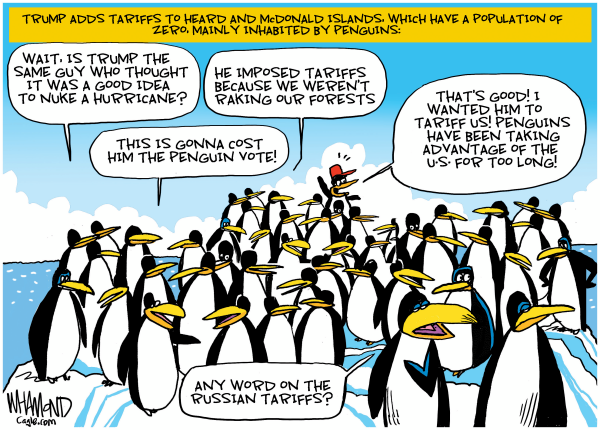
Much of the past week has been spent laughing at penguin memes. Because when the U.S. decides to put tariffs on islands containing nothing but penguins, seagulls and seals, the world will provide penguin memes.
So. Many. Penguin. Memes. And rightfully so.
Sure, they’re laughing at us. But at least some of us can laugh along with them, and lord knows I love penguins (they’re my second favorite animal after cats).

Meanwhile, I find myself defending use of they/them as singular, something I might have had a problem with years back when I was a little more snobby about grammar (back when I didn’t know that many of our grammar rules were the result of someone’s pet peeve, and that making oneself understood is more important than following grammar rules that came about because someone didn’t like prepositions ending sentences). That was before I made peace with the fact that, like life itself, language evolves. And sometimes it evolves back to older usage.
Luckily, not back to thee and thou, though. Yet. Give the performative Bible-thumpers a chance …
If you’re honest with yourself, you might realize you’ve been using they/them as singular long before the more recent pivot back to it (though maybe not in writing) when you were referring to someone whose gender you might not know until they appear. “When they get here, we can figure out what they want” sounds like something lots of people would say.
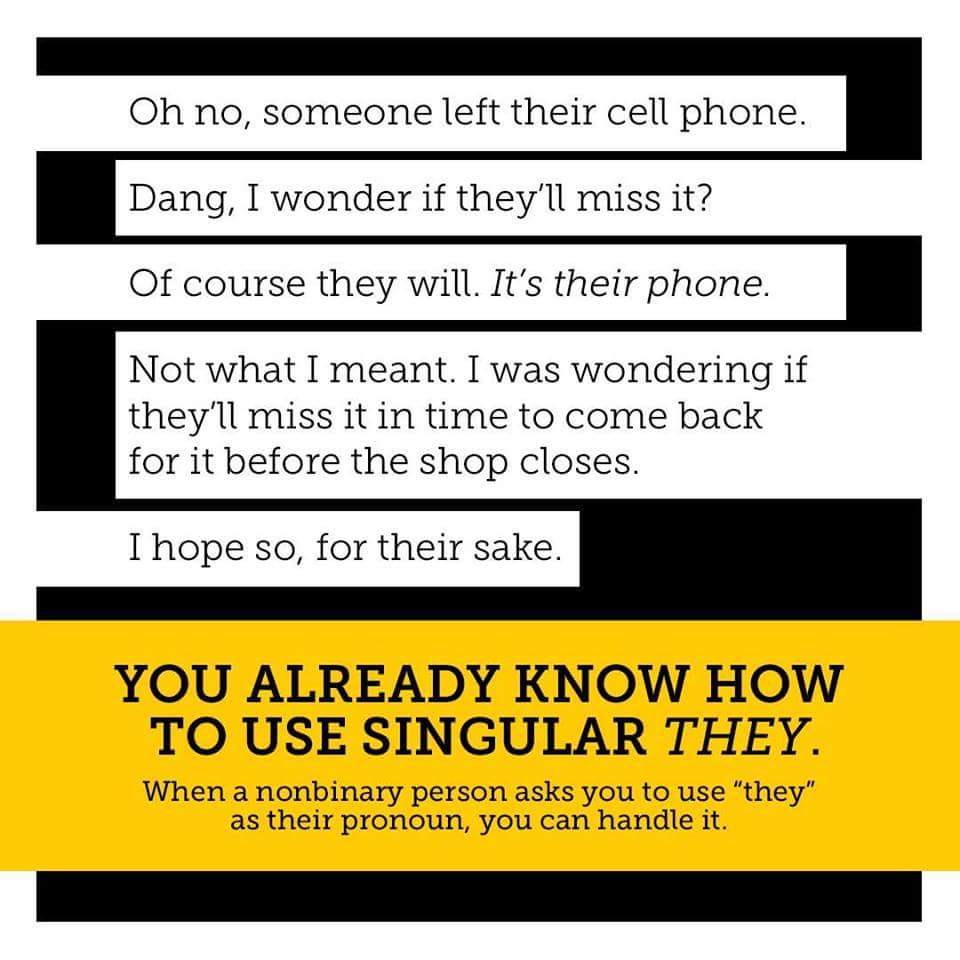
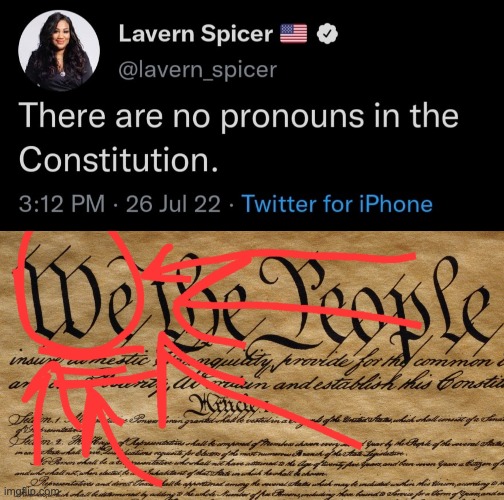
Only now, some want to fight about it, mainly because nonbinary people and others prefer to be referred to as they/them rather than he/him or she/her. Some wanting to fight even go so far as to attack pronouns in general (please, do that some more; it’s hilarious when you then fail to notice that words like I, you, and me are pronouns). If you really want to get rid of pronouns, don’t blame me when conversation becomes unwieldy since there are a lot of them (not just personal pronouns, though ditching those by themselves would be problematic).
The Oxford English Dictionary is pretty much the authority on the English language. Does it have a problem with the singular they/them? Nah. The researchers there have traced its use back to the 1375 medieval romance “William and the Werewolf,” noting, “Except for the old-style language of that poem, its use of singular they to refer to an unnamed person seems very modern.” The dictionary further notes that the use of the singular they is probably even older than late 14th century since it may be a while before some forms of speech are written down.
But, you know, someone always has to stick their nose in, and a lot of the time it’s grammarians (grammar snobs are no fun, and often make things more difficult to understand).
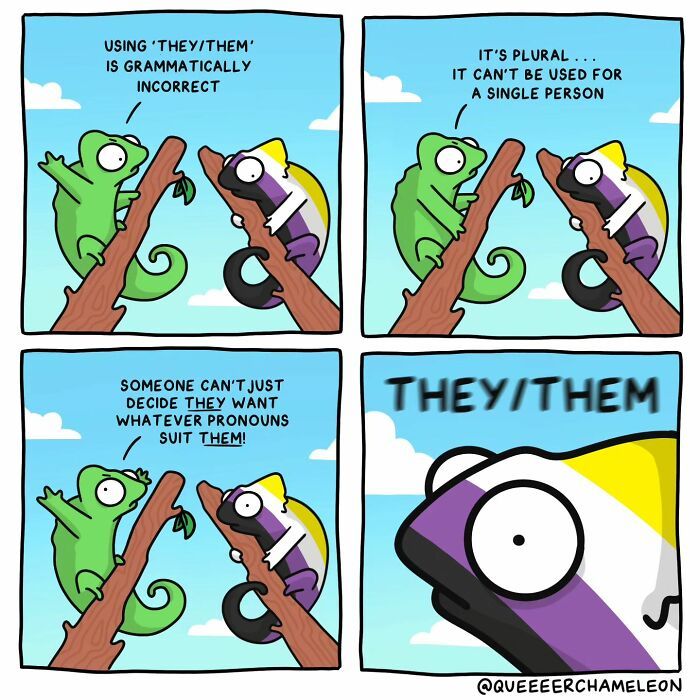
“In the 18th century,” Dennis Baron, professor of English and linguistics at the University of Illinois at Urbana-Champaign, wrote on the OED blog, “grammarians began warning that singular they was an error because a plural pronoun can’t take a singular antecedent. They clearly forgot that singular you was a plural pronoun that had become singular as well. You functioned as a polite singular for centuries, but in the 17th century, singular you replaced thou, thee, and thy, except for some dialect use. That change met with some resistance. In 1660, George Fox, the founder of Quakerism, wrote a whole book labeling anyone who used singular you an idiot or a fool. And 18th century grammarians like Robert Lowth and Lindley Murray regularly tested students on thou as singular, you as plural, despite the fact that students used singular you when their teachers weren’t looking, and teachers used singular you when their students weren’t looking.”
Bet you didn’t know that grammar could be so exciting. Or so scandalous.

Use of you as a singular pronoun is now normal and unremarkable, said Baron. “And singular they is well on its way to being normal and unremarkable as well. Toward the end of the 20th century, language authorities began to approve the form.”
But not everyone approved, including the Chicago Manual of Style … and an awful lot of people who tend to get bees in their bonnets, such as the Tennessee legislature in 2015, which tried to forbid the use of taxpayer dollars for gender-neutral pronouns. (How would that even be accomplished? In that particular instance, they tied it to funding for diversity programming at the University of Tennessee. They’re still at the whole pronoun thing, by the way. Someone should maybe check on them to see if they’re OK.)
Baron wrote, “Former Chief Editor of the OED Robert Burchfield, in The New Fowler’s Dictionary of Modern English Usage (1996), dismisses objections to singular they as unsupported by the historical record. Burchfield observes that the construction is ‘passing unnoticed’ by speakers of standard English as well as by copy editors, and he concludes that this trend is ‘irreversible,’ People who want to be inclusive, or respectful of other people’s preferences, use singular they. And people who don’t want to be inclusive, or who don’t respect other people’s pronoun choices, use singular they as well.”
(Side note: Baron is someone I just discovered through that OED piece, and I can’t believe I didn’t know about him before now. He’s pretty awesome, and has a blog here. His laws of usage post is great.)
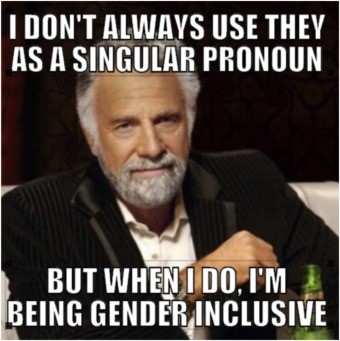
Using someone’s preferred pronoun is just like using Bob instead of Robert or Winnie instead of Winifred if that’s the name that person prefers. I’ll admit to being unfamiliar with some of the newer pronouns like ze, but if that’s how someone prefers to be referred to, it’s no trouble to do that. Making a fuss about it, on the other hand …
Of course, I also took some heat from the same reader who took issue with my being OK with the singular they/them for referring to myself as a cisgender woman (meaning my gender identity aligns with that that I was assigned at birth), something I’ve adopted because of my friends in the LGBTQ+ community. He seemed to be of the mind that there are only two genders, so we definitely don’t need terms like cisgender and transgender. I wasn’t about to get into it with him about chromosomes and intersex people. But in a way, he was right. I have no problem referring to my transgender friends and family as women or men, whichever they are, so trans- isn’t so necessary. 😏
But what really annoyed me was the idea that I had no authority to speak on the idea of allowing trans women in women-only spaces, his reasoning being that I wasn’t a mother of a daughter. Excuse me????
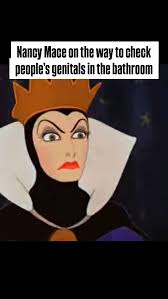
I’m a woman. I’m a daughter. I’m a feral aunt. I am the friend of a lot of women in all walks of life. In what universe am I not an authority on how women feel about being in the same bathroom with a trans woman? What too many men don’t seem to get is that trans women aren’t really the problem. They just want to pee in safety and in peace, which they wouldn’t really be able to do in the men’s room; transgender people are more likely to be victims than perpetrators of sexual assault.
The problem is men who have no compunction over sexual assault and who don’t care about the rules (this kid in Virginia helped muddy the waters, but he was definitely a male in the girls’ restroom).
Trans women aren’t taking hormones, going through therapy and having surgeries so they can assault women in women-only spaces. If that was what they wanted, they wouldn’t even need to dress up, since men walk into women’s restrooms all the time, sometimes in some weird “knight in shining armor” mindset (like when a very tall and/or androgynous-looking woman goes to the restroom, because clearly all women are petite girly girls), and sometimes with the express purpose to assault someone.

Transgender people go through the therapy, hormones and surgeries because they make the person they are on the outside finally match the person they are on the inside. Let them be happy. Is it really so hard?
Answer: It’s not. Getting “One (Singular Sensation)” from “A Chorus Line” and the associated trauma from performing it with your pops ensemble in college for the Governor’s Prayer Breakfast in front of at least a few hungover attendees out of my head is a lot harder since I decided to go with that for the headline of this piece.
Why do I do these things to myself?

 Serenity is a fuzzy belly
The “third person masculine” practice was a problem for me when I started writing textbooks. I solved it by saying things like “If you and I did a survey,” and If we needed a third person, I’d add Pat, Jan, or some other androgynous name. I used the third-person plural for singular folks freely. And in fifty years of textbook writing, not a single student (or professor) has ever objected. There is a ready therapy for any who are bothered by such practices: Lighten up.
LikeLiked by 3 people
A rose by any other name…? 🤔
LikeLiked by 2 people
“Roses are red, violets are purple. Sugar is sweet, and so is maple surple.” — Roger Miller
LikeLiked by 3 people
For writing this column, thee deserves at least one werewolf in thy stable of friends.
LikeLiked by 2 people
Maybe that’s why I love huskies (the only large-breed dog I would ever have). They look wolfish, and act comically human at times.
LikeLiked by 1 person
Brenda your comment is almost as Ruff as Bark.
LikeLike
Started my day with a laugh at the penguin gif. So cute!
I was writing something the other day and realized I written “they” re a person of unknown gender. But having noted it, I moved on. All the talk has made me aware, yet has changed nothing.
I do still call myself simply “woman.” I see no need to change just because someone else calls themself “trans.” (There’s another singular “them.”) If others feel the need to use “cis” that’s up to them.
LikeLiked by 2 people
I generally use cis- only in specific instances, like when talking about the whole bathroom kerfuffle. There’s no reason to do so otherwise usually.
LikeLiked by 1 person
“Of all the gin joints, in all the towns in all the world, they walks into mine.” Just doesn’t sound right. There are bigger problems though.
LikeLiked by 2 people
My favorite penguin video is of the penguin who jumps into a boat full of tourists so it won’t become a meal for a hungry orca.
LikeLike