
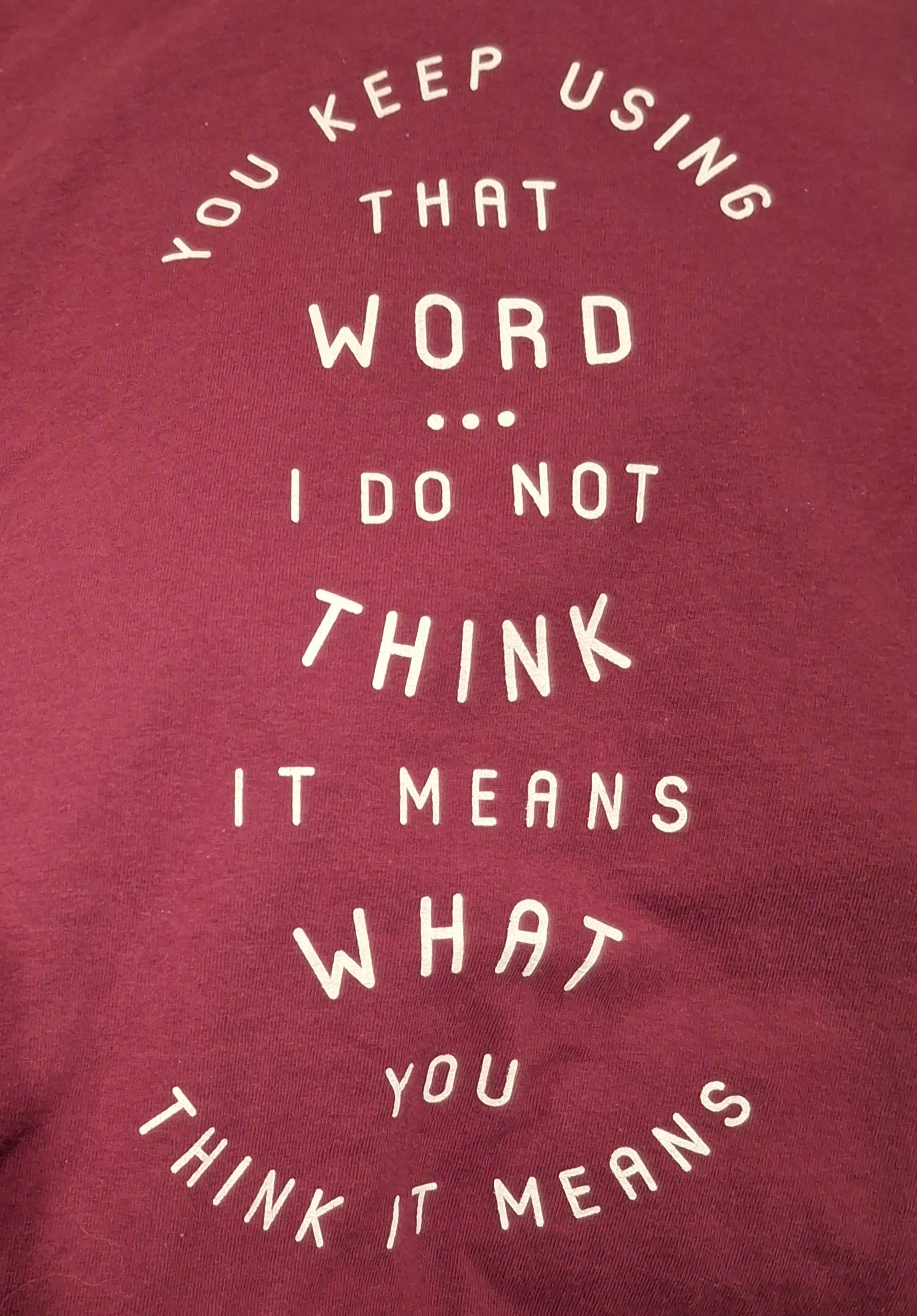
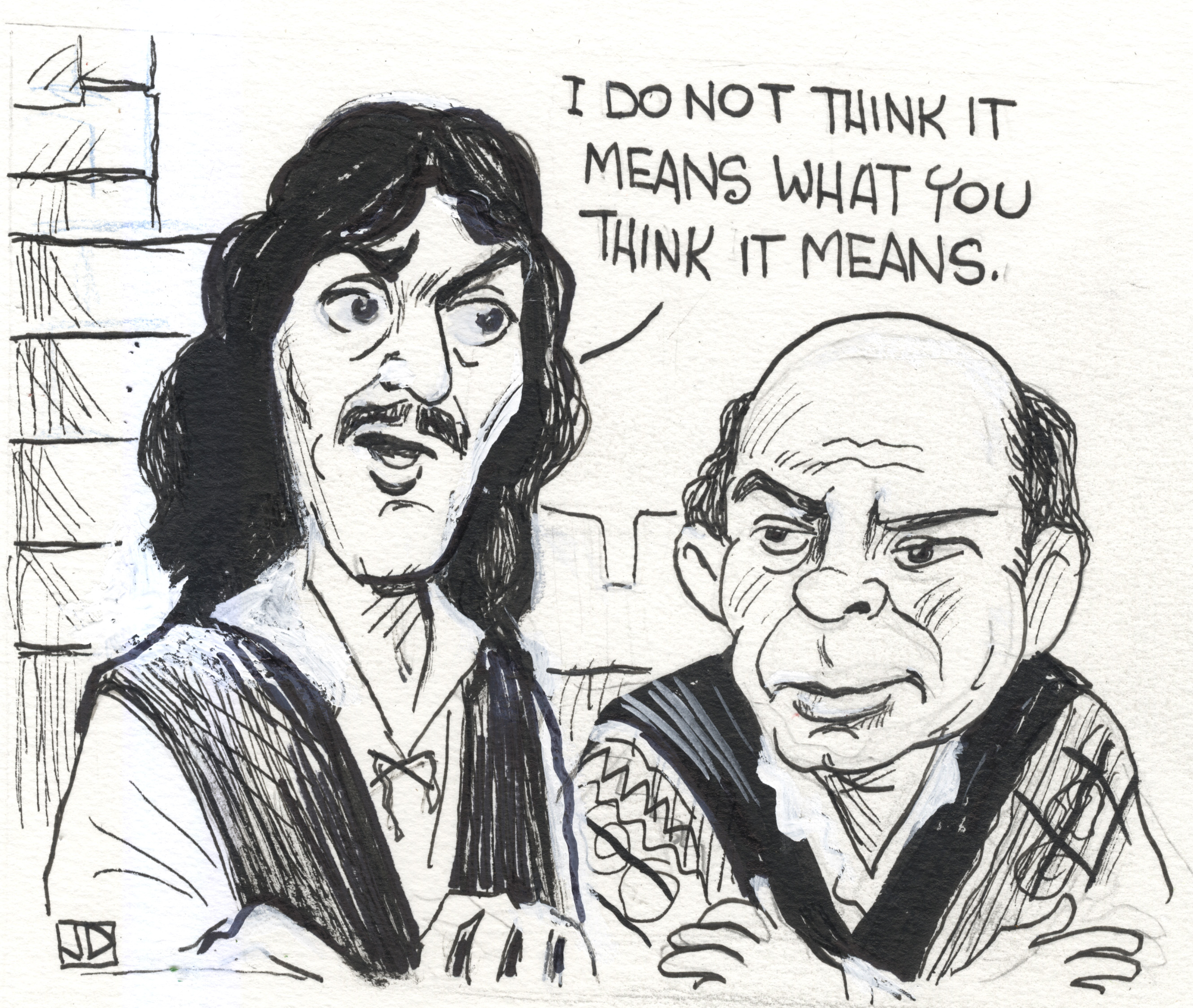
“You keep using that word. I do not think it means what you think it means.” —Inigo Montoya, “The Princess Bride”
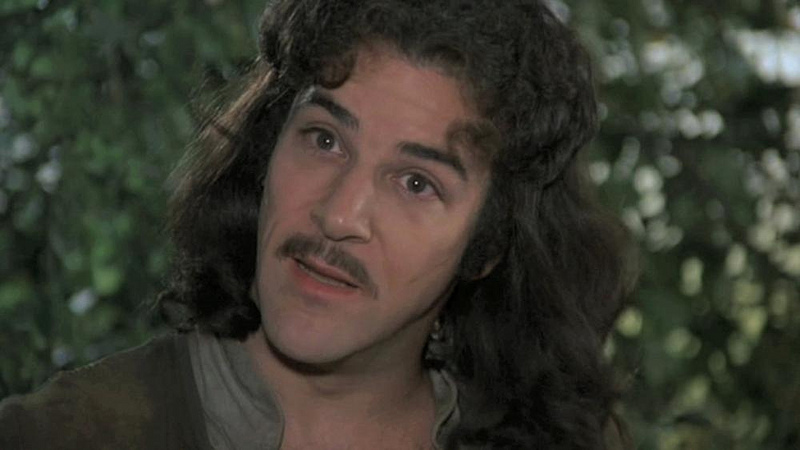
It would be easy to say that everything I ever needed to know I learned from “The Princess Bride.” It would be wrong, but go with me here. There’s what’s been called the master class in introductions: Polite greeting and name. (“Hello, my name is Inigo Montoya.”) Relevant personal link. (“You killed my father.”) Manage expectations. (“Prepare to die.”)
There are other lessons from the movie (one of my all-time favorites, up there with classics like “Young Frankenstein,” “Monty Python and the Holy Grail,” and “It’s a Wonderful Life”): “Death cannot stop true love.” “Get used to disappointment.” “Life is pain, Highness. Anyone who says differently is selling something.” “Never get involved in a land war in Asia.” (OK, so Vizzini wasn’t as smart as he thought he was.)
And of course, for word nerds like me, there’s that quote at the top of this column, which I love so much I even have it on a T-shirt, which I’m wearing as I type this. It comes in handy, especially when dealing with people who don’t seem to get that not understanding (or worse, trying to forcefully change) the meaning of a word makes them look foolish. Especially when the meaning of the word is well-known and clear.
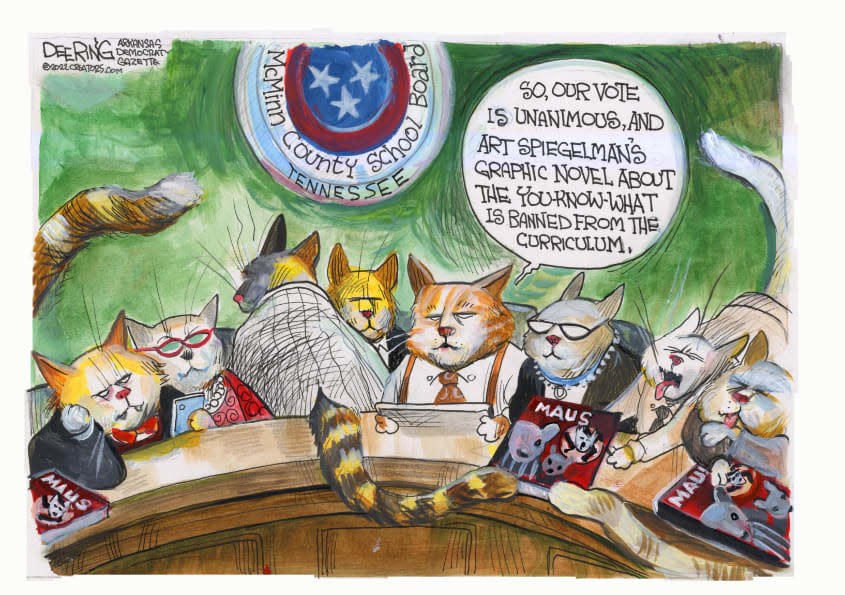
A recent one I encountered was “unanimously,” as in “Donald Trump was elected president unanimously.” Uh, unless you’re talking about as chair of the Kennedy Center board (after he got rid of the previous board and filled it with his lackeys), nope (and how is a president of a country supposed to have time for this in the first place???). Unanimously means without opposition, with the agreement of all people involved. Considering that 77,897,589 voters selected someone other than Donald Trump (who received 77,303,568 popular votes and 312 electoral votes), that’s far from unanimous. Only one U.S. president has ever been unanimously elected, and that was the very first one, George Washington, selected by all 69 electors (the popular vote wasn’t recorded, nor was there any consistency in how states chose electors), and he didn’t even want the job.
Along the same lines are words like “majority,” “landslide,” and “mandate,” all of which have been getting treated horribly by politicians in recent years. A simple, or absolute, majority is 50 percent plus one. When people say that Trump won the majority of American voters, that’s not true; it was a plurality, or relative majority (that “relative” is an important modifier there since it was less than 50 percent). While he got the most votes among the candidates, more people voted against him than for him. A supermajority is generally 60 percent or greater.
According to data posted by the American Presidency Project at the University of California at Santa Barbara, the last president to get the majority of popular votes was Joe Biden (51.31 percent in 2020), and the last time that majority surpassed 60 percent, which one might call a landslide, was 1972, when incumbent Richard Nixon got 60.7 percent of the vote. If you’re talking electoral votes, 1972 was definitely a landslide, meaning a decisive victory by an overwhelming margin, with only 17 votes falling to George McGovern. The percentage of popular votes for Ronald Reagan in 1984 was 58.8, but the Electoral College margin was one of the closest to Washington’s, with only 13 electoral votes going to Walter Mondale.
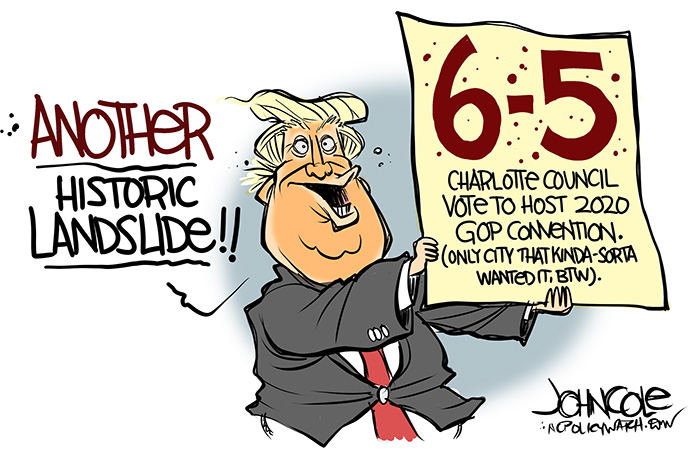
A margin of about 1.5 percent in the popular vote is definitely not a landslide, and I wouldn’t call 312 electoral votes a landslide either (it’s still among the lower margins of presidential wins, though it surpassed the 2016 election, ranking him at around 44th out of 60 elections; 2016 was 48th) … unless you really want to have the word have no meaning at all; reserve that for wins of at least 400 or more electoral votes as far as I’m concerned.
Many victors in campaigns have claimed a mandate to govern in a specific way, but as Marquette University political science professor Julia R. Azari wrote on The Conversation Nov. 22, 2024, “Shortly after the 2024 election was called in Donald Trump’s favor, he declared that voters had given him ‘an unprecedented and powerful mandate.’ As the popular vote margin shrinks, however, this claim seems less plausible. But it puts Trump squarely within the historical tradition of how presidents—and those around them—have claimed electoral mandates.
“These claims don’t necessarily tell anything meaningful about the election results. More often, they reflect dynamics of presidential power and other political forces.”
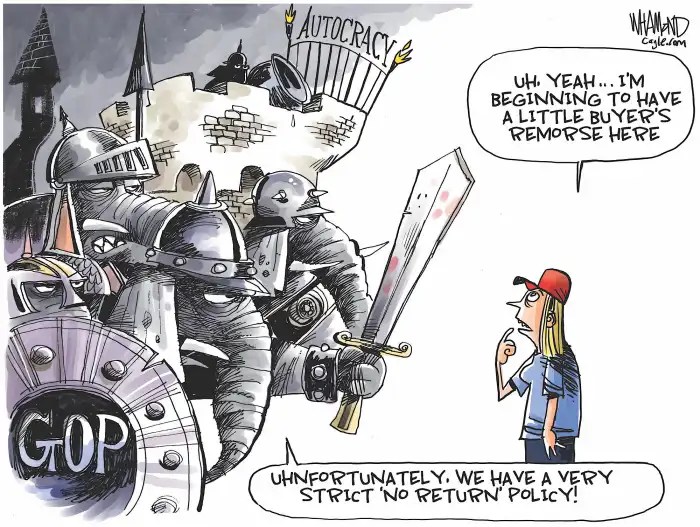
“Scholars of American politics have expressed skepticism about mandates. Does a mandate mean that the election carried a special message? How do we know what voters were thinking as they cast ballots? Are some elections mandates and others not? If so, how do we know? What’s the popular vote cutoff—is it a majority or more? Who decides? One scholar has flatly declared, ‘There’s no such thing as a mandate.’”
It seems it’s been used of late to mean a majority of the base supporting one person over another. That’s not really a mandate, since a person is elected to serve all constituents, not just those who voted for them.
In her research on the changing nature of the word as it relates to politics, Azari “found that recent mandate narratives are sometimes successful. But often, they are not. They’ve been increasingly employed by politicians in weak positions, in response to polarized politics and flagging legitimacy. But they have also historically been connected to unprecedented expansions of presidential power. This could be a recipe for overreach, as it often has been for modern presidents. Or it could be a way to give an unchecked executive the veneer of following the popular will.”
Uhh … there’s nothing like that going on right now, is there? I mean, that would be inconceivable! 😉
✍️✍️✍️✍️✍️
Words matter, which is why sometimes letters to the editor for the Voices page must be edited to get around misunderstood meanings, or tossed altogether (I edited around Mr. Unanimously’s claim in his already too-long letter). Even when the words are perfectly understood, they’re sometimes just not true (words matter, and so do facts; if you state something as a fact, it had better be, or hedged as opinion), too explicit (please don’t describe anything in lurid terms; if you need to describe a beating, you might call it bloody and prolonged, but there is no need to go into further detail), too full of obscenity/vulgarity/profanity, or too invested in playground insults when referring to specific letter-writers by name.
As for the conservative-liberal divide in letters, liberals still send in actual landslide proportions of the letters we receive, and little wonder at the moment (I mean, Elon, Donnie, Vance, Ukraine, the Arkansas Ledge, etc, … there’s so much going on, plus several of our conservative columnists have the tendency to tick people off). There’s no quota for certain types of letters, and we can only print what we receive (and right now we’re running a backlog).
Want your voice heard? Write us a letter, as long as you follow the rules and you’re willing to stand behind what you’ve said. If you can’t do that, don’t gripe about a dearth of conservative letters.

 Serenity is a fuzzy belly
“Hello, my name is Don Junior.”
“You are my father.”
“Prepare to lie.”
LikeLiked by 2 people
When Don Junior visited Greenland earlier this year, my third and youngest sister jokingly suggested that if Greenland was still inhabited by Vikings and was still a Viking possession, their response would have been to cut off Don Junior’s head and send his head back to Washington, D.C. Yes my sister is a Democrat and NO she does not like Donald Trump or any members of his family.
LikeLike
I think I understand the MAGA crowd’s thinking on “mandates.” Their idol campaigned on the concept of shaking things up, move fast and break stuff. By that definition, it’s OK to offend other countries, govern by impulse, and play with the economy as if it were a toy game. Like you say, we tried to tell them.
LikeLiked by 2 people
I read “The Princess Bride” when I was fifteen and I was not favorably impressed by it. As a result, I was reluctant to watch the movie based on this book. Last year or the year before, I finally watched the movie and I am still surprised at how much I enjoyed the movie. This is a rare example of a movie being an improvement over the book and a movie which was better than the book.
LikeLiked by 1 person
Instead of having my voice heard in a letter to newspaper, myself and my cows would prefer for our mooooosic to be herd.
LikeLiked by 1 person
Brenda did I tell you what happened to me when I tried to vote last year?
LikeLike
Brenda how is your arm? Is it healing properly?
LikeLike
I wince every time Trump says “mandate.” I couldn’t define it exactly and even the dictionaries seem to vary a bit, but I’m pretty sure that slightly less than 50% of the popular vote is not a mandate. For whatever reason I’ve always felt “mandate” is a big enough margin of victory as to leave no doubt about what the voters wanted. In other words, a pretty decisive margin of victory.
LikeLiked by 2 people
Pingback: A day of your own | Serenity is a fuzzy belly