

The oh-so-glamorous life of a working journalist. At least three people in this picture from seven years ago have gone on to bigger and better things. At the front on the right is one of my birthday buddies, John Sykes.
Image found on Who Needs Newspapers.
You can be easily forgiven if you think that anyone who willingly enters the field of journalism must be completely nuts. After all, why would someone want to be abused by those in power?

And Jim Acosta, you’re very fake news!
Image found on RawStory.
And it is believable to some, as Morning Consult’s poll released Friday indicated that 37 percent of those polled trusted Donald Trump to tell the truth, while 29 percent trusted the political media to tell the truth (the other 34 percent—a very sizable chunk—said they didn’t know). That’s a painful result, considering that the Washington Post tallied 488 false and misleading statements from Trump in his first 100 days (nearly five a day!!).
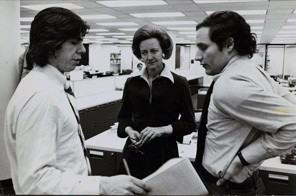
Publisher Katharine Graham with Carl Bernstein and Bob Woodward at the height of the Watergate scandal.
Image found on Washington Post.
“It’s a simple concept, yet something very difficult to get right because of the enormous amount of effort, thinking, persistence, pushback, removal of ideological baggage and, for sure, luck that is required, not to mention some unnatural humility.
“Underlying everything reporters do in pursuit of the best obtainable version of the truth, whatever our beat or assignment, is the question ‘what is news?’ What is it that we believe is important, relevant, hidden, perhaps, or even in plain sight and ignored by conventional journalistic wisdom or governmental wisdom?
A lot of this goes on; while we get a lot of information by going to the scene, the hardest work is often getting the background.
Image found on Washington Post.“I’d say this question of ‘what is news’ becomes even more relevant and essential if we are covering the president of the United States. Richard Nixon tried to make the conduct of the press the issue in Watergate, instead of the conduct of the president and his men. We tried to avoid the noise and let the reporting speak. Richard Nixon tried to make the conduct of the press the issue in Watergate, instead of the conduct of the president and his men. We tried to avoid the noise and let the reporting speak. … [A]lmost inevitably, unreasonable government secrecy is the enemy, and usually the giveaway about what the real story might be. And when lying is combined with secrecy, there is usually a pretty good road map in front of us. Yes, follow the money, but follow, also, the lies.”
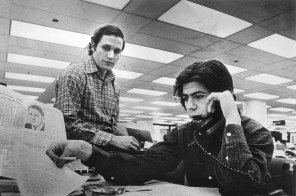
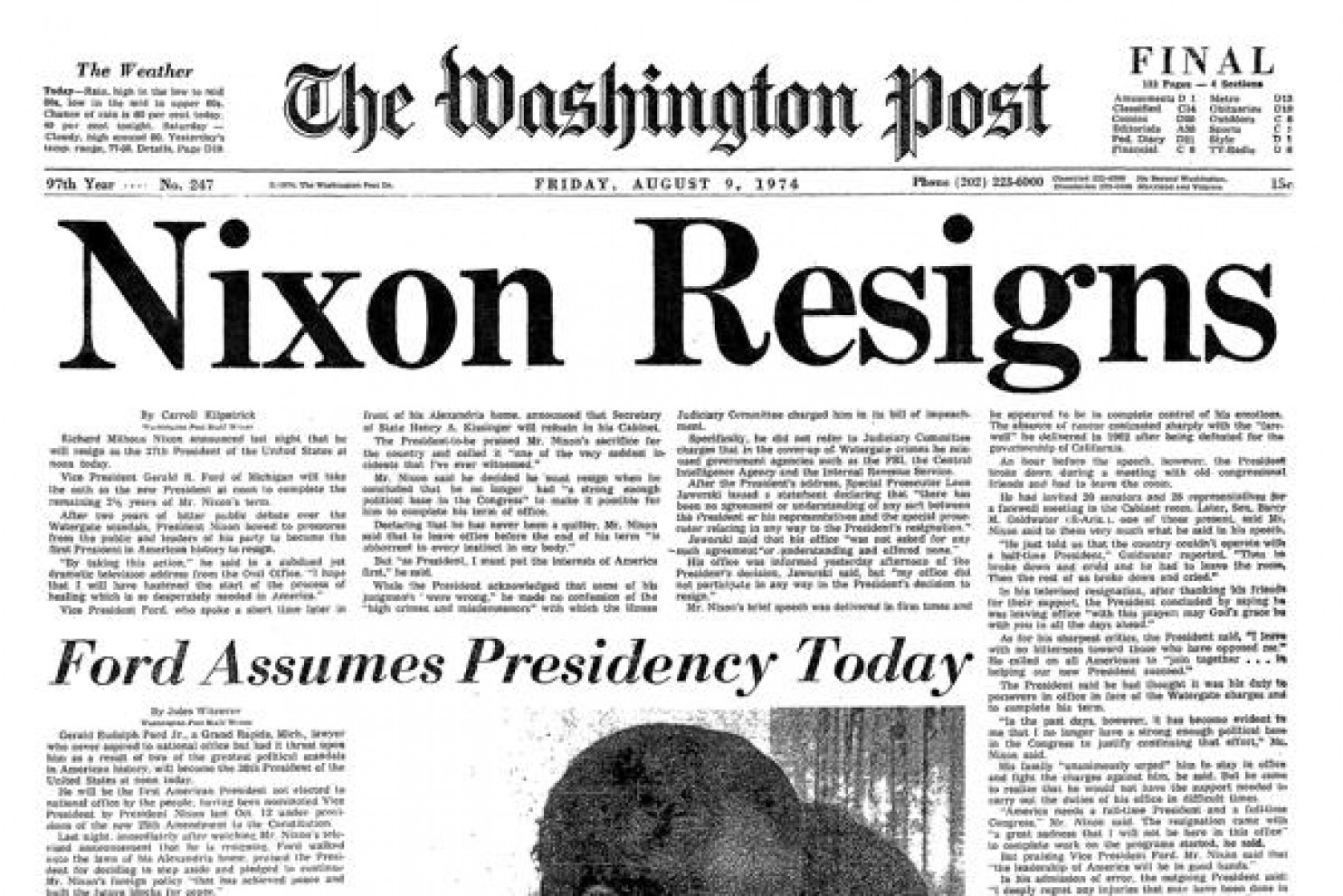
This is what can happen when dedicated reporters can’t stop digging.
Image found on Washington Post.
Bernstein touted the importance of keeping after a story: “I know of no important story I’ve worked on in more than half a century of reporting that ended up where I thought it would go when I started on it.” The pair wrote more than 300 stories on Watergate, he said, and kept uncovering more information.
“And then, inevitably, one story led to another and another, and the larger talk expanded because of this reportorial dynamic. The best obtainable version of the truth became repeatedly clearer, more developed and understandable.
“We’re reporters—not judges, not legislators. What government or citizens or judges do with the information we’ve developed is not part of our process, or our objective. Our job is to put the best obtainable version of the truth out there, period. Especially now.”
“In 1973, I recall standing on Pennsylvania Avenue with Carl after a court hearing. We watched three of the Watergate burglars and their lawyer filling a cab, front and back seats. Carl was desperate—desperate that he would lose them and this opportunity. He was short on cash and didn’t know where he might be going. I gave Carl $20.
“There was no room in the cab, but Carl, uninvited, got in anyway, piling in on top of these people as the door slammed. He ended up flying with the lawyer to New York City and came back with another piece of the puzzle. I never got my $20.
If only more people felt like this about newspapers today.
Image from Woodward and Bernstein exhibit at the Harry Ransom Center.“The point: very aggressive reporting is often necessary. [Ben] Bradlee and the editors of the Washington Post gave us the precious luxury of time to pursue all leads, all people who might know something—even something small.
“Now, in 2017, the impatience and speed of the Internet and our own rush can disable and undermine the most important tool of journalism: that method that luxury of time to inquire, to pursue, to find the real agents of genuine news, witnesses, participants, documents, into the cab.
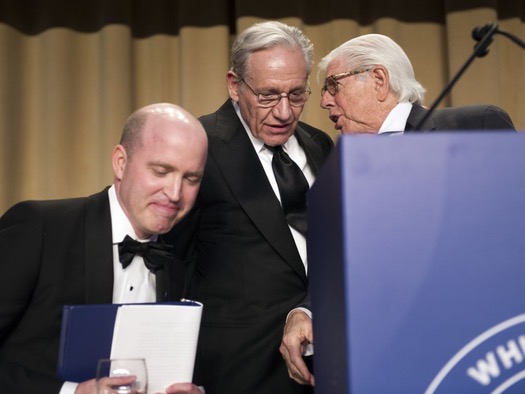
Three men–White House Correspondents’ Association President Jeff Mason, Bob Woodward and Carl Bernstein–with a message for the president: We’re not fake news.
Image by Cliff Owen, Associated Press.“Any president and his administration in Washington is clearly entitled to the most serious reporting efforts possible. We need to understand, to listen, to dig. Obviously, our reporting needs to get both facts and tone right. The press, especially the so-called mainstream media, comes under regular attack, particularly during presidential campaigns like this one, and its aftermath. Like politicians and presidents, sometimes, perhaps too frequently, we make mistakes and go too far. When that happens, we should own up to it. But the effort today to get this best obtainable version of the truth is largely made in good faith. Mr. President, the media is not fake news.”
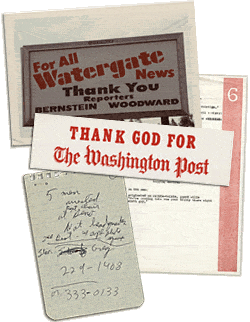
Woodward spoke of current Post executive editor Marty Baron’s recent speeches in which he said that reporters must be humble and modest and demonstrate that we in the press intend to be fair in our coverage. “In other words, that we have an obligation to listen. At the same time, Marty said, ‘when we have done our job thoroughly, we have a duty to tell people what we’ve learned, and to tell it to them forthrightly, without masking our findings or muddling them.'”
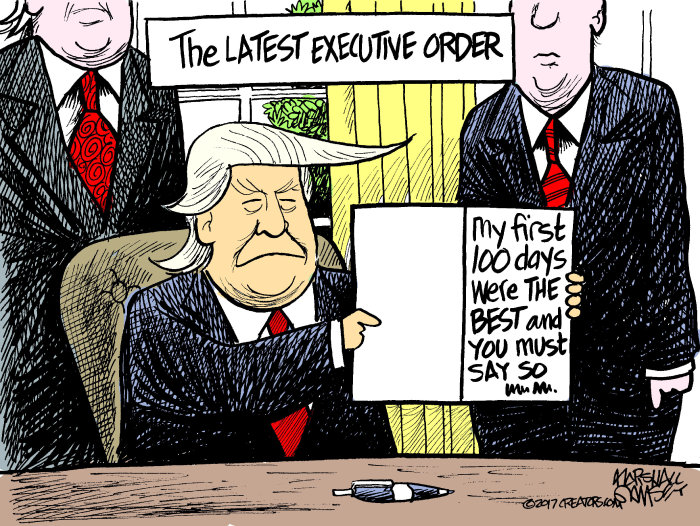
I’d threaten to hold my breath until you do, but the FAKE NEWS media would like that.
Editorial cartoon by Marshall Ramsey, Clarion-Ledger.
I love you, catnip mousie!
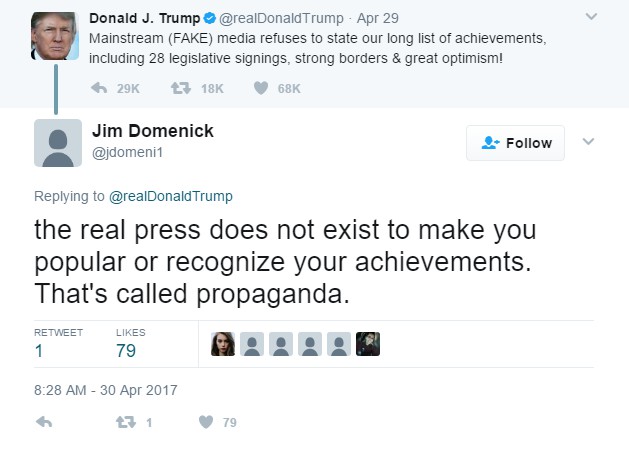
Nuh-uh! It’s only propaganda if it’s the other side that does it! 😦
Screenshot from Jim Domenick’s Twitter page.

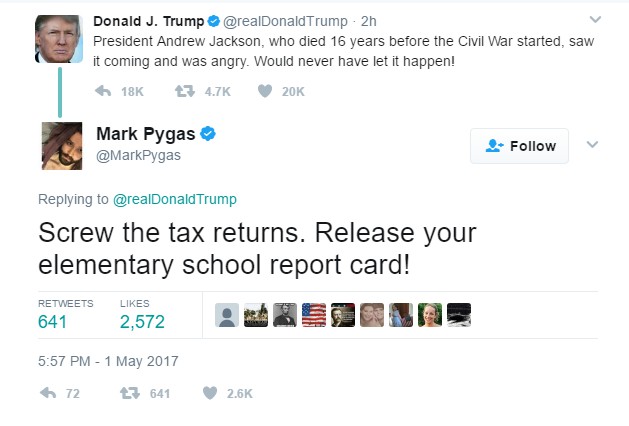
And your book reports … you surely had to read at some point in your life …
Screenshot from Mark Pygas’ Twitter page.
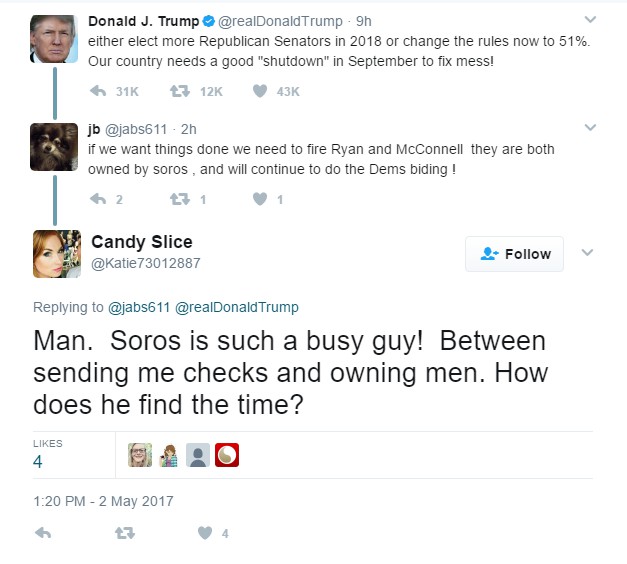
George Soros must be superhuman to do all the things he’s accused of doing.
Screenshot of Candy Slice’s Twitter page.
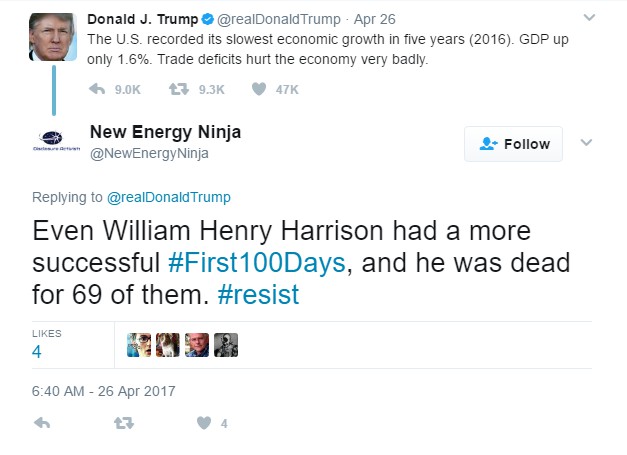
Too bad he didn’t have the sun come out as soon as he started talking, huh? Oh, wait … you didn’t either?
Screenshot from New Energy Ninja’s Twitter page.
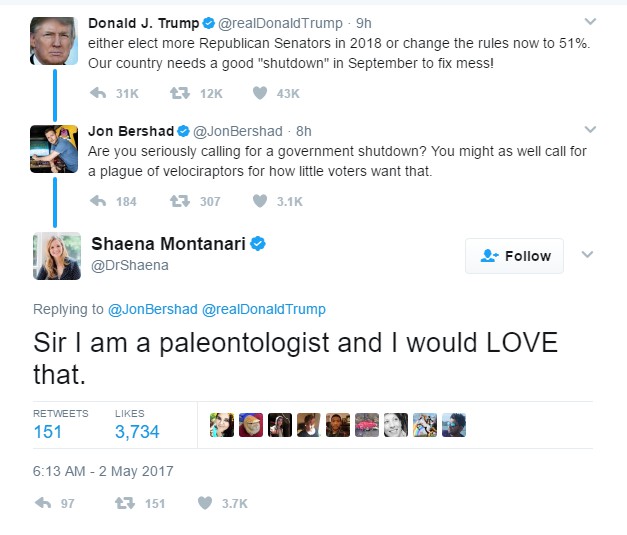
She’s my favorite person right now.
Screenshot from Shaena Montanari’s Twitter page.
 Serenity is a fuzzy belly
The Willian Henry Harrison tweet is priceless. However, it will probably just confuse the president who recently told a group of GOP leaders, “Lincoln was a Republican. Not many people know that. Did you know that?” (sound of jaws hitting the floor)
As a social scientist who writes textbooks on how to do research, I am well aware of how elusive “facts” can be. They do not always leap out at us. That means we sometimes have to work harder, but it is never justification for substituting opinions for facts.
I appreciated Bernstein’s comment about how important stories never ended up where he thought they might at the beginning. That’s a mark of journalism with integrity.
Bless the Press.
LikeLike
Very true. I used to do research for an investigative reporter/editor here (now retired), and sometimes we found things we didn’t expect.
If only we had a president who thought before he spoke. Doesn’t even rise to the level of intellectual stupidity (a phrase one of his supporters on Twitter used this morning against an Anti-Trumper. 😂
LikeLike
Andrew Jackson was mad about the Civil War. Not sure how Trump will top that story. And I almost spewed coffee on my keyboard when I heard about that First Amendment thing. He doesn’t like what the press says about him so he’s going to change the First Amendment. The man is certifiable!
LikeLike
As are many of his supporters. There were a couple commenting on the column on the newspaper site who just couldn’t let go of his talking points. It’s fascinating and terrifying at the same time. I think that’s one of the reasons I’m focusing on the often hilarious responses to his tweets rather than the tweets themselves. I love that scientists are now hijacking his threads! 😉
LikeLike