

As a word nerd, I’m always thrilled when I can introduce a word to readers that they might not have heard before. Last week, several readers contacted me about “zhuzh” (which our editing system’s spellcheck feature did not like): “Don’t like history because it accurately describes something your favored group did? Rewrite it and just zhuzh it up so your guys look better.”
Merriam-Webster (my favorite social-media-savvy dictionary) defines it as “a small improvement, adjustment, or addition that completes the overall look, taste, etc., of something” as a noun, and as a verb, “to improve in flavor or appearance by way of a small improvement, adjustment, or addition—often used with up.”
The word’s etymology is fuzzy, with various accounts attributing it to Romani, Yiddish and British gay (Polari) origin. But its origin doesn’t matter to me because it’s fun to say. Need I remind you of my love for words like persnickety, tump, kerfuffle and discombobulate?
Frankly, I wish the discombobulation I’m feeling as I type this were the fun kind, but no, it’s migraine/sinusitis/IBS/general blerginess.
The usual trolls, of course, landed on different words, not being fans of whimsy (not sure what whimsy and Dr. Anthony Fauci being grilled in Congress by Rand Paul have to do with each other, but you do you, Pack). “Neurodivergent” seemed to set off a few who apparently think I made it up.
Hey, if I’m going to make up words, they’re going to be fun ones, and neurodivergence is not fun. It’s an umbrella term, not a medical one, that according to Cleveland Clinic, “describes people whose brain differences affect how their brain works. That means they have different strengths and challenges from people whose brains don’t have those differences. The possible differences include medical disorders, learning disabilities and other conditions. The possible strengths include better memory, being able to mentally picture three-dimensional (3D) objects easily, the ability to solve complex mathematical calculations in their head, and many more.”

Someone who’s neurodivergent may be dyslexic (have difficulty with reading), dyspraxic (have difficulty with coordination), have ADHD, autism spectrum disorder, bipolar disorder, obsessive compulsive disorder, social anxiety or any number of other conditions, which probably includes a family member or three of just about everyone since it’s estimated that one in five people worldwide is neurodivergent. It’s not necessarily a good or bad thing, just a difference in how the brain works that can make learning more difficult or challenging (especially for those who are bored because they already know this stuff, who then end up disrupting class or maybe just check out entirely). One might consider Marilu Henner, who has highly superior autobiographical memory (HSAM), neurodivergent, though some don’t consider that particular condition, found in only about 100 people in the world, to fall under the neurodivergent umbrella.
The term refers to more than a few of us who’ve spent years masking because we felt (and still do) alien to others, and it was just easier to pretend to “get” what everyone else did. I masked my depression for years (but hey, my trauma makes me funny!), as have many others. I inherited my grandpa’s ability to do math in my head (though that’s waned a bit since my stroke in 2015), and my fascination with sociology/behavioral research is likely related as well, because I’ve always wanted to understand how “normal” people react to things. I’d like to seek an autism assessment, but it can be prohibitively costly (as is a lot of mental health care), which is a real shame because mental health care is essential.
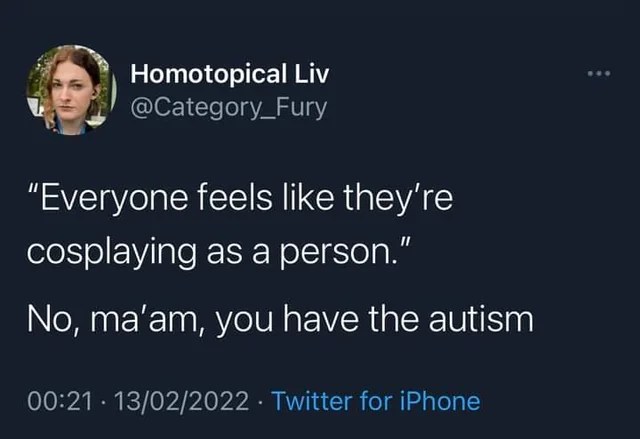
If I do turn out to be autistic, I would be far from the only woman (or adult) diagnosed later in life. Autism Speaks notes that classic diagnosis tools were built around male behavior (which doesn’t surprise me; in grad school I served as camera person for a psychology professor who was doing a study of an autistic boy and how his teachers handled his behaviors; at no time did the professor ever mention autistic girls).
“Autism doesn’t always look the same in girls as it does in boys,” notes the website. “Girls and women may show fewer obvious repetitive behaviors. They may have stronger conversational skills or be more likely to share their interests with others. Their special interests may appear typical for their age and therefore go unnoticed.
“’I think that sometimes examples of behavioral features in autism (like a strong interest in trains and spending a long time lining them up) are less commonly recognized in females,’ says Dr. Vanessa Bal, expert in adult autism and professor of psychology at Rutgers University. ‘Parallel examples in girls, like a strong interest in Barbies and spending a long time arranging them, is often not recognized due to differences in expectations.’
“Social expectations also play a role. From a young age, girls are often encouraged to be socially aware and accommodating. Many learn to carefully observe others and copy their behaviors, even when social interactions feel confusing or exhausting. This is often called masking.
“Masking can include forcing eye contact, holding back stimming behaviors, copying other people’s facial expressions or rehearsing what to say before a conversation. While masking can help someone fit in, it can also be draining. Research shows that long-term masking is linked to higher rates of anxiety, depression, stress and even suicidal thoughts.
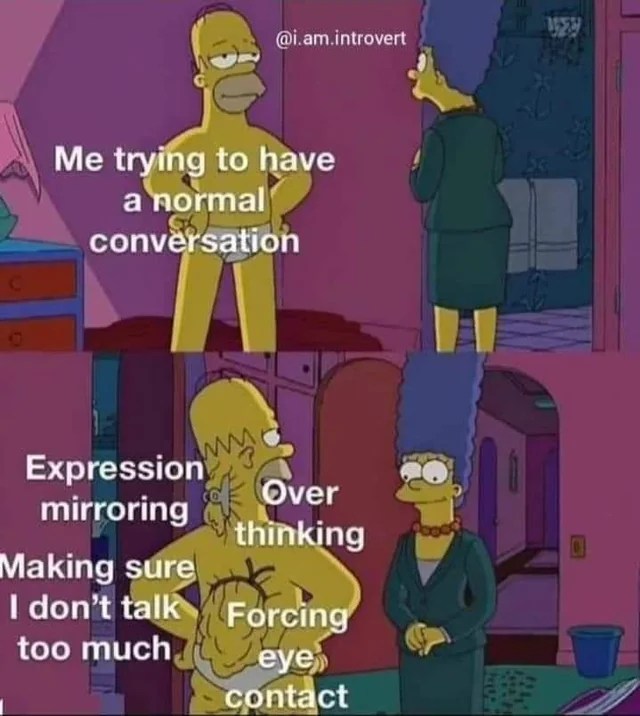
“While masking can help someone navigate social situations, it often comes at a cost. Studies link long-term masking to anxiety, depression, chronic stress and even suicidality. It can also delay diagnosis—sometimes for decades—because outward signs of autism are less visible to teachers, clinicians and even family members.
“Masking can also make autism harder to recognize. Teachers, doctors and even family members may not see the signs clearly. As a result, many girls without intellectual disability or language delays are missed or diagnosed with something else, such as anxiety or ADHD.
“That can have real consequences. Delayed diagnoses can mean that autistic people have to work harder to get the right supports, and may miss out on critical early intervention services that could have a lifelong impact on their quality of life.”
I’ve always been one of those women who can, at least for short periods, mask what I’m really feeling and my often abject terror of having to deal with people I don’t know (even people I do know I can only take in small bites sometimes because my social battery runs down quickly). That doesn’t mean I or any other woman is less capable of doing complex things.
Not that it matters to some, as one troll commented on my column last week, regarding my comment that the world isn’t exactly fun for women, the neurodivergent, and others, saying, “BS! Those listed are the most coddled and protected people in America today!”

No proof of this coddling was offered, but I imagine that in his mind it would include the fact that those people have any rights at all. I would remind him that more rights for others doesn’t mean that your rights decrease; it’s not pie. Are work and social accommodations for disabilities coddling? Are curb cuts in sidewalks for people in wheelchairs or using mobility aids coddling? Is it coddling if a woman and/or person of color or LGBTQ+ community member gets a job over a white male when they have the same qualifications or more?
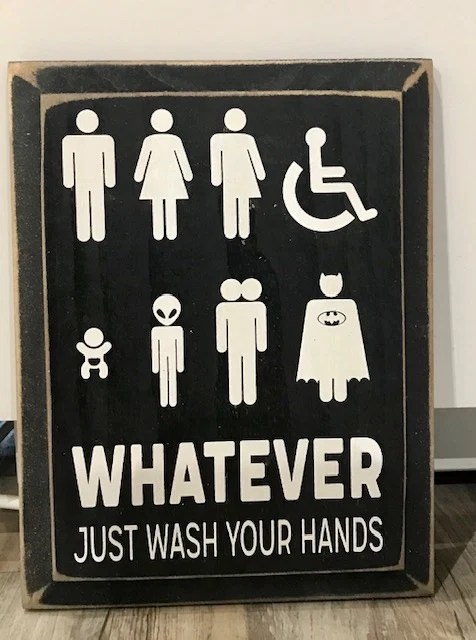
And for more strained logic, how is it inherently dangerous to allow trans women in women’s bathrooms? What in the world do men think women are doing in bathrooms? We. Have. Locking. Stall. Doors. Women just want to use the toilet, and can do so in privacy because we don’t use open urinals. And it’s not a locker room, so we’re not changing clothes most of the time (and if we are, it’s in those locked stalls). It’s far more dangerous for trans women to be in men’s restrooms. The problem in both cases tends to be cis men, not trans women.
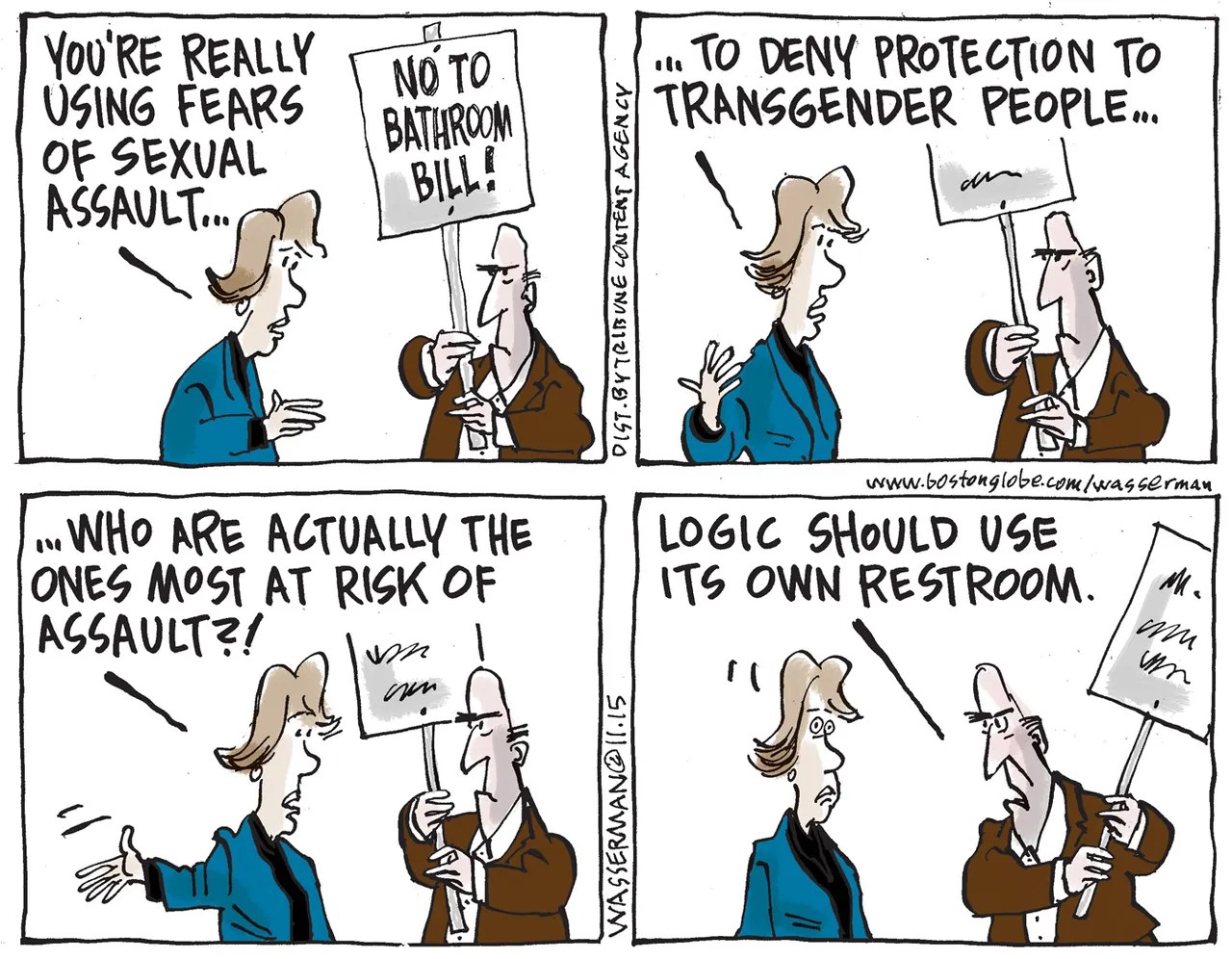
As Rockford Sexual Assault Counseling notes on its website, “Many times, when someone is arguing that trans people need to use the bathroom or changing room of the gender they were assigned at birth, they state that it is to protect women from men coming into the bathroom and hurting them. They allege that the problem is that men may pretend to be transgender in order to enter these spaces and harm women. This reasoning implies that it is not actual trans people causing the problem, but cis men trying to take advantage. This ‘fake trans’ argument overlooks a few important points. It already contradicts itself logically from the start. If the real issue is men pretending to be trans, how would stopping actual trans women from going into female-only spaces do anything? Trans women have been using female bathrooms and changing rooms for decades. Plus, men that want to hurt women in these areas have not been trying to dress up as women to do so. They can just walk in. They are already breaking the law; having additional laws does nothing to deter this violence, all it does is harm an already vulnerable population.”

Since no one flogging the “bathroom of your birth genitals” laws (what about those whose genitals are ambiguous at birth?) seems to consider trans men, I found a recent report out of Kansas quite amusing, with three bearded and burly trans men wearing shirts reading “SB244 Compliance Crew” T-shirts entering the women’s bathroom at a water park and other places, as the law demanded. The reaction was predictable, and showed just how utterly absurd such laws are.
Besides, I hear a lot of folks have gender-inclusive bathrooms in their own houses!!! What is this world coming to?


My test of whether any given strange word mentioned in your column is worthy depends on how close to acceptable pronunciation of it my darling feline can come. So far, he’s still thinking, as I read the column aloud to him. Stay tuned.
LikeLiked by 2 people
And the answer is: My furry feline liked etymology best and could pronounce it well. He does, however, think it means to have eaten some ology (probably with catnip mixed in), which tipped the feline word-choice scale.
LikeLiked by 1 person
Love the bathroom sign!
LikeLiked by 2 people
“Batman use the batroom”? GROAN! Very Good Brenda. I suppose I should applaud this by saying that I hear the sound of one hand clapping.
LikeLike
I am a neurodivergent musician who has a good memory and is able to work math problems inside my head without needing to write them out on paper. I do have Asperger’s and may have autism also. Having Asperger’s does help when I am performing because it makes it easier for me to concentrate on the music I am trying to play. Yes I have had some problems with people when I do not react or behave like their idea of what a “normal” man is supposed to do or say. However, no one has ever tried to accuse me of being specially coddled or protected.
LikeLike