
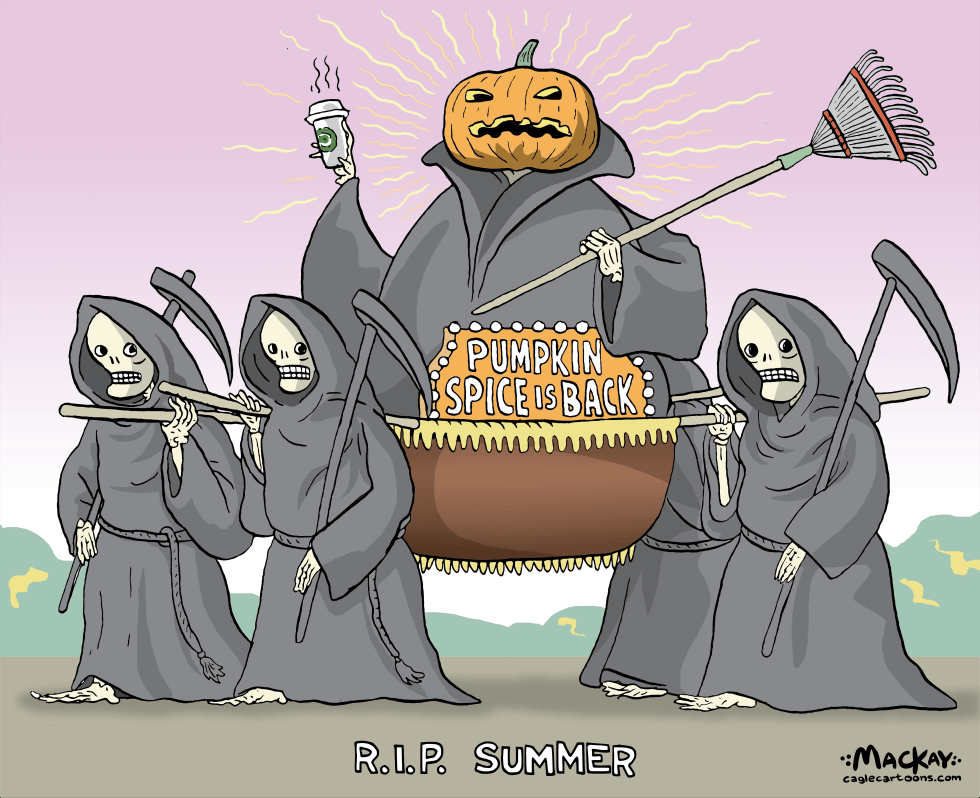
Summer is finally nearing its end, though the high temperatures linger, making any thought of hot chocolate (no, no pumpkin spice latte for me) and curling up in blankets on the couch dangerous, especially since I overheat too easily (thanks, Dad, for the wonky temperature regulator). These days still call for cold drinks and as little clothing as is practicable (mostly shorts and T-shirts or housedresses for me unless I’m going somewhere), and more than a few cold showers before bedtime.
But soon … soon it will be fall. Not that I haven’t already been wearing my “My favorite season is the fall of the patriarchy” T-shirt. It will never be a bad time for that.
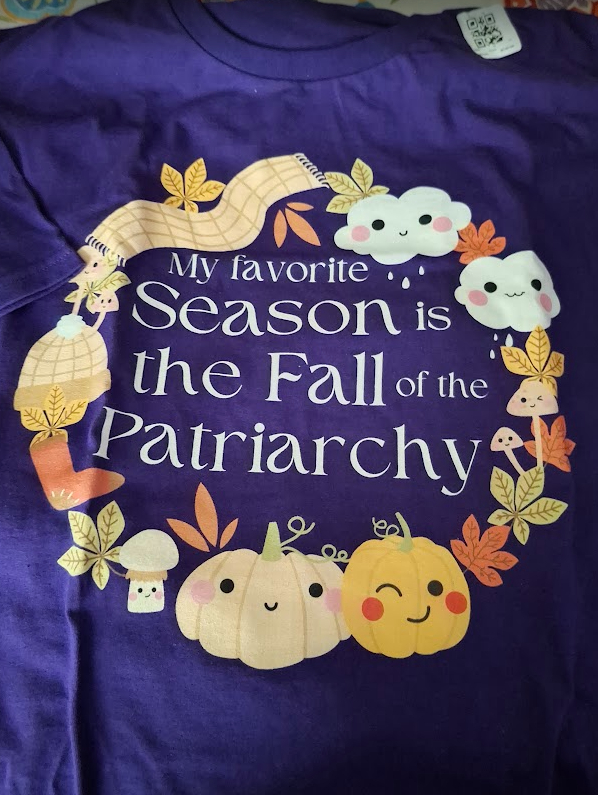
When I say things like that, I typically get glares and/or nasty comments from men (and a few women) who think that feminism is a dirty word; that’s mostly from evangelicals, who now seem to think that empathy is toxic (Jesus would be too woke for them, what with his advocacy for the poor and the outcasts … how toxic!).
I would remind you that women have only had the vote in the U.S. for just over 100 years, and until the latter part of the last century couldn’t hold bank accounts in their own name, report sexual harassment on the job, get equal pay for the same job or attend an Ivy League university, among other things. The SAVE Act (which could cause problems for married women and anyone else who has changed their name, as well as those who can’t afford a passport, if they want to vote) and other bits of pending legislation, as well as a patchwork of abortion restrictions that endanger the lives of pregnant women (you can say that the laws are clear on saving the life of the mother, but the cases of women dying because they couldn’t access a medically necessary abortion in a timely manner say otherwise) are just the canaries in the coal mine.
Some maintain that women are just too emotional to be in positions of authority. I would point to a certain individual’s crazed rants on the social media platform he created after he was tossed off Twitter for dangerous misinformation and similar tirades there as just one example that being “emotional” is not something that is exclusive to women, just as being condescending isn’t exclusive to men.

Still, I know I’m far from the only woman who has experienced condescension from men, such as when my first adviser in the College of Communications at ASU (I was in a different college my first semester or two as a poli sci major, which I didn’t want to be) told me, when presented with my proposed class schedule that was over the usual limit because of a required lab, “Honey, you can’t take 19 hours.” My answer, based on my research of school policy, was “Sweetie, yes I can. Look at my GPA.” I took those 19 hours the following semester and earned a 4.0 GPA. I knew what I was capable of, what the policy allowed, and I fought for it (I also switched to an adviser who actually listened to me, and she became one of my best friends).
I wish I could say I’ve consistently been that brave. Being 19 probably had something to do with my lack of fear of speaking up for myself; now life has beaten me down, so I’m more reticent.
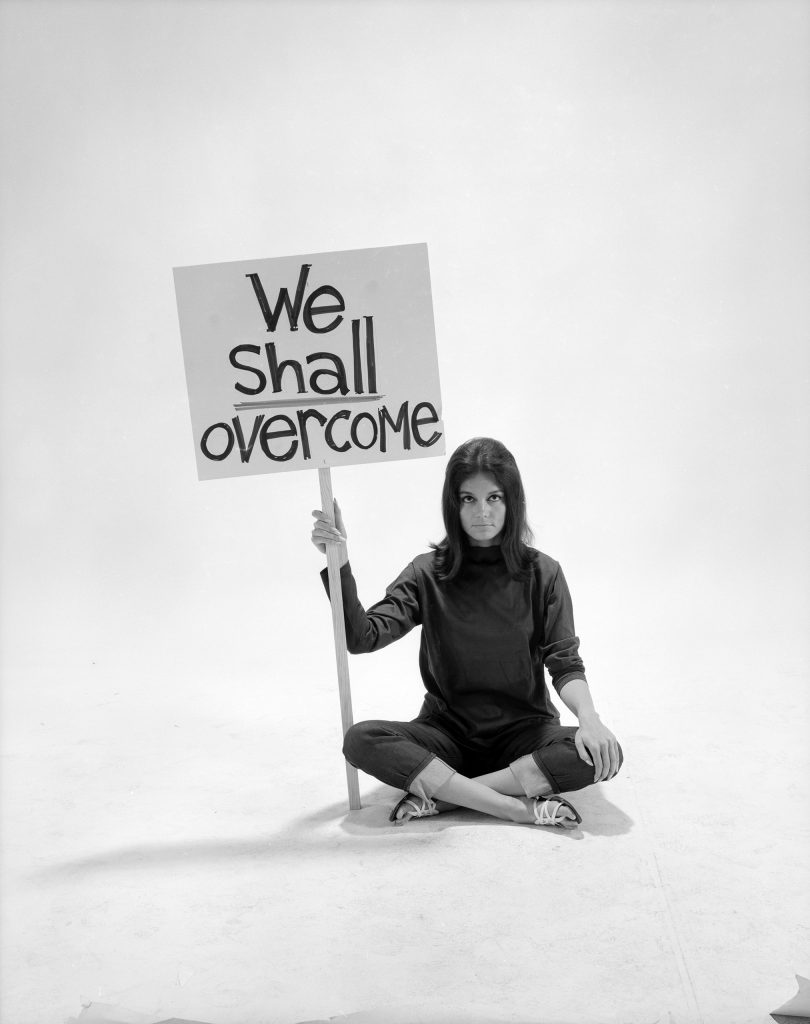
In the wake of Gloria Steinem’s death last week has come revived criticism of feminism, but as writer and activist Rebecca Solnit wrote in a recent Facebook and Meditations in an Emergency post, “To become old is to be an immigrant from a country that no longer exists, and to live among peers who sometimes remember that country and among younger people who mostly don’t know how different the past was. Much dismissiveness about feminism comes from ignorance about how profoundly feminism changed things that were so deeply entrenched, so normalized into invisibility, so ancient and customary that they first had to be denormalized, named, unpacked, and explained as to why they were incompatible with women’s status as people entitled to life, liberty, and the pursuit of happiness.”
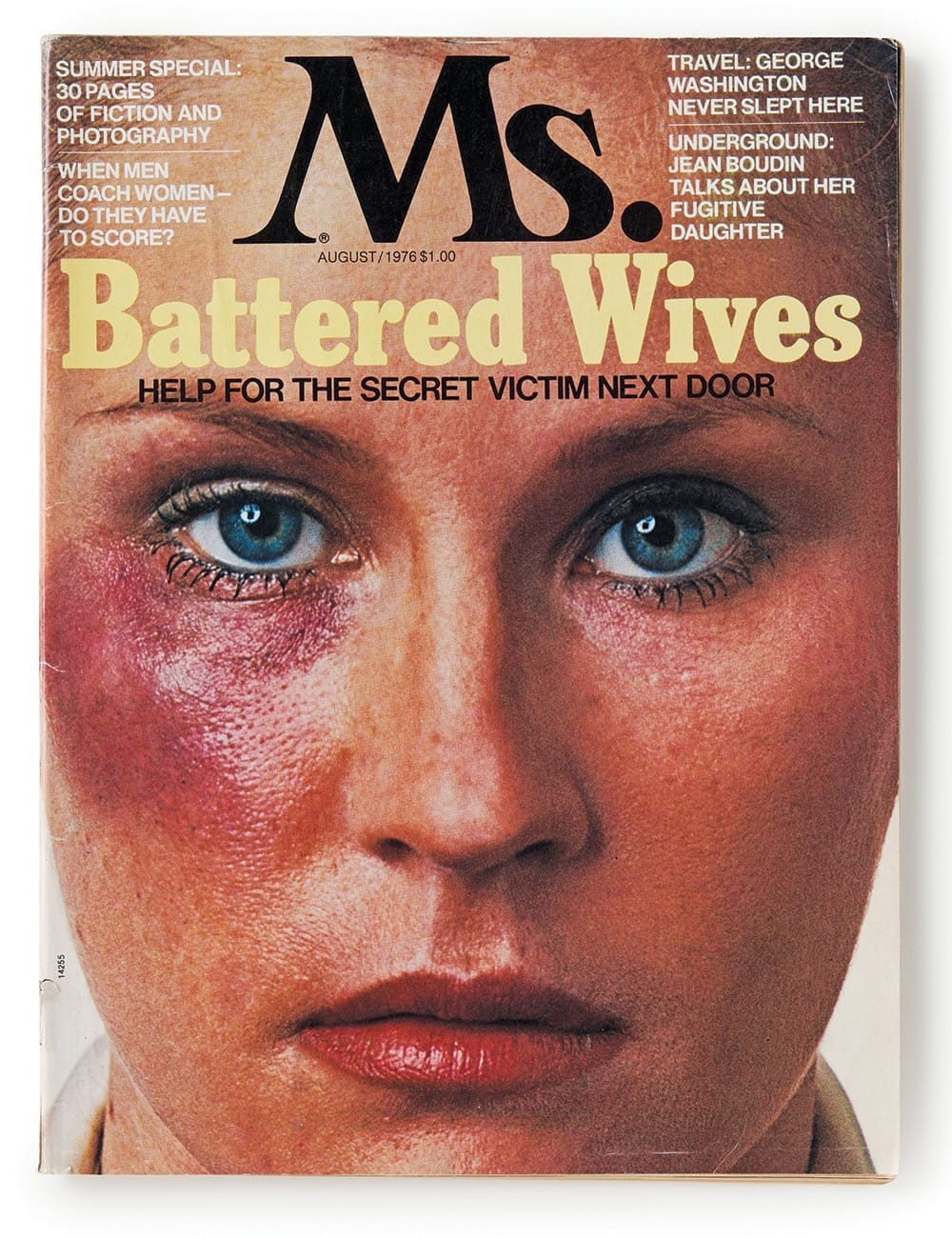
Among the many things that feminists have fought for is the idea that women’s bodies belong to themselves. Solnit wrote, “Feminists did enormous work to bring attention to and delegitimize what was then called wifebeating and is now called domestic violence or intimate partner violence and created the first domestic violence shelters. The lesbian feminist Del Martin in San Francisco published a book called ‘Battered Wives’ in 1976. I own a copy: it’s a historical artifact that documents the process of breaking the silence and addressing the impact of spousal violence. Marital rape (which Martin also discusses) was another issue feminists called attention to and got outlawed in state after state, with the last state getting onboard with the notion that even married women owned their own bodies in the early 1990s.”
There are still women who are so steeped in the idea that they’re less than their husbands that even in death they don’t have an identity apart from them. I recall an obit I handled when I was on the clerks’ desk in the newsroom for a woman who’d been widowed for several years, but nowhere in her obit was her name; she was referred to as “Mrs. [Dead Husband’s Name].” Other than saying when she died and the time for the funeral, practically the entire obit was about things her husband did in life; she didn’t even get a first name of her own. That was just really sad to me.
Political theorist Anne Phillips noted in her 2021 book “Unconditional Equals,” “Anyone, given half a chance, will prefer equality and justice to inequality and injustice. … Subservience does not, on the whole, come naturally to people.” So why do so many accept it?
Some point to the Bible as the reason for our patriarchal societies, yet women are not as trod-upon in the Bible as some would have you believe, with strong examples such as Esther, Mary, Ruth, and Mary Magdalene (who is usually portrayed, or at least was in my and other fundamentalist churches when I was a kid, as a prostitute, but non-canonical texts left out of the Bible by early church fathers defy that description; as well, the Catholic Church clarified in 1969, 1,400 years after Pope Gregory I mixed her up with someone else, that she wasn’t a sex worker). But what about cultures that don’t follow Christianity, or matrilineal societies where power is shared and property, lineage, etc., are passed through the female line?
Being a feminist doesn’t necessarily mean you hate men (though that seems to be the first insult thrown by men who keep reminding us why we choose the bear). More likely, you’re an advocate for equality and meritocracy (heck, even though Dolly Parton didn’t call herself a feminist, she was, and built a massive business and philanthropic empire on her own terms). Science journalist Angela Saini, in an April 2023 essay in National Geographic, wrote, “Patriarchy—giving all power and authority to the father—can sometimes seem like a vast conspiracy stretching into deep time. The word itself has become devastatingly monolithic, encompassing all the ways in which the world’s women, girls, and nonbinary people are abused and unfairly treated, from domestic violence and rape to the gender pay gap and moral double standards. The sheer scale of it feels out of our control.”
But it’s not universal, Saini wrote, noting there are many matrilineal societies throughout history, and still today, using a cooperative model where power is more evenly divided. “[A]s Phillips explains, nowhere do women defer to men without struggle. For centuries, from the United States to Iran, they’ve fought for more rights and privileges. Viewed this way, we might ask why matrilineal societies are still thought of as unusually unstable. Globally, impassioned movements for gender equality—sometimes tipping into violent protest—indicate that patriarchy is not as stable as it seems either. Perhaps the real matrilineal puzzle isn’t the existence of some female-focused societies but the bizarre preponderance of male-focused ones. …
“If we resign ourselves to accepting our lot as part of who we are by nature, we give up on understanding how it might have come about. When we settle the case for patriarchy on something as simple as biological difference, even though the evidence points to a reality that’s far more complex and contingent, we lose the capacity to recognize just how fragile it might be. We stop asking how inequality works or the ways in which it is being reinvented.
“The most dangerous part of any form of human oppression is that it can make people believe that there are no alternatives. We see this in the old fallacies of race, caste, and class. The question for any theory of male domination is why this one form of inequality should be treated as the exception.”
Women are capable of a great many things, but we’re still looked down upon and targeted with rhetoric on what it means to be a woman meant to keep us fighting among ourselves (which is one of the reasons certain sectors keep trying to stir up the “transgender women in the ladies’ room” argument, which is insulting and idiotic; we all have to pee, and the ladies’ room offers more privacy … plus trans women are women).
There has long been an imbalance that has run to the advantage of men, but as a whole (stop with the broad generalizations; the exception is not the rule) we aren’t asking for women to have all the power (why would we want all of it?). We’re not asking to control men’s bodies or take away their freedoms. We’re not waging a war.
We want equality for women and men. We want to be judged for our actual merits rather than our assigned sex at birth, and to make our own choices about what kind of life we want for ourselves, whether that’s at home or in the workforce. We want a society led by kindness, empathy, intelligence and common sense.
Is that really so scary?
It sure must be, or the manosphere and people like the Tate brothers wouldn’t exist.
 Serenity is a fuzzy belly